



The previous series of loop signature articles dealt with the basics of control loop optimisation, and concentrated on troubleshooting and the ‘SWAG’ tuning of simple processes. Apart from cascade control, it only dealt with single input/ single output loops in isolation from other possible interactive systems. The complete series is now available on CD and can be ordered online via www.controlloop.co.za
In this new series, consideration will be given to dealing practically with more difficult issues like interactive processes, and with processes with much more complex dynamics. In addition, there will be more ‘tying up’ of the practice to the theory. As a result, you will get a much better understanding of the practice, and it will give you more self-confidence in finding solutions to difficult problems. Many delegates who have passed through our courses have found the second part to be just as valuable as the first part, if not more, and have managed to very successfully automate loops that previously had only run in manual.
Process transfer functions
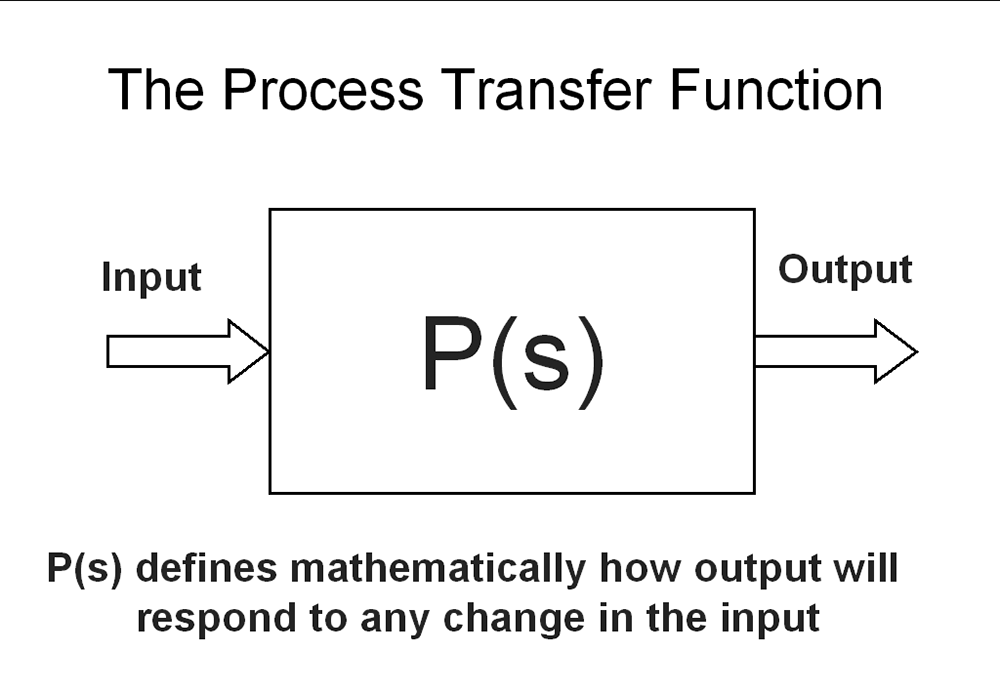
As shown in Figure 1, a process transfer function is merely a mathematical function describing how the output of a process will respond to any change on the input to that process. It is simply a mathematical description of the process.
As mentioned in Part 1, this function was considered by the mathematical control theory pioneers to be an absolute essential element that was needed in order to tune the controller. However, process transfer functions are unfortunately relatively complex as both time and frequency responses are involved, and the best way of writing the functions is to use Laplace arithmetic.
Apart from the complexity of this for ordinary C&I; people, it was extremely difficult, if not almost impossible, to actually practically establish the various dynamic Laplace constants of industrial processes by either frequency testing or modelling them by making step changes to the process input. As a result, most people forgot about all the theory they had learnd and proceeded to ‘fly by the seat of their pants’. As a result, 98% of all optimisation was (and in fact generally still is) performed by WAG (Wild Ass Guess) or SWAG (Scientific Wild Ass Guess) methods.
In certain respects, the need for process transfer functions is still as important today as it ever was. The whole of this second series of Loop Signatures will deal with these functions. Provided the C&I; practitioner has the right tools for the job, it will often not be necessary to have very accurate values of the dynamic constants. Simplified transfer functions can in fact do a great job for certain tasks, as will be seen later in the series.
However, it is absolutely vital when it comes to tuning that the practitioner is aware of what constants are present in the process response. In some cases, the relationship between the magnitudes of some of these constants is very important. Once these are established, you can decide how best to apply different types of tuning to the different types of dynamics, with sometimes, startling improvements in control performance.
How can one establish the process transfer function dynamic constants in the modern world, when full frequency testing is not possible? Simple. First-order lag and deadtime models can be determined graphically as described in the first series. Before I get a flood of correspondence from people rightfully saying that in the first series I mentioned that these models are seldom good enough for good feedback tuning, please bear with me until later in the series. Hopefully, I will prove that although this is true for feedback tuning, some more advanced features, like feedback compensators and decouplers, are far less critical when it comes to tuning and simple models are usually sufficient to tune them.
If you are fortunate enough to have access to a Protuner loop analysis software package, it gives simple a first-order lag and deadtime model on the tuning report. Otherwise, a much more complex model can be established from the relatively simple modelling procedures in the frequency plot section.
To summarise why it is necessary to have information on process transfer functions:
• A rough idea of the elements in the function should always be established when optimising any process.
• Simple first-order lag and deadtime models are needed for SWAG tuning methods; and are usually sufficient for tuning decouplers in feedforward and interactive control.
• More complex models are often needed for offline process simulation. In the next article in this second loop signature series, we will be taking a look at an extremely powerful control tool, feedforward, which in my opinion is not used nearly enough.
About Michael Brown

Michael Brown is a retired specialist in control loop optimisation, with over 50 years of experience in process control instrumentation. His main activities were consulting and teaching practical control loop analysis and optimisation. He presented courses and optimised controls in numerous plants in many countries around the world. Michael is continuing to write articles based on the work he has done, and his courses are still available for purchase in .PDF format. He is still handling the sales of the Protuner Loop Optimisation software. He is happy to answer questions people may have on loop problems.
Contact details: Michael Brown Control Engineering CC, +27 82 440 7790, [email protected], www.controlloop.co.za






© Technews Publishing (Pty) Ltd | All Rights Reserved
 printer friendly version