



Comtest has developed a range of thermal imaging and wireless testing tools from Fluke, designed to ensure safety is the top priority for engineers working in potentially dangerous arc flash zones. Every company’s electrical safety strategy should be based on limiting workers’ exposure to such electrical hazards as arc flash and electrocution. Fluke says the best way to keep operators out of harm’s way is to give them access to the right non-contact tools that not only protect them, but also dramatically reduce (by up to 50%) the amount of time they are required to work on live circuits in arc flash zones.
Arc flash is the light and heat created from an arc fault explosion; temperatures can reach up to 19 000°C, and are capable of igniting an operator’s clothing and burning the skin of anyone within a couple of metres. Arc flash can also melt metal, cause lung and eyesight damage, and lead to hospitalisation or even death.
Engineers and health and safety teams will be familiar with establishing arc flash boundaries and wearing arc-rated clothing and rubber-insulating gloves. However, using non-contact test and measurement tools means operators can minimise the level of personal protective equipment (PPE) required and the amount of time they need to spend inside the boundary.
One such product is Fluke’s PQ400 electrical measurement window (EMW), permanently installed into cabinets with voltage and current connections inside the panel. The PQ400 gives workers access to critical power quality and energy data while decreasing testing time and maintaining a high level of safety. Users can plug their power quality tools directly into the EMW to collect all the needed data.
Together with the safety aspect, the advantages of using the PQ400 include lower maintenance costs and reduced downtime. This is attained by making critical power quality and energy measurements without opening the panel door. The EMW also enables logging and monitoring to be done at any time without disrupting operations, while increasing measurement efficiency.
A second product, Fluke’s CV400 ClirVu window, is a permanent infrared window that provides a view of what is on the other side of a panel, without workers being exposed to live voltage or needing full PPE. It offers the most visibility into a panel for a thermal camera, simplifying the inspection process by allowing measurements to be taken without having to open a cabinet. The widest Fluke window option available also helps to reduce the time and costs involved in preventive maintenance.
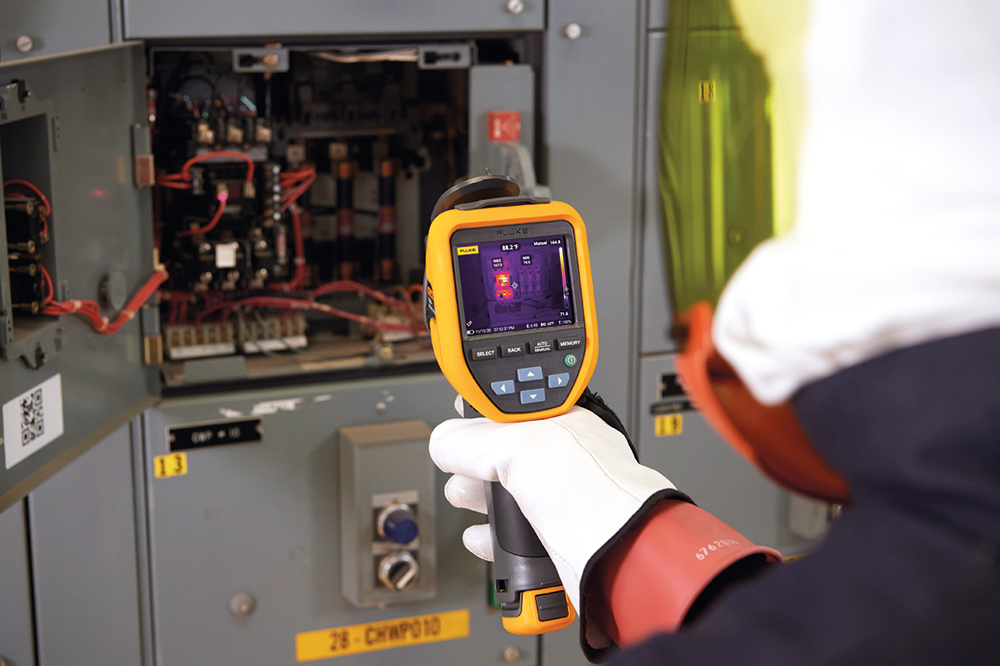
Likewise, Fluke’s TiS75+ thermal camera enables operators to capture and measure heat energy emanating from a source without having to make physical contact, meaning they can see instantly what’s running too hot or too cold before anything breaks down. Offering one-handed image capture, review and save facilities, the camera helps operators keep a safe distance from an arc flash boundary. Using the Fluke Connect app allows them to compare thermal scans over time.
A fourth product, the Fluke 376 FC clamp meter, makes it possible to set up measurements and transmit the data from inside the arc flash boundary, meaning someone within 20 metres of the equipment can open the Fluke Connect app and read the figures from outside the boundary. As well as reducing the time technicians spend in the arc flash boundary, the clamp meter helps them log, trend and monitor measurements remotely so they can pinpoint intermittent faults.
Finally, the Fluke 3000FC digital multimeter is a flexible DMM allowing users to read results through the Fluke Connect app outside the arc flash boundary. Using this equipment cuts technicians’ time inside the boundary, and offers them an easy-to-read display with large digits and a bright backlight.
In summary, there is no need for engineers to put themselves in an arc blast zone if they can avoid being there. Products such as wireless and non-contact tools and remote displays can help place them as far away as possible from risk and danger, while allowing them to take accurate, instant readings that can be analysed remotely. Arc flash safety is essential, and the latest thermal imaging and wireless testing tools are the best way to offer operators maximum protection.
Product: https://bit.ly/3GosRsB
| Tel: | +27 10 595 1824 |
| Email: | [email protected] |
| www: | www.comtest.co.za |
| Articles: | More information and articles about Comtest |






© Technews Publishing (Pty) Ltd | All Rights Reserved
 printer friendly version