


Maintenance, Test & Measurement, Calibration


Infrared thermometers for electrical, industrial and HVAC applications

October 2026 Maintenance, Test & Measurement, Calibration

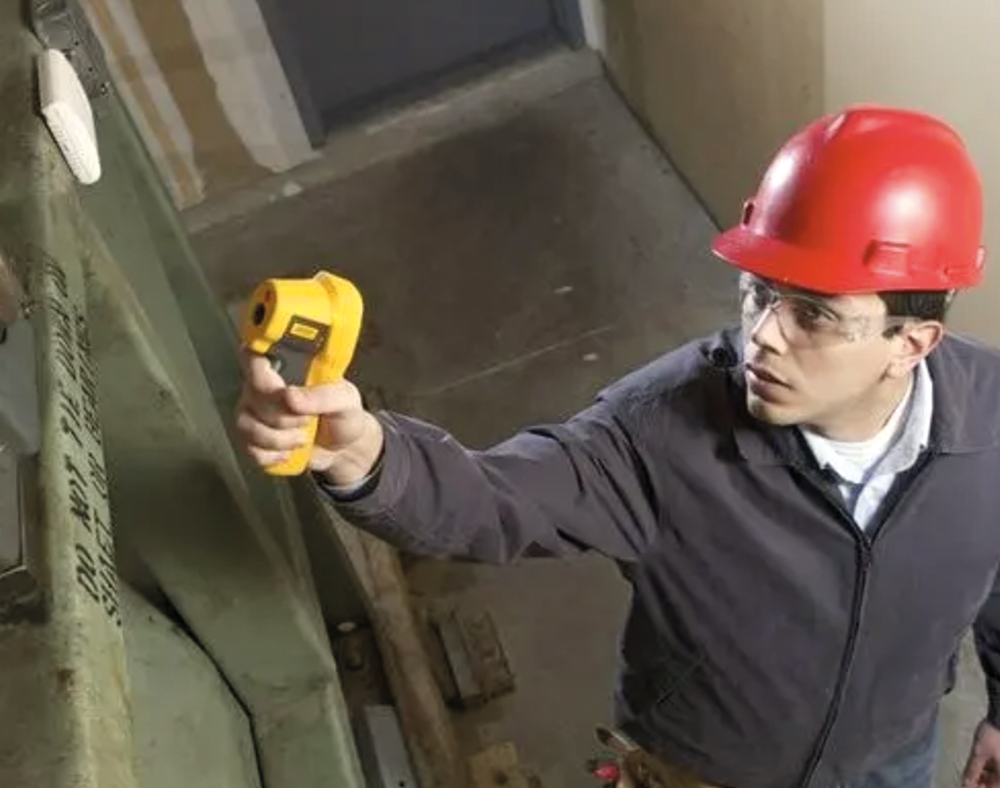
Handheld infrared (IR) thermometers have gone from specialist tools to commonplace instruments in just a few years, and Comtest, distributor of Fluke test and measurement equipment, says this shift is transforming how maintenance teams in electrical, industrial and HVAC environments approach troubleshooting. Portable and convenient, these instruments allow technicians to check both product quality and process quality without contacting the equipment being tested.

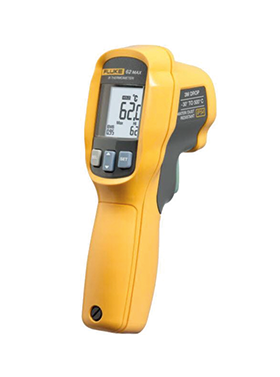
Fluke’s range of IR thermometers goes further on accuracy. The Fluke 62 MAX+ features two targeting lasers instead of the usual single centre-spot laser. Dual rotating beams trace the outer boundary of the exact circle being measured, so users know precisely what area they are reading.
Temperature measurement strategies

There are three ways to use a non-contact IR thermometer:

• Measuring temperature at a spot: Used to measure and track temperature at a single point, useful for trending an object’s temperature, or comparing a measurement against a specification. High repeatability helps ensure consistency.

• Comparing the temperature of two spots: Used to check the functioning of a steam trap by measuring the temperature of the inlet and outlet. No change indicates the trap has failed open; a very large change indicates it has failed to close.

• Scanning an object and detecting changes within a continuous area: Allows the user to find hot or cold spots on housings, panels and structures, for example, checking the heat sink of air-cooled transformers for cool tubes that indicate restricted or absent flow.

Applications for infrared thermometers

IR non-contact thermometers are suited to moving targets and machinery, hazardous, inaccessible or distant targets, electrical components, broad evaluations of machinery or surfaces and trending records. Insurance companies are also encouraging customers to implement preventive infrared scanning. IR thermometers can perform diagnostics that were previously impossible without shutting down systems.

Electrical maintenance

IR thermometers can check for heat build-up at loose connectors and troubleshoot problems in battery banks, power panel terminations, ballasts, switchgear and fuse connections. Hot spots in the output filters on DC battery connections can also be identified. Inspecting supply power connections and circuit breakers for equal temperatures helps locate faults, and when a thermal overload protection device fails and a motor shuts down, an IR thermometer is effective for determining the source of the problem. Because electrical currents generate heat, temperature monitoring is an efficient way to predict potential equipment failure.

Equipment maintenance

Checking moving parts and housings in motors and gearboxes for hot spots is a common application. Temperature change can indicate developing problems in equipment ranging from ovens and boilers to freezers. Routine temperature audits of generators and their bearings can prevent expensive repairs. Scanning bearing temperatures allows the maintenance engineer to detect hot spots and schedule repairs or replacements before they lead to equipment failure.

Building controls

HVAC components can be monitored for quick energy audits and room balancing. An IR thermometer with a 60:1 distance-to-spot ratio makes elevated vents and returns easier to reach. For example, a thermometer with a 10:1 distance-to-spot ratio allows measurement of a 25 mm circle from 250 mm away; at 3 m from the target, the measurement spot becomes a 300 mm circle.

Compressor head, compressor oil sump, evaporator coil and suction line, discharge line, condenser coil and liquid line, and fan motor temperatures can all be measured quickly. Insulation on all surfaces can be scanned for leakage and losses.

Process and product monitoring

IR thermometers can monitor process lines and check the temperature of different products on production lines, from rubber tyres to plastics and from concrete to food products. A lighted display makes it easier to view results in poorly lit areas. High-temperature alarm warnings, especially when both audible and visible, call attention to temperatures exceeding a specified threshold, even in loud environments.


Credit(s)


Share this article:
Share via emailShare via LinkedInPrint this page

Further reading:

Reverse-engineering legacy industrial gearbox parts
Maintenance, Test & Measurement, Calibration
WEG Africa’s turbine workshop uses 3D scanning technology to reverse-engineer components for legacy gearboxes, turbines and compressors, enabling equipment to run for decades after OEM support and spare parts have dried up.

Read more...
Unlocking ICCP remote monitoring
Omniflex Remote Monitoring Specialists Maintenance, Test & Measurement, Calibration
Cathodic protection keeps buried and submerged pipelines safe from corrosion, but verifying it traditionally means costly, hazardous manual site visits. Omniflex explains how a retrofit module brings remote monitoring to ageing transformer rectifiers without replacing functional infrastructure.

Read more...
Microdieseling – the explosions you never hear
Maintenance, Test & Measurement, Calibration
Microdieseling is a pressure-induced thermal degradation mechanism in which entrained air bubbles are compressed so rapidly that the surrounding oil ignites, producing soot, varnish and sludge. WearCheck explains how it happens, why the damage varies, and how oil analysis detects it.

Read more...
Electrostatic spark discharge – when static strikes back
Wearcheck Maintenance, Test & Measurement, Calibration
WearCheck technical manager, Steven Lumley explains how static electricity accumulates in modern low-conductivity lubricants, why compact system designs and fine filtration make ESD more likely, and how to recognise the degradation it leaves behind.

Read more...
High-speed cameras for crash testing
Horne Technologies Maintenance, Test & Measurement, Calibration
Vision Research has expanded its Phantom C-series with two cameras optimised for crash and safety testing, offering 4 and 8 megapixel sensors rated to 170G, up to 1180 frames per second, and Phantom Academy application training planned for South Africa next year.

Read more...
SKF extends remanufacturing expertise to bearing clearance modification
SKF South Africa Maintenance, Test & Measurement, Calibration
Using its clearance modification expertise, SKF helped a mining equipment OEM salvage spherical roller bearing inventory that would otherwise have been scrapped, confirming a new capability within its remanufacturing services and avoiding redundant procurement.

Read more...
When maintenance-system compliance starts replacing plant reliability
Wearcheck Maintenance, Test & Measurement, Calibration
WearCheck ARC division manager, Annemie Willer argues that the greatest threat to effective maintenance is no longer a lack of technology, but the gradual replacement of technical judgement by CMMS compliance, leaving no one owning the machine.

Read more...
Automatic lubrication systems drive mobile mine machine reliability and uptime
SKF South Africa Maintenance, Test & Measurement, Calibration
SKF’s Lincoln P203 progressive lubrication systems are improving reliability and uptime on mobile machines at a Zambian gold mine, with installation of 45 units completing by October 2026.

Read more...
Nitration: the acid you didn’t see coming
Wearcheck Maintenance, Test & Measurement, Calibration
Nitration is as destructive as oxidation in many engines but far less understood. WearCheck technical manager, Steven Lumley explains how nitrogen oxide gases degrade lubricants, why the process is difficult to detect, and what oil analysis can reveal before damage occurs.

Read more...
KSB makes mechanical seals for its own pumps and other brands
Maintenance, Test & Measurement, Calibration
KSB Pumps and Valves is expanding its range of mechanical seals to fit its own pumps and competitor brands. The portfolio covers component and cartridge seals, API 682-compliant systems, slurry and high-pressure seals, and ATEX-certified solutions, supported by refurbishment and field service capabilities.

Read more...


While every effort has been made to ensure the accuracy of the information contained herein, the publisher and its agents cannot be held responsible for any errors contained, or any loss incurred as a result. Articles published do not necessarily reflect the views of the publishers. The editor reserves the right to alter or cut copy. Articles submitted are deemed to have been cleared for publication. Advertisements and company contact details are published as provided by the advertiser. Technews Publishing (Pty) Ltd cannot be held responsible for the accuracy or veracity of supplied material.


© Technews Publishing (Pty) Ltd | All Rights Reserved

