



When retrofitting and upgrading boilers, operational experience and technical knowledge of different boiler types, operating conditions and water treatment all matter. Through operating 79 boilers, AES knows what works and what does not. This equips the company to share insights and make recommendations that carry genuine weight.
Motivation for boiler retrofits
“Retrofitting a boiler is like upgrading some components on a car rather than replacing its entire engine,” says AES Commercial Director Dennis Williams. “New control systems improve fuel efficiency, emissions and load response without changing the boiler’s original pressure rating. The right upgrades deliver meaningful performance improvements while extending the delivery of value through existing assets.”
Williams notes that the main motivations for applying a retrofit or upgrade to an existing boiler include:
• Unworkability of obsolete instrumentation and equipment, and non-availability of spare parts such as SCADA, PLC, control modules and electronic components.
• Incompatibility with updated technology in management systems, for example collection of site operating data, process management and efficiency tools.
• Efficiency impacts due to obsolete design of air preheater or economiser components, combustion or burner and control system design, and fuel management and air distribution systems.
• Inability to comply with emissions targets because of ageing and poorly performing emission abatement plant.
• Desire to reduce carbon footprint through a fuel switch where the combustion system can be changed.
Additional considerations include maintenance of boiler steam output due to changes in combustion and emission abatement systems that require changes to draught management, as well as improved electrical efficiency through the application of the latest technology in electrical motors and drives, and better boiler operability, that is, improving a boiler’s ability to respond to load changes and operate with lower emissions.
First-hand insights
“Retrofits such as boiler control systems, combustion systems, burners and flue gas upgrades can improve boiler combustion and overall efficiency, mirroring the benefits of a new plant with its better operating efficiency, yet unfortunately also high capital cost requirements,” Williams notes.
An example of the potential payback: a 15% improvement in efficiency with a 13,1% reduction in fuel intensity per ton of steam generated following the retrofit of a boiler control and steam load-balancing system on a fast-moving consumer goods client site featuring multiple boilers. Benefits included access to operating data from the boiler house for overall plant management insight and planning, and a reduction of between 40 and 50% in boiler house electrical use when applying updated control systems with variable speed drives.
When it comes to boiler changes, AES has evaluated various combustion and burner systems. “Having liaised with OEM suppliers, visited their sites and their client reference plants, AES has first-hand insights into pyrolysis, gasification, biofuel combustion and various other technologies which can often be retrofitted to package boilers for fuel switching,” Williams says. AES has developed its own inhouse control system that affects a boiler’s combustion and overall efficiency, load-following capability and can incorporate load-balancing systems, enabling the spreading of steam across multiple operational boilers.
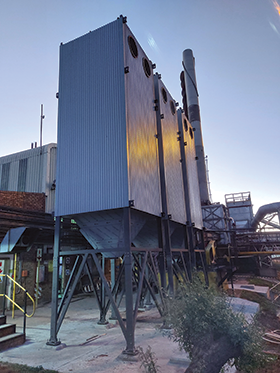
AES also installs and operates emission abatement solutions including bag filters and electrostatic precipitators (ESPs), and has first-hand experience of alternatives. “AES has access to advanced cyclone particulate emission abatement plant, which achieves particulate loading in flue gas below 120 mg/Nm3. This technology is more cost-effective than bag filters and ESPs in terms of capital and operating cost,” Williams says.
To retrofit or not
Williams emphasises that there is a major difference between a retrofit and legally required maintenance and repairs to pressure vessels, including welding repairs and tube replacements. A full boiler replacement only applies when an asset has limited remaining life expectancy and there is benefit from purchasing a new one. “When addressing emissions, if a retrofit can achieve the same outcomes and changes can be made to control systems, combustion systems and burners on an existing boiler, then that would negate almost all of the benefits of a new boiler.”
Replacement might also not be considered where an asset’s days are numbered. This applies when the wall thickness on the pressure parts of an older boiler is compromised through rusting of the outer shell, or internal pitting corrosion due to poor water treatment. “This may render boilers non-compliant in terms of their originally designated steam pressure and temperatures. In such a case, it is possible with the aid of professional engineering experts doing design calculations and an approved inspection authority, to repair the boiler’s affected areas or de-rate the operating pressure to allow the boilers to continue operating,” Williams says.
Using a boiler originally designed to operate at 20 bar as an example, he notes that should there be a case for a boiler to be de-rated from a pressure perspective and recertified to operate at a lower maximum pressure, this steam pressure still needs to be suited to the client’s requirements.
Safety and legal compliance
Another safety aspect involves ensuring that a new liquid or gas burner installed in a boiler has the correct flame shape and size to prevent impingement of the flame onto the boiler’s metal surfaces. Flame adjustment and set-up is needed to prevent localised overheating and possible failure. Steam plant safety requirements in South Africa and boiler compliance requirements go hand in hand. Adjustments must be undertaken in alignment with legal requirements such as the Pressure Equipment Regulations. Changes affected by legal and design restrictions require sign-off by approved and professional parties.
“If we arrive on site and find that an asset is not signed off legally to be operational, we will immediately shut it down. It is absolutely critical that clients understand legislative requirements in terms of boilers as pressure vessels, and safety around these is strictly not negotiable,” Williams concludes.
For more information contact AES,






© Technews Publishing (Pty) Ltd | All Rights Reserved
 printer friendly version