


Analytical Instrumentation & Environmental Monitoring


Determining drinking water safety is essential

July 2023 Analytical Instrumentation & Environmental Monitoring

Access to safe drinking water is a privilege not shared by many in Africa. Often, drinking water is contaminated by damaged infrastructure and distribution systems, breakdowns at treatment facilities, rapid urbanisation and general water pollution, meaning scores of South Africans are obliged to turn to groundwater.

However, to avoid disease and ill health, it is important to ascertain whether this groundwater is fit for human consumption.

Condition monitoring specialist company, WearCheck, recently integrated its sister company – previously Set Point Water Laboratories, now WearCheck Water − into its operations, adding yet another analysis service to the company’s repertoire. WearCheck’s extensive range of condition monitoring services also includes the scientific analysis of used oil and other fluids, asset reliability care (ARC), transformer oil testing, lubricant-enabled reliability (LER) services and advanced field services (AFS), which include rope testing, technical compliance and non-destructive, testing amongst others.

Thelma Horsfield, general manager of WearCheck Water, explains that the company is ISO 17025:2017 accredited, and tests water from any source. “We conduct analysis on water from many sources – ranging from drinking water to factory/industrial effluent, and everything in between – to determine the presence and levels of potentially harmful substances, whether the water is used for drinking, agriculture or to be disposed of after an industrial process,” she said. “Naturally available ground and surface water are invaluable sources of water that should, when utilised, be closely monitored. The South African Bureau of Standards (SABS) and National Water Act published SANS241: Drinking Water Quality, outline the minimum requirements for safe drinking water.
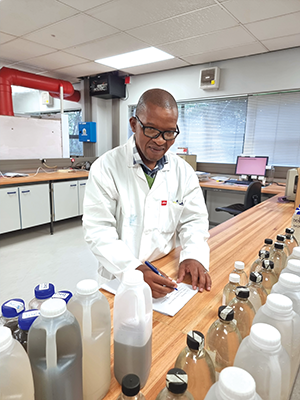

Moses Lelaka, WearCheck Water’s technical water laboratory manager.

WearCheck Water operates two ISO17025-accredited laboratories – one in Cape Town, the other in Johannesburg. Technicians at these laboratories conduct scientific analysis of water samples for a range of clients in different industries from across Africa. Moses Lelaka, WearCheck’s technical water laboratory manager in Johannesburg, explains some of the quality systems that govern the water-testing process:

“SANS241 sets out the minimum requirements for potable water to be considered safe for human consumption, covering physical quality, chemical components, heavy metal levels, organics and microbiology. Additional determinants for nearby pollutant influences must be added to SANS241. For instance where there are nearby agriculture holdings, checking for fertiliser contamination should be included.

“However, we find that, while annual testing of SANS241 determinands is followed by water providers, monitoring programmes are often lacking. Daily, weekly, and bi-weekly monitoring, based on the number of people serviced, is often overlooked by SANS241 standards.

“Monitoring is an invaluable tool that signals environmental changes in the water table that can quickly occur due to seasonal changes, rainfall, drought, heavy industry, agriculture, natural disasters, and so much more. Responsible monitoring signals any changes in water quality before any harm to life occurs.”

WearCheck offers water analysis services in every region in Africa where the company has a presence (RSA, Zambia, Zimbabwe, Ghana, Namibia, Mozambique and the DRC).


Credit(s)


Share this article:
Share via emailShare via LinkedInPrint this page

Further reading:

Getting the chemistry right
Analytical Instrumentation & Environmental Monitoring
Grace’s European production site has relied on analogue compression load cells from Minebea Intec for decades, with the long-proven measurement concept now serving as the reference for new silo projects as the company expands its capacity.

Read more...
Why measurement matters in smelting
Endress+Hauser South Africa Analytical Instrumentation & Environmental Monitoring
South African smelters returning to operation after energy constraints face new demands for tighter control, better visibility and environmental compliance. Endress+Hauser explains how modern measurement technology supports safer, more efficient furnace operation and local beneficiation.

Read more...
Sun tracking with pinpoint precision
Senseca Analytical Instrumentation & Environmental Monitoring
Senseca has introduced the SEMS-2000 solar energy measurement system, a 2-axis solar tracker with pinpoint sun-pointing accuracy that automatically monitors direct, global and diffuse irradiance for unattended outdoor solar installations.

Read more...
When oil gets old
Wearcheck Maintenance, Test & Measurement, Calibration
WearCheck explains how oxidation breaks down lubricating oils over time, and how routine oil analysis can catch the warning signs before equipment failure.

Read more...
AMETEK expands 993X gas analyser series with explosion-proof enclosures
Analytical Instrumentation & Environmental Monitoring
AMETEK Process Instruments has added ATEX and IECEx Zone 1-certified explosion-proof enclosures to its 993X series of gas analysers, enabling reliable installation in Zone 1 hazardous locations where purge gas is unavailable.

Read more...
WearCheck demonstrates advanced condition monitoring at Electra Mining
Wearcheck News
Condition monitoring specialist WearCheck will demonstrate its used-oil analysis, fuel analysis, transformer chemistry and asset reliability services at Electra Mining Africa as the company marks 50 years of predictive maintenance expertise.

Read more...
Why medical device leak testing matters for South Africa's MedTech future
ATEQ South Africa Analytical Instrumentation & Environmental Monitoring
As South Africa works to grow local medical technology manufacturing, non-destructive leak and flow testing is becoming a strategic quality assurance tool, helping manufacturers verify device integrity, meet regulatory requirements and improve production efficiency.

Read more...
Moving forward with reverse osmosis
Analytical Instrumentation & Environmental Monitoring
Rising water costs and pressure on infrastructure are changing the way industries view reverse osmosis. G-Chem Aquacare is developing tailored, containerised solutions that make the technology more accessible for South African industry.

Read more...
Meteorological data logger with up to 32 analogue sensors
Senseca Analytical Instrumentation & Environmental Monitoring
Senseca has introduced its advanced data acquisition system for environmental monitoring, which has a universal data logger for up to 32 analogue, pulse and smart digital sensors.

Read more...
Oils don’t die, they degrade
Wearcheck Maintenance, Test & Measurement, Calibration
WearCheck explores the main ways lubricants degrade in service and how these degradation modes affect oil performance and machine reliability.

Read more...


While every effort has been made to ensure the accuracy of the information contained herein, the publisher and its agents cannot be held responsible for any errors contained, or any loss incurred as a result. Articles published do not necessarily reflect the views of the publishers. The editor reserves the right to alter or cut copy. Articles submitted are deemed to have been cleared for publication. Advertisements and company contact details are published as provided by the advertiser. Technews Publishing (Pty) Ltd cannot be held responsible for the accuracy or veracity of supplied material.


© Technews Publishing (Pty) Ltd | All Rights Reserved

