



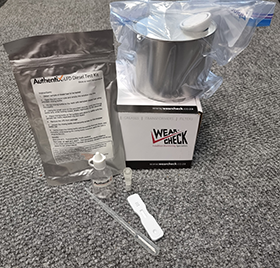
In response to an article that appeared in Fin24 on 15 June of this year, Gwede Mantashe, the minister of mineral resources and energy, warned of the use of illuminating paraffin (IP) to doctor diesel in an attempt to defraud the revenue services and increase profits. WearCheck’s diagnostics manager, John Evans, gives a bit of background to this practice, the deleterious effects it can have and the various methods for testing diesel for the presence of illuminating paraffin.
Diesel can be subjected to a variety of chemical and physical tests in the fuels laboratory. One of the most common and important things to look for is contaminants, the most common of which are dirt and water. Diesel can also be contaminated with other fuels and solvents, in particular illuminating paraffin. IP is a readily available power source for domestic lighting, heating and cooking. Chemically, it is very similar to diesel but because it is used as a domestic power source, it is not subject to the taxes and levies that diesel is; in other words, it is cheaper than diesel.
Some less-than-honest members of our society have taken to doping diesel with IP, and because it is so similar to diesel (but not exactly the same), a diesel engine will run quite happily on a diesel/IP mixture at less than the cost of diesel. Although the engine will run without problems in the short term, in the long term the IP will be quite damaging.
IP has a lower viscosity and less lubricity than diesel and will cause damage in terms of increased wear to the components of the fuel system. Although the price difference may not be huge (about R25 for diesel and about R20 for paraffin), if you think of the thousands of litres of diesel used every day, doping diesel with 10 or 20 percent paraffin represents a large cost saving for nefarious operators and significant loss of income for the revenue services (SARS).
The effects of IP contamination on diesel are that the viscosity, density and flashpoint will decrease, and the sulphur concentration will increase. IP also has a lower lubricity than diesel. Low viscosity and lubricity mean increased wear of fuel system components. Low density means you get less bang for your buck (more litres of fuel required for the same number of kilometres travelled). Low flashpoint could become a safety issue and elevated sulphur could impact the emission controls of modern engines and increase combustion by-products being introduced into the lubricating oil and reducing its ability to lubricate the engine adequately.
Interestingly enough, small amounts of IP may not affect the properties of diesel enough for it to fail the South African Bureau of Standards specification SANS 342, so IP can be present even though the fuel will still pass said specifications. In fact, IP is often legally added to diesel in small amounts by the refineries as it helps prevent the diesel from waxing (freezing) during the cold winter months inland. Doping diesel with IP, in the long term, is not a good idea and it is also illegal.
Because this type of doping represents a loss of income for SARS, a chemical marker has been introduced into illuminating paraffin sold in South Africa. The marker comes from a company in the United States called Authentix, a company that specialises in brand protection and anti-counterfeiting. This marker is added to IP at a precise concentration once the product leaves the refinery.
It is possible to test for this marker using a lateral flow test kit, similar to those used for testing for Covid or even pregnancy. The answer is just a simple yes or no, the marker either was or was not detected. The test kit is very easy to use and takes hardly any time at all. What it cannot tell you is how much IP is present. What is important to mention, is that if the IP came from a source that was not marked, for example, as have coming from across our borders where markers are not used, then no marker will be detected, yet the sample could still be contaminated – just not by enough to fail the other physical tests that are carried out, such as viscosity, density and flashpoint.
Further testing is possible, however. The diesel sample can be sent to a SARS-approved laboratory, where an instrument called a GC-MS (gas chromatography – mass spectroscopy) is used that can measure the actual amount of the marker that is in the fuel and, from that, it is possible to calculate the actual amount of IP in the fuel.
The reason for having two levels of testing is because (at the time of publishing), the lateral flow test kits cost about R500, whilst the actual percentage test costs around R5500 (more than ten times the lateral flow test) and has to be outsourced.
Although it is possible for gas chromatography to be carried out on the suspect diesel sample to look for IP itself, because of the very similar physical and chemical characteristics of the two liquids and the large number of compounds in each, the process is slow, expensive and not particularly accurate.
Non-IP contaminants
While on the topic of contaminants in diesel, it is important to take a quick look at the other contaminants that can be found in diesel and have a deleterious effect on the fuel’s performance.
The two most common contaminants are dirt and water. Contamination from these two sources is usually a matter of poor hygiene practice, and enters the diesel through the supply train. Diesel leaving the refinery will be clean and dry, but transport, storage, dispensing and use all introduce sources of contamination.
Dirty diesel can cause increased abrasive wear of injectors and fuel pumps, while water can cause corrosion of fuel system components. There are plenty of companies that can remediate or clean up contaminated diesel, and it would be hoped that the engine’s on-board fuel filtration system would go some way to keeping harmful contaminants away from sensitive mechanical components.
The other contaminant that needs to be considered is sulphur. Sulphur-containing compounds occur naturally in diesel but are removed during the refining process, as sulphur can poison catalytic converters found on most modern diesel engines. High sulphur content can also have an effect on combustion by-products entering the engine oil and reducing its ability to lubricate the engine adequately. The testing for the IP marker is fairly straightforward, easy and cheap to carry out, however, sulphur testing requires sophisticated laboratory instrumentation.
South Africa produces three grades of diesel, containing either less than 10 ppm, 50 ppm or 500 ppm of sulphur. Diesel (and other fuels) coming into the country from over-border sources may not be subject to our laws restricting the amount of sulphur present, and represent a hazard to both the lubrication of the engine and the operation of emission control components.
In the end, keep your diesel clean and dry and do not pollute it with foreign compounds that may cause engine damage and may also be illegal. If you suspect your diesel is dirty or has been doctored, a WearCheck laboratory can perform comprehensive fuel testing for your peace of mind.
| Tel: | +27 31 700 5460 |
| Email: | [email protected] |
| www: | www.wearcheck.co.za |
| Articles: | More information and articles about Wearcheck |






© Technews Publishing (Pty) Ltd | All Rights Reserved
 printer friendly version