Balluff adds wireless solution to IO-Link portfolio
March 2022Industrial Computer Hardware
Fieldbus & Industrial Networking
As a digital interface, the IO-Link communication standard enables fieldbus-independent point-to-point connection and seamless communication between intelligent sensors and automation systems. The technology is thus an essential building block for the factory of the future.
With the introduction of IO-Link Wireless, Balluff is now adding a wireless solution to its own extensive IO-Link portfolio. “Whether in inaccessible places, in robotics or in highly dynamic transport systems, IO-Link Wireless promises an even more flexible and sustainable application – while maintaining system integration and compatibility,” says Balluff product manager, Michael Zahlecker. Customers already using IO-Link can easily configure IO-Link Wireless via the integrated web server.
Via the IO-Link master, intelligent sensors and actuators are linked to the controller.
Instead of using cables, the wireless master receives the sensor data by radio via a bridge or hub. “The new wireless standard meets the high demands of factory automation,” says Zahlecker. Easier planning and installation, greater flexibility and mobility, and the elimination of plugs or cables are among the major advantages over a wired system. At the same time, IO-Link Wireless can be used worldwide without a licence in a frequency range of 2,4-2,483 GHz.
“When developing IO-Link Wireless, high reliability was of paramount importance to us,” explains Zahlecker. A latency of 5 ms and an error rate of 10-9 thus enable direct connection as well as fast and reliable data transmission. A further plus-point is the problem-free scaling and extended integration of up to forty devices.
The wireless IO-Link variant is used in dynamic, fixed and mobile applications: On transport systems with high speeds, compatible sensors can thus be placed directly on the carriage for more precise monitoring. When changing tools on a gripper, the absence of cabling enables data transmission in confined spaces. This also applies to milling machines, which offer little space for sensors but require high process reliability. Here, the new system scores with its robustness: “Since there is no need for cabling, IO-Link Wireless can also be used to install condition monitoring sensors in monitoring systems, even in inaccessible places,” explains Zahlecker, “making the system ideally suited for retrofitting existing solutions.”
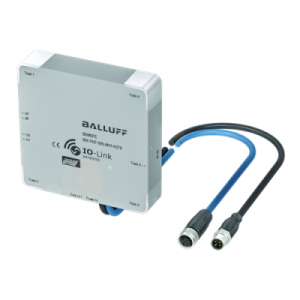
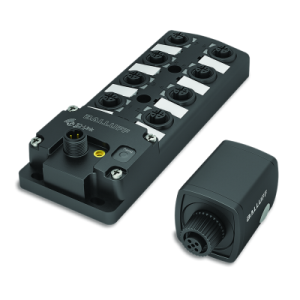
Instead of using cables, the wireless master receives the sensor data by radio via a bridge (right) or hub (left). The technology is thus an essential building block for the factory of the future.
In addition to the new IO-Link wireless standard, Balluff offers various solutions for contactless data and power transmission, and is constantly expanding its own wireless portfolio. “Using wireless technology, we want to unleash industrial communication,” says Hubertus Breier, head of technology at Balluff, describing the benefits of wireless solutions in industrial communication. “Thanks to the IO-Link Wireless standard, we can now collect data in applications, for example, where this was either technically impossible or too costly before.”
Read more...Siemens and HighByte partner to scale industrial AI Siemens South Africa
IT in Manufacturing Fieldbus & Industrial Networking
Siemens is expanding its Industrial Edge ecosystem through a partnership with HighByte, enabling customers to connect, contextualise and transform data from operational technology and information technology sources to build AI models and applications at scale.
Read more...RS South Africa is Master Distributor for Arduino platform RS South Africa
Industrial Computer Hardware
RS South Africa has been named Master Distributor for the Arduino UNO Q, reinforcing its position as a leading technology partner for engineers and developers across South Africa and the broader African region.
Read more...Loop signature Part 2-4: Feedforward Control: Part 3 Michael Brown Control Engineering
Editor's Choice Fieldbus & Industrial Networking
In the previous articles in this series, the basic theory behind feedforward control was discussed, and it was also shown how to apply feedforward in practice. In this article, it will be shown how well feedforward can work in practice by giving a couple of examples.
Read more...Panel PC for industrial HMI markets Vepac Electronics
Industrial Computer Hardware
AAEON has released its new AI Panel PC series, positioned for use in applications requiring on-system inferencing such as industrial control panels.
Read more...Loop signature Part 2-3: Feedforward Control: Part 2 Michael Brown Control Engineering
Editor's Choice Fieldbus & Industrial Networking
Feedforward control tuning is not nearly as critical as feedback tuning, and fairly simple models are usually fine for the purpose in hand.
Read more...How to protect your industrial network RJ Connect
Editor's Choice Fieldbus & Industrial Networking
Network security is no longer a matter of preventing hacking or data breaches. Traditional defence mechanisms for perimeter protection may not fully address internal threats or device-level vulnerabilities alone.
While every effort has been made to ensure the accuracy of the information contained herein, the publisher and its agents cannot be held responsible for any errors contained, or any loss incurred as a result. Articles published do not necessarily reflect the views of the publishers. The editor reserves the right to alter or cut copy. Articles submitted are deemed to have been cleared for publication. Advertisements and company contact details are published as provided by the advertiser. Technews Publishing (Pty) Ltd cannot be held responsible for the accuracy or veracity of supplied material.











 printer friendly version