



In the future, hydrogen will make an important contribution to a sustainable energy supply. Renewable energies from wind, sun and biogas are often available when they are not needed. Many wind turbines are even shut down when wind conditions are favourable, and they could be operating efficiently. The problem is oversupply and weak power grids that cannot adequately draw and transport the energy.
Storage technology is needed, and batteries have major disadvantages in terms of durability and components that are not indefinitely available and are difficult to recycle. Without storage technology for the ‘green’ energy, there will always be a gap in energy supply that will have to be filled with climate-damaging fossil fuels. Many experts therefore believe that green hydrogen is the solution, and the German government is promoting the development of hydrogen and fuel cell technologies to stay ahead of the competition.
H2 Forum – Green Hydrogen 2025
Recently, a virtual conference for energy suppliers, automotive and industrial companies, technology manufacturers and research institutions took place, at which Knick was represented by two conference speakers. The online event brought together decision-makers, experts and solution providers around the future of green hydrogen. Expert presentations and a virtual product exhibition invited discussion and networking. Joachim Baumann, sales director for interface technology at Knick, talked about current and high-voltage measurements on electrolysis cells. Thereafter, Dr Michael Kogej spoke about process analysis in hydrogen production.
Electrical measurement technology for electrolysis cells
Electrolysers are independent systems in which hydrogen is produced by electrolysis using direct current. With such systems, renewable energy can be converted into hydrogen directly at the point of generation. Electrolysers consist of the stacks (electrolysis cell packages) of a water treatment unit, a gas treatment unit, power electronics including measurement technology, and control and interface management. Ideally, all modules are integrated in a ready-to-connect container and can then be installed directly at wind farms, solar farms or biogas plants.
Precise measurement of system parameters such as current, voltage and temperature directly at the electrolysers are general requirements for safe operation in the electrolytic production of hydrogen. Regardless of the type of conversion process, the operators place extremely high value on reliability and demand a long service life.
With the ProLine P40000 product range, Knick offers solutions with a choice of measuring ranges. Extremely high MTBF values (above 2000 years) calculated from products in service are proof of the reliability. The isolating amplifiers for current and voltage measurement can be used in systems up to 2200 V DC. Together with the P41000 and one MACONIC shunt resistor, currents up to 20 000 A can be measured. Knick interface products are known for:
• High accuracy (low linearity and gain errors).
• Low temperature coefficient.
• Very high common mode rejection.
• Good dynamic behaviour.
Knick process analytics for hydrogen production
Although process analytics equipment seems to be superfluous in hydrogen generation, it is nonetheless very important for technical and efficiency reasons. By developing and optimising electrolysis techniques, these processes will become more efficient in the future. The main source for clean and green hydrogen is water, which must have a high purity to be used for the purpose.
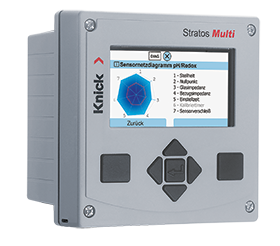
The Stratos Multi measurement system, in combination with the SE605(H) conductivity sensor, guarantees high-quality water. The system monitors water quality online and directly displays/transfers the measurement values to operators and the control system. Other features and benefits include:
• Easy and intuitive handling.
• Digital Memosens inductive sensor connection for preventing electrostatic influences.
• Multichannel and multiparameter ability for measurement point optimisation (conductivity, pH).
• Diagnostic functions for optimised maintenance.
• Traffic light system for easy user information.
• Reliable and repeatable measurements.
• Compact and robust design.
The SE605(H) conductivity sensor is specially designed for conductivity measurements in pure/ultra-pure water. The digital Memosens protocol is implemented inside the sensor head, allowing pre-calibrated sensors to be used after installation and connection to the measurement system.
| Tel: | +27 11 257 6100 |
| Email: | [email protected] |
| www: | www.mecosa.co.za |
| Articles: | More information and articles about Mecosa |






© Technews Publishing (Pty) Ltd | All Rights Reserved
 printer friendly version