


Electrical Power & Protection


When not just any battery will do

January 2021 Electrical Power & Protection

Only high-quality batteries from reputable suppliers should be used for security and other mission critical equipment, to avoid potentially costly failures. This is according to the director of one of the country’s fastest growing battery distributors, Greg Pritchard from GSS Group, who adds that intermittent load shedding and other environmental factors can quickly damage batteries that are not specifically designed and manufactured for these applications.

Heavyweight battery

“One of the easiest ways to gauge the quality of a lead acid battery is its weight,” explains Pritchard. “Lead is one of the most expensive components of a battery and is often where some manufacturers try to save. Our commonly sold 8 Ah battery, for example, is very heavy and has the required amount of lead to make it one of the most durable available. Beneath the skin are other design features that set these batteries apart, such as the type of acid used, layout and design.

“Unfortunately for the installer or layman, these facts are not commonly known and it usually falls to trial and error to figure out which batteries are better, last longer and are best able to handle mission critical applications under any power conditions. That is where our GSS batteries have performed excellently and is the reason for our company’s rapid growth in the four years we have been trading.
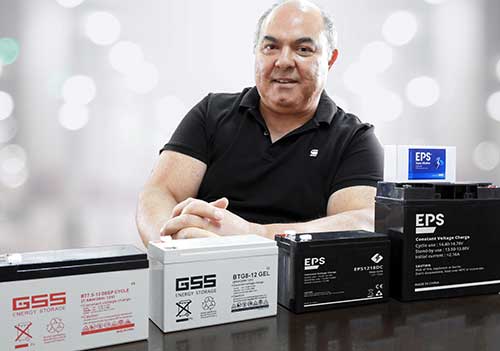

Greg Pritchard showing current and newly rebranded batteries.

“Our batteries have been specified, designed and built according to our own requirements, using knowledge based on thirty years of industry experience. We have applied the lessons learned and come up with a number of different types and sizes of batteries specifically for mission critical applications in South Africa.”

Good reputation

He says there are a number of reasons why monitoring companies should use quality GSS batteries and why end users should insist on them. In security applications, a battery can mean the difference between life and death, while a failure in IT infrastructure can lead to data and telecommunication interruptions, or even the failure of instruments in manufacturing plants.

Faulty batteries also lead to false alarms and unnecessary call-outs which cost monitoring companies money, while an excessive number of false alarms can taint their reputations in the long run. What is more, the homebred GSS batteries are competitively priced and available online from the company’s website, via delivery or direct from the company’s premises in Benoni.

Pritchard has also worked for the country’s leading security product suppliers and interfaced with all the major electronic installation companies, overseas manufacturers, technicians and end users. He is eager to share his knowledge and welcomes customers to work with him and his team to supply quality batteries and power products for their applications.

Growing range

GSS batteries are available in a range of sizes and types from 6 V/4,5 Ah used mainly in emergency lighting, 12 V/1,3 Ah and 2,4 Ah for garage automation, 12 V/4,5 Ah for uninterruptible power supplies, 12 V/7,2 Ah for gate automation, as well as 12 V/7,5 Ah deep-cycle batteries used mainly for solar, UPS and gate automation applications.

The company also has ranges of lithium polymer and lithium phosphate batteries, power supplies and transformers, as well as security communication cable, Cat5, Cat6 and control cable (EN0575, IEC60332-1 standards), and security products including detectors, beams and CCTV.

New name in batteries

One of the country’s most sought after battery brands in security and other mission critical applications, GSS batteries, is changing its name to better reflect its outstanding features.

Manufactured for GSS Group in South Africa, the newly-branded EPS (Energy Power Storage) battery trade name has been adopted by the company and stands for quality and commitment to the local market. Pritchard says that due to the vast number of batteries stockpiled during lockdown and the sheer number of batteries sold on a monthly basis, the two brands may appear together on shelves for a while until stock is depleted.

“The reason for the name change is simply to separate the company from the brand and give a significant meaning to the name of our batteries,” he concludes.




Share this article:
Share via emailShare via LinkedInPrint this page

Further reading:

Overcoming the bottling industry’s fragmented visibility
Schneider Electric South Africa IT in Manufacturing Electrical Power & Protection
Beverage bottling facilities are among manufacturing’s most energy-intensive environments, yet many still operate without granular insight into where that energy goes. Rezolia Muller-Potluri of Schneider Electric explains how tiered metering architecture and advanced

Read more...
Schneider Electric introduces next-generation BlokSeT switchboard
Schneider Electric South Africa Electrical Power & Protection
Schneider Electric has launched its next-generation BlokSeT low-voltage switchboard in West Africa, offering high reliability, predictive maintenance capability and digital integration for critical infrastructure and industrial applications.

Read more...
Powering South Africa’s renewable energy expansion
Electrical Power & Protection
ACTOM Distribution Transformers, the sole NECRT contract holder for Eskom, is powering South Africa’s renewable energy expansion through robust neutral earthing transformer solutions deployed across solar and wind projects in southern Africa.

Read more...
You can’t digitise a blackout
Schneider Electric South Africa Electrical Power & Protection
Across East Africa, smart meters and AI promise cleaner, more reliable power, but digital tools cannot optimise a grid too weak to carry the load. Schneider Electric’s Symphrose Ochieng sets out why operators should strengthen physical infrastructure first, then add digital capability in phases.

Read more...
Battery energy storage is key to powering South Africa’s manufacturing sector
Electrical Power & Protection
South Africa’s shift to renewables is creating a significant opportunity in battery energy storage, but local manufacturers face an uphill battle against cheap imports and stop-start demand. Richard van Moltke of ACTOM Static Power examines what it will take to build a sustainable local battery storage industry.

Read more...
Decarbonisation is reshaping mining strategy in Africa
Schneider Electric South Africa IT in Manufacturing Electrical Power & Protection
Mining companies across Africa are embedding decarbonisation into operational strategy, driven by investor, regulatory and customer pressure to reduce emissions while improving resilience.

Read more...
How to tell whether your mini-substation is new or refurbished
Electrical Power & Protection
Cosmetically refurbished mini-substations are being misrepresented as new equipment and sold back into the market, posing serious reliability and safety risks for mining, industrial and commercial operations. Trafo Power Solutions explains what to look for and what questions to ask before purchasing.

Read more...
Optimising energy reliability for African manufacturing
Electrical Power & Protection IT in Manufacturing
Unreliable power can cost African manufacturers as much as 31% in sales. Behind-the-meter power offers manufacturers in sub-Saharan Africa control, visibility and resilience in their energy provisioning.

Read more...
Electrical solutions for FMCG manufacturing giant
Electrical Power & Protection
An electrical upgrade at a leading fast-moving consumer goods facility demonstrates how ACTOM Kenya turned a fragile, reactive power infrastructure into a resilient, data-driven backbone for production. The project is also a case study in bridging legacy equipment with modern automation without disrupting operations.

Read more...
Yokogawa digital plant to accelerate green hydrogen revolution
Yokogawa South Africa Editor's Choice Electrical Power & Protection IT in Manufacturing
Yokogawa explains how a digital plant approach and autonomous operations can integrate the full green hydrogen value chain, from renewable power generation to end-use applications, and why digitalisation and system integration are central to making green hydrogen viable in South Africa.

Read more...


While every effort has been made to ensure the accuracy of the information contained herein, the publisher and its agents cannot be held responsible for any errors contained, or any loss incurred as a result. Articles published do not necessarily reflect the views of the publishers. The editor reserves the right to alter or cut copy. Articles submitted are deemed to have been cleared for publication. Advertisements and company contact details are published as provided by the advertiser. Technews Publishing (Pty) Ltd cannot be held responsible for the accuracy or veracity of supplied material.


© Technews Publishing (Pty) Ltd | All Rights Reserved