South Africa’s dirtiest fuel is building its most resilient boilers
September 2026
Electrical Power & Protection
Specialist high-pressure equipment engineering firm, Steinmüller Africa says the fuel South Africa has spent decades trying to get rid of may be the key to building its most reliable industrial boilers, and that the engineering required to make that case is now well established.
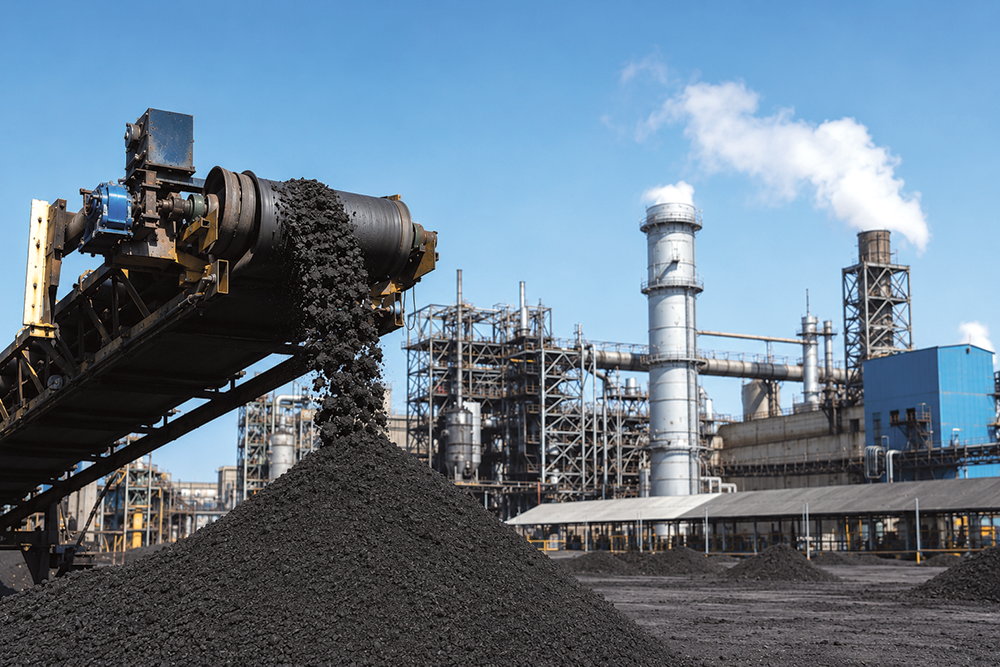
South Africa currently holds in excess of 1,5 billion tons of coal fines and discards on surface stockpiles, accumulated over decades as a by-product of the coal washing process that separates export-grade material from lower-quality streams. For most of that time, this material has been treated as an unavoidable liability: too fine, too wet and too inconsistent to deploy in any commercially meaningful way. Steinmüller Africa argues that characterisation can now be challenged.
The harder the fuel, the stronger the system
Duff coal is not simply a lower grade of fuel. Its ash, moisture, volatile and sulphur content shift significantly depending on the season, the source, and the age of the stockpile material, placing extraordinary demands on any combustion system designed to handle it.
Industrial boilers operate for 35 to 40 years, and every design decision must account for that full range of variability, not just at commissioning, but across the entire asset life. A system engineered to those demands is more robust, more adaptable and more resilient than one designed for a stable, predictable fuel.
“Duff coal is one of the most demanding combustion challenges in industrial energy,” says Moso Bolofo, chief executive officer of Steinmüller Africa. “Engineering a system that handles its full variability reliably over a complete asset lifetime is not a compromise. It is a standard.”
Where engineering progress meets commercial reality
The commercial case for duff coal has historically stalled at feasibility. The engineering tools existed, but emissions regulations were not previously stringent enough to make circulating fluidised bed combustion, the technology best suited to duff coal, commercially competitive.
That picture is changing. Tightening compliance requirements are closing the gap, circulating fluidised bed technology has matured to utility scale, and fuel characterisation methodology has advanced to the point where a plant’s full performance envelope can be defined with genuine confidence. Projects that could not previously be made to stack up are now within reach.
A full-system engineering undertaking
A duff coal energy project involves more than a boiler. It is a full-system engineering undertaking spanning fuel preparation, combustion design, ash handling, emissions management and long-term operations and maintenance. What is now achievable is the ability to model the interaction of all these elements across a full asset life, producing a system designed to remain commercially viable and operationally reliable throughout.
A system engineered to handle duff coal variability is also, by its design, capable of accommodating future fuel blending, including biomass and waste-derived streams. For heavy industry navigating the energy transition, this represents a practical and phased pathway forward, grounded in engineering reality.
The environmental case is equally straightforward. Unmanaged stockpiles are not passive. Weathering, oxidisation and spontaneous combustion release emissions without any form of control. An engineered combustion environment, built to regulatory compliance standards, is a materially better outcome.
“Energy security, long-term cost certainty and environmental responsibility are not competing objectives,” says Bolofo. “The right engineering foundation makes them mutually reinforcing. Duff coal is where that case can be proven.”
For more information contact Mpho Mafela, Steinmüller Africa, +27 11 806 3321, [email protected], www.steinmullerafrica.com/boilers-heat-exchangers
Further reading:
Africa’s net-zero ambition must become operational
Schneider Electric South Africa
Electrical Power & Protection
Schneider Electric’s Rohit Chashta argues that the biggest gap in Africa’s green transition is not ambition but execution, and outlines how advisory services, bankable project roadmaps, digital visibility and SF6-free switchgear can turn sustainability commitments into measurable progress.
Read more...
High-efficiency half-brick DC-DC converters
Vepac Electronics
Electrical Power & Protection
The Supreme series half-brick DC-DC converters from Vepac Electronics use synchronous rectification for high conversion efficiency, in a six-sided metal case built to withstand harsh industrial and transportation environments.
Read more...
Zinc-based batteries power a more sustainable energy future
Electrical Power & Protection
Zinc-based batteries are gaining ground as a safe, recyclable and cost-effective energy storage option, from consumer electronics to grid-scale systems. The International Zinc Association’s Simon Norton explains why zinc is well placed to support the clean energy transition.
Read more...
Energas introduces lower-cost German gas genset for South African market
Electrical Power & Protection
Energas Technologies will supply R Schmitt Enertec’s new Energy Line genset to the South African market, offering German-engineered gas-to-power generation of 400 to 500 kW at a lower entry cost through focused standardisation and a simpler standalone architecture.
Read more...
ACTOM plays key role in large transmission substation project in Swellendam
ACTOM Electrical Machines
Electrical Power & Protection
ACTOM has been appointed to engineer, procure, construct and commission the 1000 MVA main transmission substation for the Overberg Wind Farm in Swellendam, one of the largest substations of its kind in South Africa.
Read more...
Reliable power conversion from high-voltage DC buses
Conical Technologies
Electrical Power & Protection
The MEAN WELL DDRH-240 from Conical Technologies is a high-reliability DIN-rail DC-DC converter with a wide 250 to 1500 V DC input range, deriving stable low-voltage power directly from high-voltage DC buses in renewable energy, storage, charging, railway and industrial installations.
Read more...
AES maintains a strong value and safety stance on boiler retrofits
Electrical Power & Protection
AES Commercial Director Dennis Williams explains when a boiler retrofit makes more sense than replacement, outlines the range of efficiency and emissions upgrades available, and draws the line at safety: a boiler not legally signed off is shut down, no exceptions.
Read more...
The grid needs to become more intelligent
Schneider Electric South Africa
Electrical Power & Protection
South Africa’s power grid is becoming bidirectional and far more dynamic as distributed energy resources proliferate. Schneider Electric’s Nishandra Bajinath explains why digitalisation, DERMS and aggregation are essential to keep this increasingly complex grid stable and efficient.
Read more...
ACTOM’s integrated electrical solutions reduce project risk and accelerate delivery
Electrical Power & Protection
ACTOM has secured multiple orders across four divisions for the Naos-1 hybrid solar and battery project in the Free State, demonstrating its integrated model for supplying the full electrical chain from high-voltage equipment to distribution transformers.
Read more...
Smarter energy management starts with intelligent electrification
ABB South Africa ABB Electrification Products
Electrical Power & Protection
ABB Electrification specialists Adeline Maleka and Nokulunga Dube explain how the convergence of electrification, digitalisation and automation is helping South African industries gain real-time visibility, reduce energy waste and build operational resilience.
Read more...










 printer friendly version