Preventing expensive unscheduled shutdowns by knowing the state of electrical supply systems
June 2000
Analytical Instrumentation & Environmental Monitoring
Anglo Allied Engineering
The sudden loss of electrical power, even in a small section of a modern plant, can result in the unscheduled shutting down of the whole plant which may prove to be very costly. Obviously, a good 'feel' for the state of the electrical wires and insulation in the plant would be of great help when planning scheduled maintenance and equipment overhauls.
In distributed IT TN and TT systems, insulation fault location can also be costly in terms of time and money. The Bender on-line insulation fault and residual current location system provides an automatic solution to these problems.
Time and money are saved by being able to monitor residual currents and verify insulation integrity while the plant is still running. The system will indicate the exact location of the fault, saving time looking for it. The resultant early preventative maintenance, without having to shut down the plant, makes it a cost-effective approach.
The system is modular and flexible, able to monitor the electrical supply system in any plant. Its flexibility permits easy retrofitting and extension, with up to 360 branches capable of being monitored by one system.
Its universal application is implemented through three system types. The EDS system is for use with all AC/DC IT systems, the RCMS system is for all AC, TN and TT systems and there are portable systems for working with small power systems and subcircuits. EDS devices comply with IEC/EN61557 \9 (draft).
Insulation fault
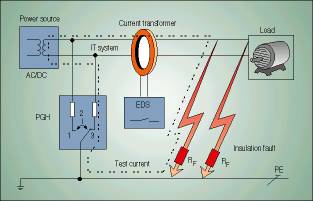
When an insulation fault occurs in IT systems, it will be detected and indicated by the A-Isometer insulation monitoring device. The test device generates a test signal for a defined period. This test signal will propagate via any insulation fault locations, and be able to be detected at any of the current measuring transformers within the insulation fault path.
Residual current location
All the conductors for a given circuit are fed through the core of a current transformer. In normal operation, the sum of all the currents will be zero. In a fault condition, there will be an imbalance in the total. This imbalance will be detected by the current transformer and the result will be evaluated by the RCMS470's electronics.
A maximum of 12 current transformers (ie 12 circuits) may be monitored by one RCMS470-12 evaluator, any faulty circuits are indicated by an LED. All the RCMS units work in parallel to minimise system evaluation.
The combination of an RCMS and PRC provides a central control and display of the measuring results and pre/main alarm warning set-up (10 mA to 10 A) for each circuit. The use of current transformers allows the RCMS system to be independent of both the load current and the voltages used in the installation.
Central control unit
The PRC470 is the central control unit for the system. All monitoring parameters and important operating states are displayed in a test window, providing a compete overview of the entire installation. Communication interconnection between controller and the evaluators is made by means of a cost saving two-wire interface which is easily extended.
Further reading:
Matching HVAC to the real demands of buildings and processes
Analytical Instrumentation & Environmental Monitoring
Industrial Climate Engineering director, Alin Gomes explains why effective HVAC goes beyond specifying equipment on capacity, covering load profiling, ventilation requirements, heat recovery and turnkey delivery for specialised manufacturing and processing environments.
Read more...
How SCE approaches sensor selection for critical environments
Specialised Climate Engineering
Analytical Instrumentation & Environmental Monitoring
Specifying the right sensor for a critical climate involves far more than matching a datasheet accuracy figure. As an authorised Vaisala HVAC partner, SCE explains how understanding the environment, the measurement purpose and sensor placement determines effective climate control.
Read more...
Changing gas quality calls for smarter combustion control
Analytical Instrumentation & Environmental Monitoring
As South Africa prepares for a transition from declining Mozambican natural gas to a proposed methane-rich bridge, LNG, industrial users can no longer assume a constant Wobbe Index and calorific value. The compact RMG RGQ 5 provides fast, plant-level gas-quality data to support approved burner and engine settings.
Read more...
Getting the chemistry right
Analytical Instrumentation & Environmental Monitoring
Grace’s European production site has relied on analogue compression load cells from Minebea Intec for decades, with the long-proven measurement concept now serving as the reference for new silo projects as the company expands its capacity.
Read more...
Why measurement matters in smelting
Endress+Hauser South Africa
Analytical Instrumentation & Environmental Monitoring
South African smelters returning to operation after energy constraints face new demands for tighter control, better visibility and environmental compliance. Endress+Hauser explains how modern measurement technology supports safer, more efficient furnace operation and local beneficiation.
Read more...
Sun tracking with pinpoint precision
Senseca
Analytical Instrumentation & Environmental Monitoring
Senseca has introduced the SEMS-2000 solar energy measurement system, a 2-axis solar tracker with pinpoint sun-pointing accuracy that automatically monitors direct, global and diffuse irradiance for unattended outdoor solar installations.
Read more...
AMETEK expands 993X gas analyser series with explosion-proof enclosures
Analytical Instrumentation & Environmental Monitoring
AMETEK Process Instruments has added ATEX and IECEx Zone 1-certified explosion-proof enclosures to its 993X series of gas analysers, enabling reliable installation in Zone 1 hazardous locations where purge gas is unavailable.
Read more...
Why medical device leak testing matters for South Africa's MedTech future
ATEQ South Africa
Analytical Instrumentation & Environmental Monitoring
As South Africa works to grow local medical technology manufacturing, non-destructive leak and flow testing is becoming a strategic quality assurance tool, helping manufacturers verify device integrity, meet regulatory requirements and improve production efficiency.
Read more...
Moving forward with reverse osmosis
Analytical Instrumentation & Environmental Monitoring
Rising water costs and pressure on infrastructure are changing the way industries view reverse osmosis. G-Chem Aquacare is developing tailored, containerised solutions that make the technology more accessible for South African industry.
Read more...
Meteorological data logger with up to 32 analogue sensors
Senseca
Analytical Instrumentation & Environmental Monitoring
Senseca has introduced its advanced data acquisition system for environmental monitoring, which has a universal data logger for up to 32 analogue, pulse and smart digital sensors.
Read more...










 printer friendly version