Leonardo fitted with backup power by Zest WEG Group
July 2019
Electrical Power & Protection
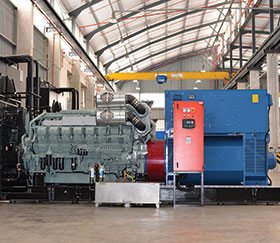
As Sandton anticipates the completion this year of the Leonardo, the top end mixed-use skyscraper being constructed by Aveng-Grinaker LTA, Level 1 BBBEE-rated Zest WEG Group has supplied generator sets to keep lights on during outages. The iconic structure, that will dominate the skyline as the tallest building in Africa, is being built for 75 on Maude, a partnership between Legacy Group and Nedbank.
According to Craig Bouwer, projects and product manager at Zest WEG Group genset division, the commissioning of the units was undertaken in the first quarter of 2019 with practical completion in the second quarter of 2019. This follows the original awarding of the tender in November 2017.
“We are proud to have designed, manufactured and supplied the two 2000 kVA, 11 kV generator sets which are installed in the Leonardo’s dedicated plant room on ground level,” says Bouwer. “Our contract included delivering the units to site and placing them in position, which was done in September last year. We were also responsible for the complete installation, testing, commissioning and handing over to the client in full working order.”
The gensets will provide the building with emergency power backup and comprise prime rated Mitsubishi powered diesel generators coupled to WEG alternators. To reduce noise levels to local council requirements, Zest WEG Group supplied and installed inlet and outlet splitter attenuators. The fuel storage and transfer system ensures eight hours of operation, with bulk and day fuel tanks installed in compliance with local fire regulations.
The company also installed medium voltage (MV) generator protection and a control panel, as well as a main MV distribution panel for the building, comprising six tiers for all incoming supply and feeder breakers. All the related cabling for the MV and low voltage (LV) reticulation were also provided for the generator sets, fuel system and auxiliary control equipment.
Significantly, Zest WEG Group holds a Construction Industry Development Board (CIDB) rating of 6EB for electrical engineering work in buildings, as well as a 9EP rating for infrastructural electrical engineering work.
“We conducted full in-house MV testing of the system at our modern Cape Town facility before delivery to site,” Bouwer says. “We were assisted by our transformer division with the supply of three 500 kVA, 11 kV to 400 V step-down transformers to enable load testing at 400 V. This allowed us to conduct functional and load tests on the generator sets in our workshop, testing them individually as well as in full synchronisation and load share operation.”
He adds that the location of the generator plant room and the physical size of the generator sets meant that the generator sets could not be installed as fully assembled units. “This challenge was overcome by disassembling the generator sets prior to delivery and re-assembling them in the generator plant room,” he concludes. “Due to the weight of the equipment, special rigging equipment was required inside the plant room to facilitate the re-assembly process.”
Further reading:
Africa’s net-zero ambition must become operational
Schneider Electric South Africa
Electrical Power & Protection
Schneider Electric’s Rohit Chashta argues that the biggest gap in Africa’s green transition is not ambition but execution, and outlines how advisory services, bankable project roadmaps, digital visibility and SF6-free switchgear can turn sustainability commitments into measurable progress.
Read more...
High-efficiency half-brick DC-DC converters
Vepac Electronics
Electrical Power & Protection
The Supreme series half-brick DC-DC converters from Vepac Electronics use synchronous rectification for high conversion efficiency, in a six-sided metal case built to withstand harsh industrial and transportation environments.
Read more...
Zinc-based batteries power a more sustainable energy future
Electrical Power & Protection
Zinc-based batteries are gaining ground as a safe, recyclable and cost-effective energy storage option, from consumer electronics to grid-scale systems. The International Zinc Association’s Simon Norton explains why zinc is well placed to support the clean energy transition.
Read more...
Energas introduces lower-cost German gas genset for South African market
Electrical Power & Protection
Energas Technologies will supply R Schmitt Enertec’s new Energy Line genset to the South African market, offering German-engineered gas-to-power generation of 400 to 500 kW at a lower entry cost through focused standardisation and a simpler standalone architecture.
Read more...
ACTOM plays key role in large transmission substation project in Swellendam
ACTOM Electrical Machines
Electrical Power & Protection
ACTOM has been appointed to engineer, procure, construct and commission the 1000 MVA main transmission substation for the Overberg Wind Farm in Swellendam, one of the largest substations of its kind in South Africa.
Read more...
Reliable power conversion from high-voltage DC buses
Conical Technologies
Electrical Power & Protection
The MEAN WELL DDRH-240 from Conical Technologies is a high-reliability DIN-rail DC-DC converter with a wide 250 to 1500 V DC input range, deriving stable low-voltage power directly from high-voltage DC buses in renewable energy, storage, charging, railway and industrial installations.
Read more...
AES maintains a strong value and safety stance on boiler retrofits
Electrical Power & Protection
AES Commercial Director Dennis Williams explains when a boiler retrofit makes more sense than replacement, outlines the range of efficiency and emissions upgrades available, and draws the line at safety: a boiler not legally signed off is shut down, no exceptions.
Read more...
The grid needs to become more intelligent
Schneider Electric South Africa
Electrical Power & Protection
South Africa’s power grid is becoming bidirectional and far more dynamic as distributed energy resources proliferate. Schneider Electric’s Nishandra Bajinath explains why digitalisation, DERMS and aggregation are essential to keep this increasingly complex grid stable and efficient.
Read more...
ACTOM’s integrated electrical solutions reduce project risk and accelerate delivery
Electrical Power & Protection
ACTOM has secured multiple orders across four divisions for the Naos-1 hybrid solar and battery project in the Free State, demonstrating its integrated model for supplying the full electrical chain from high-voltage equipment to distribution transformers.
Read more...
Smarter energy management starts with intelligent electrification
ABB South Africa ABB Electrification Products
Electrical Power & Protection
ABB Electrification specialists Adeline Maleka and Nokulunga Dube explain how the convergence of electrification, digitalisation and automation is helping South African industries gain real-time visibility, reduce energy waste and build operational resilience.
Read more...










 printer friendly version