



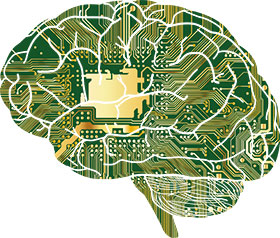
At a certain age, around 70, our bodies begin to show signs of wear. What becomes apparent is that our built in control loops and data processing software steps in to compensate, and covers the gaps in the best way possible, working with the degraded sensors and equipment still functioning.
This was first obvious to me when I started to try to monitor the effects of glaucoma, which results in blind spots in the areas of sight for each eye. This is not apparent in normal life, as what you see is the brain-processed image from two eyes. Where one eye has a blind spot, data from the second eye is used to complete the single image in the mind – and this is how we do not notice the normal blind spots everyone has where the optic nerve leaves each eyeball. With the early stages of glaucoma, the smallish blind areas are only obvious when one eye is closed, so that your brain only works from one sensor. But our own sophisticated data processing fills in the blind spots with a plain area in the same colour/style of image as its surroundings, so you think that you see the whole panorama. With luck, opening the other eye will add detail from the second sensor, to complete the picture.
When glaucoma gets severe, the blind spots from each eye begin to overlap, meaning that the processor has no data coming in from either of its two sensors for certain areas of your view, so the processor moves up a gear and fills the area with sort of a plain colour, the same as the surrounding areas. But actually it tries harder, and if you were viewing an array of books on shelves, the mind can insert a sort of composite image of the books there, and fill the blind spot: it almost tries to fill the space with past image information, when it last had an input from that area – when you were looking at that spot maybe. But the brain is not so good at this, and anyway it is old data. The driving authorities do not allow glaucoma sufferers to drive cars, as a child, or animal, or bollard, can disappear in a blind spot, replaced by an image of the surrounding tarmac road surface.
Astronomers already use this approach to refine telescope pictures of planets: getting the sharpest bits of multiple repeat images, disturbed by atmospherics, vibration etc., which can then be processed to produce an unblemished image.
Cataract operation
Cataracts affect the vision, basically by making the image less precise, almost by adding a fog. I have just had the right eye operated on, and a ‘clean’ plastic lens inserted to replace the old cloudy lens. This does not help the glaucoma, but it gives the processor a whole new set of problems. Having worn glasses for myopia for 60 years, these were discarded as the new lens can see perfectly at distance. The brain now still uses the two sensors, but presents preferentially the sharply focused image from the right eye for distance viewing, supressing the fuzzy, out of focus image still available from the left eye. For close up views, maybe when reading, the left eye image is used, as the muscles of the right eye have lost some of their strength, and cannot focus up-close. So the brain switches sensors. All this happened straight away, no learning time needed.
It was more of a problem when my glasses came back, one lens replaced with plain glass. Maybe they had been distorted by the optician, but the two images were displaced vertically with respect to one another. This requires the eyeballs to not move together, as they do when moving from side to side, but for one eye to move up with respect to the other. Not easy, particularly as the processor called on muscles not accustomed to such work to operate separately. So there was a mechanical delay in the control loop, of around a second, whenever I moved my gaze onto a different subject. The brain was doing the job, it was just the body complaining! However, a better option here is to adjust the frame of the glasses to restore normal operations.
But do I need to wear glasses at all … or can the brain do the job without them?

Nick Denbow spent 30 years as a UK-based process instrumentation marketing manager, and then changed sides – becoming a freelance editor and starting Processingtalk.com. Avoiding retirement, he published the INSIDER automation newsletter for five years, and then acted as their European correspondent. He is now a freelance Automation and Control reporter and newsletter publisher, with a blog on www.nickdenbow.com






© Technews Publishing (Pty) Ltd | All Rights Reserved
 printer friendly version