Profiler 'sees' through tank walls
February 2002
Analytical Instrumentation & Environmental Monitoring
A version of the Tracerco Profiler had already proved its accuracy and reliability on-shore in refinery vessels for a combined total of 20 years when the technology was applied to separator measurement and control.
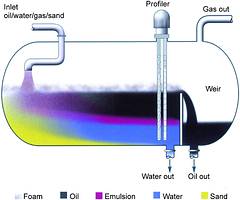
The instrument comprises sealed titanium dip-pipes installed within the separator through a single 6" or 4" flange. A narrow dip-pipe holds a vertical array of low energy radiation emitters. A typical system will have two parallel dip-pipes, each holding a detector of up to 48 Geiger Muller tubes. Combined, they can give a 96-point measuring system with a minimum vertical pitch of 28 mm.
Each emitter transmits radiation through the fluid within the separator to be picked up by the detector. Oil, water, sand, foam and emulsion have different densities, they will attenuate the signal passing through them by different amounts. The density registered by each tube is transmitted to a signal processing unit housed in the dome, above the dip-pipes.
Figure 1
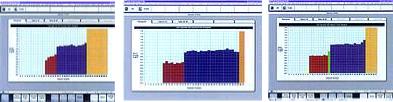
The information is converted into serial data and sent via fibre-optic cable to the plant computer. On the screen the fluid density at each 28 mm channel is depicted in realtime. For the first time ever one can see a complete profile of the distribution of fluids within the separator:
* The interface between water and oil or oil and gas.
* The quality of the separation.
* The extent of foam build up.
* The total liquid position.
* The level of sand build-up.
Figure 2
The BP Forties field
In 1999, the Tracerco Profiler newly installed on a BP production platform in the Forties field detected a considerable build-up of sand within a separator. The operators were unaware of the sand and had attributed poor production rates to reservoir conditions. The thin oil phase made control difficult and good separation hard to achieve without water carry-over.
To remove the sand, the operators began to jet wash the separator. The overall effect was to reduce environmental risk, optimise assets and save on chemicals in the separator.
With the aid of readings from the Profiler, the operators monitored the effectiveness of chemicals added to control foaming and emulsion. Wastage was reduced. The separator was brought under perfect control. With residence time up to target levels, rates of production were optimised. The risk of carry-over was eliminated.
Whilst this was taking effect, a band of emulsion between the oil and water phase and foam on top of the water was observed.
Since installation two years ago, BP has carried out no maintenance on the system. The Tracerco Profiler is suitable for use on floating production facilities.
Tracerco Africa
(011) 706 2592
bram@tracerco.co.za
Further reading:
AMETEK expands 993X gas analyser series with explosion-proof enclosures
Analytical Instrumentation & Environmental Monitoring
AMETEK Process Instruments has added ATEX and IECEx Zone 1-certified explosion-proof enclosures to its 993X series of gas analysers, enabling reliable installation in Zone 1 hazardous locations where purge gas is unavailable.
Read more...
Why medical device leak testing matters for South Africa's MedTech future
ATEQ South Africa
Analytical Instrumentation & Environmental Monitoring
As South Africa works to grow local medical technology manufacturing, non-destructive leak and flow testing is becoming a strategic quality assurance tool, helping manufacturers verify device integrity, meet regulatory requirements and improve production efficiency.
Read more...
Moving forward with reverse osmosis
Analytical Instrumentation & Environmental Monitoring
Rising water costs and pressure on infrastructure are changing the way industries view reverse osmosis. G-Chem Aquacare is developing tailored, containerised solutions that make the technology more accessible for South African industry.
Read more...
Meteorological data logger with up to 32 analogue sensors
Senseca
Analytical Instrumentation & Environmental Monitoring
Senseca has introduced its advanced data acquisition system for environmental monitoring, which has a universal data logger for up to 32 analogue, pulse and smart digital sensors.
Read more...
Importance of gas analysis in the petrochemical industry
Elemental Analytics
Analytical Instrumentation & Environmental Monitoring
Gas analysis plays a critical role in petrochemical operations, supporting process optimisation, product quality and plant safety. As an experienced and expert gas analysis supplier, Elemental Analytics can provide the correct analyser and sample system package to meet individual plant requirements.
Read more...
Fully integrated standalone thunderstorm warning system
Senseca
Sensors & Transducers Analytical Instrumentation & Environmental Monitoring
Senseca South Africa has introduced its BTD-1 fully integrated, standalone thunderstorm warning system, which detects lightning by monitoring the background quasi-electrostatic field. The system can generate alerts before the first lightning strike, with a detection raterange of up to 83 km.
Read more...
Environmental monitoring with testo Saveris 1
Analytical Instrumentation & Environmental Monitoring
The testo Saveris 1 environmental monitoring system has been in continuous use since 2010 at Jungbunzlauer, a biotechnology company in Germany, providing seamless temperature and humidity data for audit-ready, GxP-compliant processes across laboratories, warehouses and production areas.
Read more...
Reliability restored through systemic vibration analysis
Wearcheck
Analytical Instrumentation & Environmental Monitoring
Condition monitoring specialist, WearCheck uses a variety of testing techniques to enhance reliability in machinery components and prevent failures.
Read more...
Yokogawa’s free chlorine analyser is gold standard for water treatment utilities
Yokogawa South Africa
Analytical Instrumentation & Environmental Monitoring
One of the key factors in ensuring safe drinking water is the accurate monitoring of free chlorine residuals. This is where advanced online analysers, such as Yokogawa’s FC800 free chlorine analyser, are becoming increasingly valuable for water treatment operators and municipal utilities.
Read more...
Cooling tower bleed control
Analytical Instrumentation & Environmental Monitoring
Cooling towers rely on evaporation to remove heat, but this process also concentrates dissolved solids in the system. Left unmanaged, this buildup can lead to scaling, corrosion and fouling, reducing efficiency and increasing maintenance costs.
Read more...










 printer friendly version