How a new generation of miniaturised devices is changing the radiation detection industry
Technews Industry Guide: Maintenance, Reliability & Asset Optimisation 2018
Analytical Instrumentation & Environmental Monitoring
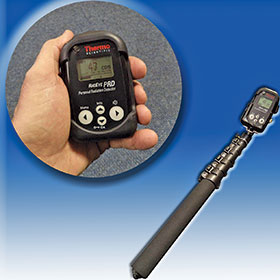
Exposure to harmful levels of radiation can easily be prevented with a new generation of ultra-small, wearable dosimeters. Less expensive, simpler to use, and portable, these devices boast the same levels of accuracy as their larger counterparts. In fact, miniaturisation is set to become one of the most important trends in the radiation detection market, estimated to become a $1,6 billion industry by 2020.
This growth is caused by falling costs in detection equipment, as well as factors like higher cancer rates, growing popularity of radiation therapy, and fears of nuclear terrorism. Global industry experts include the Middle East and Africa as one of the world’s top three fastest-growing regions. “Recent innovations in lightweight, wearable devices have dramatically reduced the cost of radiation detection, bringing devices within reach of new users,” notes Raymond Naidu, CEO of OEN Enterprises.
These smaller devices are perhaps the industry’s biggest advancement in recent years, in the fight against radiation exposure and contamination. They are capable of detecting alpha, beta, gamma or neutron radiation, sounding different types of alarms depending on the threat levels, and keeping accurate records of the levels detected.
“Mauritz van Niekerk, head of radiation at OEN explains that it is essential to select the right device for one’s needs. For example, while Thermo Scientific’s Electronic Personal Dosimeters, weighing only 95 grams, may be useful for most industries, the RadEye PRD would be required for a customs officer looking for hidden sources of radiation. At 160 grams, the more specialised RadEye PRD is up to 100 000 times more sensitive than typical electronic dosimeters.
These newer ranges of dosimeters capitalise on the power of Big Data. With their data recording and archiving features, users can closely track exposure, measured over periods of time, ensuring that exposure is within certain dose thresholds. South Africa’s National Nuclear Regulator pegs the safe radiation threshold at 20 millisieverts per year, averaged over the past five consecutive years.
“Above all,” notes Naidu, “radiation detection equipment must be 100% reliable. As with anything relating to personal safety, we advocate higher quality and longer lasting dosimeters, to give users the peace of mind that they are fully protected.”
For more information contact Mauritz van Niekerk, OEN Enterprises, +27 (0)11 675 4447, sales@oen.co.za, www.oen.co.za
Further reading:
Why measurement matters in smelting
Endress+Hauser South Africa
Analytical Instrumentation & Environmental Monitoring
South African smelters returning to operation after energy constraints face new demands for tighter control, better visibility and environmental compliance. Endress+Hauser explains how modern measurement technology supports safer, more efficient furnace operation and local beneficiation.
Read more...
Sun tracking with pinpoint precision
Senseca
Analytical Instrumentation & Environmental Monitoring
Senseca has introduced the SEMS-2000 solar energy measurement system, a 2-axis solar tracker with pinpoint sun-pointing accuracy that automatically monitors direct, global and diffuse irradiance for unattended outdoor solar installations.
Read more...
AMETEK expands 993X gas analyser series with explosion-proof enclosures
Analytical Instrumentation & Environmental Monitoring
AMETEK Process Instruments has added ATEX and IECEx Zone 1-certified explosion-proof enclosures to its 993X series of gas analysers, enabling reliable installation in Zone 1 hazardous locations where purge gas is unavailable.
Read more...
Why medical device leak testing matters for South Africa's MedTech future
ATEQ South Africa
Analytical Instrumentation & Environmental Monitoring
As South Africa works to grow local medical technology manufacturing, non-destructive leak and flow testing is becoming a strategic quality assurance tool, helping manufacturers verify device integrity, meet regulatory requirements and improve production efficiency.
Read more...
Moving forward with reverse osmosis
Analytical Instrumentation & Environmental Monitoring
Rising water costs and pressure on infrastructure are changing the way industries view reverse osmosis. G-Chem Aquacare is developing tailored, containerised solutions that make the technology more accessible for South African industry.
Read more...
Meteorological data logger with up to 32 analogue sensors
Senseca
Analytical Instrumentation & Environmental Monitoring
Senseca has introduced its advanced data acquisition system for environmental monitoring, which has a universal data logger for up to 32 analogue, pulse and smart digital sensors.
Read more...
Importance of gas analysis in the petrochemical industry
Elemental Analytics
Analytical Instrumentation & Environmental Monitoring
Gas analysis plays a critical role in petrochemical operations, supporting process optimisation, product quality and plant safety. As an experienced and expert gas analysis supplier, Elemental Analytics can provide the correct analyser and sample system package to meet individual plant requirements.
Read more...
Fully integrated standalone thunderstorm warning system
Senseca
Sensors & Transducers Analytical Instrumentation & Environmental Monitoring
Senseca South Africa has introduced its BTD-1 fully integrated, standalone thunderstorm warning system, which detects lightning by monitoring the background quasi-electrostatic field. The system can generate alerts before the first lightning strike, with a detection raterange of up to 83 km.
Read more...
Environmental monitoring with testo Saveris 1
Analytical Instrumentation & Environmental Monitoring
The testo Saveris 1 environmental monitoring system has been in continuous use since 2010 at Jungbunzlauer, a biotechnology company in Germany, providing seamless temperature and humidity data for audit-ready, GxP-compliant processes across laboratories, warehouses and production areas.
Read more...
Reliability restored through systemic vibration analysis
Wearcheck
Analytical Instrumentation & Environmental Monitoring
Condition monitoring specialist, WearCheck uses a variety of testing techniques to enhance reliability in machinery components and prevent failures.
Read more...










 printer friendly version