



The SAW (surface acoustic wave) technique offers fascinating opportunities for many different styles of monitoring sensor. The first example seen many years ago really impressed me: it was called TorqSense, a torque measurement sensor applied onto a drive shaft, with no external electrical connections to the shaft needed. This used a SAW device mounted on a quartz substrate: the input and output sensors for the acoustic waves are separated by the length of this substrate, which changes as the quartz is deformed by the torque. Feedback creates a high-Q resonant circuit, and the resonant frequency changes as the quartz is distorted. RF excitation and monitoring of this resonance from an external unit gives a measure of the torque: this has been offered commercially by Sensor Technology (UK) for over 10 years.
Since then SAW techniques and sensors have been studied and researched by many universities, and sensors have resulted that measure temperature, pressure, viscosity, humidity, and even chemical concentrations. The idea is to choose a substrate or acoustic delay-line material between the acoustic transducers that is influenced by the environment to be monitored, such that it is stretched, or the acoustic path length changes in some other way. A recent market status report, by Mordor Intelligence, suggests that the total market for all such SAW sensor systems will be almost $4bn by 2018.
The clever part in creating a sensor is to modify the acoustic properties of the piezoelectric material between two sensors in some way. Chemical and biochemical sensors for monitoring liquids have been created using a lithium tantalate piezoelectric with a micron thick coating of PMMA or cyanoethyl cellulose, which is sensitive to the chemical target, and keeps the surface waves near the surface, which are therefore influenced by the liquid properties.
Industrial flow applications
After collaborating with such university research for some years, in 2014 Bürkert saw the opportunity to develop a liquid flowmeter using SAW transducers, which could give major advantages particularly in hygienic applications – one of its key market areas. In this case, the SAW transducers were to be used to launch the ultrasonic pulse into the pipe wall of the flowmeter, which then leads to transmission of the signal diagonally across the fluid flow. The pipe wall and the moving liquid create the variable length acoustic delay line between opposing pulsed sensors, and fluid movement creates the change in this delay.
Effectively, Bürkert was using the SAW transducers as the upstream and downstream sensors for a time of flight type ultrasonic flowmeter. But also there is no intrusion into the flow tube, so the meter is suitable for ultra-pure applications like pharmaceuticals, water for injection and so forth, as well as food and beverage applications.
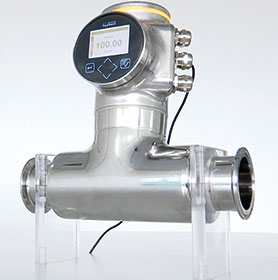
Development and field testing has covered the last two years, with a careful product release for suitable applications – typically initially used on low conductivity clean liquids, such as water for injection (WFI) in the pharmaceutical sector. Indeed one field test unit was installed in the supply line of a production filling system for infusion bags. Now, the Bürkert FLOWave range of flowmeters, covering DN15 to DN50 pipe sizes, is fully available for sale. This range of sizes covers the smaller bores typical of industrial requirements, in contrast to the larger ultrasonic flowmeters available from other suppliers. FLOWave is designed for hygienic use, and certified to EHEDG and 3A standards. The pipe has hygienic style end connections, and is internally finished to 0,8 or 0,4 microns: it is fully CIP and SIP tolerant, and indeed has been used to control CIP cycles, as the unit also provides a temperature measurement of the flowing liquid. It uses four SAW transducers, two on each side of the sensor pipe section, therefore acting as a dual path flowmeter. Flow measurement performance over the range 1-10 m/sec flow velocity is 0,4% of reading.
The latest development work has introduced density measurement and an acoustic transmission monitor parameter, which allow indications of the viscosity, bubble and suspended solids content of the liquid. This is useful in CIP process control, and also for monitoring milk in the dairy, during filtration. Bürkert claim an advantage over other styles of flowmeter, in that the unit is small and light in weight when used on a skid. Other applications now being investigated are for wort concentration monitoring in breweries, and homogenisation control in paint manufacture. Highly viscous liquids, such as glue, are also being monitored, where the full bore obstruction-free design is important.

Nick Denbow spent 30 years as a UK-based process instrumentation marketing manager, and then changed sides – becoming a freelance editor and starting Processingtalk.com. Avoiding retirement, he published the INSIDER automation newsletter for five years, and then acted as their European correspondent. He is now a freelance Automation and Control reporter and newsletter publisher, with a blog on www.nickdenbow.com






© Technews Publishing (Pty) Ltd | All Rights Reserved
 printer friendly version