HMI systems for marine engine room operation
August 2017
System Integration & Control Systems Design
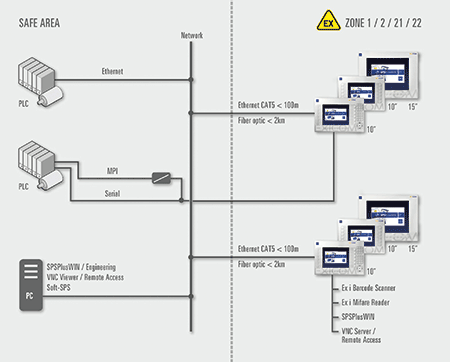
The operating conditions in an engine room posed a particular challenge to the design of an HMI system. These conditions necessitated a closed explosion-protected system that would also be able to withstand the tough marine environment. Flexible panel PC systems using R. Stahl’s Eagle platform will now be used onsite as the ship’s new operating and monitoring systems. With the right interfaces for the application and useful connection options, the series is an asset to both the current and future communication solutions.
These devices also make automation technology easier to use. If the sensors in the engine room below decks need to be recalibrated, for example, this can be carried out onsite on the new operating device.
Designed for maritime use
Panel PCs using the Eagle device platform, with display sizes ranging from 10” to 19”, have DNV, Lloyd’s Register, ATEX, IECEX and ABS certification for use worldwide in hazardous areas and on ships. They are resistant to corrosive gases in accordance with ISA 71.4 G3, have IP66 protection, as well as being vibration-resistant and shockproof.
Their state-of-the-art quad-core processors make them universally suitable for the operation of machinery and processes, as well as in filling stations. All HMIs come with a touchscreen as standard. The 15” device can optionally be fitted with an innovative, sunlight-readable display. The control panel’s add-on modules are able to withstand ambient temperatures ranging from -20 to 55°C. The operating stations, integrated in enclosures, are able to withstand ambient temperatures of between -30 and 50°C, and can be configured in numerous ways.
The seawater resistant materials and the vibration resistant design of the HMI systems, coupled with adequate EMI resistance, make these systems a reliable, durable choice for maritime applications. Owing to the tough conditions in these operating environments, solid state drives (SSDs) are used because they are physically more rugged.
Modular explosion protection
Unlike some standard version panel PCs, the Eagle platform is composed of modules that are individually protected against explosions, allowing users to maintain the devices themselves by swapping out specific individual assemblies as needed. The optimal type of protection for each module has been used: the display module has Ex m protection, others such as CPUs and power supplies have Ex d protection, and connection PCBs feature either Ex e or Ex i protection.
An Ex e ‘increased safety’ terminal box has connection ports for USB 2.0 flash drives, mass storage devices which are very easy to swap out on these boxes. In addition to two standard USB 2.0 interfaces and two intrinsically safe USB 2.0 interfaces, these devices feature two serial ports, a copper or Fibre Optic/Ethernet interface, a connection for keyboards and trackballs (joysticks), and optional interfaces for barcode and card readers. The devices boast all-round IP66 protection and can also be installed as front panel add-on devices without additional protective measures, directly in hazardous areas.
For more information contact Preshan Moodliar, Stahl Esaco, +27 (0)11 608 3120, preshan@esaco.co.za, www.esaco.co.za
Further reading:
How certified industrial automation channels become co-creators in the AI era
Schneider Electric South Africa
System Integration & Control Systems Design
As industrial automation becomes software-driven and AI-enabled, the role of channel partners is shifting from equipment supply to outcome-based consulting, software integration and lifecycle services that require continuous certification and capability development.
Read more...
Why integration defines the next competitive edge in pulp and paper
System Integration & Control Systems Design
ABB’s Arvin Ramjee argues that fragmented automation, assembled from different suppliers at different stages of a plant’s lifecycle has become one of the pulp and paper industry’s most overlooked commercial risks, and that true integration, rather than surface-level connectivity, is what delivers measurable business value.
Read more...
Integrated automation enhances water treatment at dairy facility
Process Dynamics
System Integration & Control Systems Design
Process Dynamics delivered the electrical, instrumentation, control and automation integration for an advanced water treatment and reverse osmosis system at a major South African dairy processing facility, achieving a 50% reduction in the client’s water utility costs.
Read more...
Intelligent process control is reshaping cement production in Africa
System Integration & Control Systems Design
Advanced process control, predictive analytics and automation are helping African cement producers cut energy use and stabilise output as they contend with rising electricity costs and tighter margins.
Read more...
Schneider Electric’s Alliance Programme turns system integrators into trusted technology partners
Schneider Electric South Africa
System Integration & Control Systems Design
: Schneider Electric’s Alliance Partner Programme is helping system integrators across Africa move beyond one-off projects and build the skills and service models needed to become long-term industrial technology partners.
Read more...
Process Dynamics – Integrated Automation for Dairy Water Treatment
Process Dynamics
System Integration & Control Systems Design
Project and industry
Process Dynamics delivered the electrical, instrumentation, control and automation integration for an advanced water treatment and Reverse Osmosis (RO) system at one of South Africa’s
...
Read more...
New SI programme strengthens Schneider Electric’s partner ecosystem
Schneider Electric South Africa
System Integration & Control Systems Design
Schneider Electric’s SI Energise 2.0 programme offers system integrators a competency-based framework to develop deeper expertise in EcoStruxure and AVEVA software, enabling them to deliver full-lifecycle industrial automation solutions.
Read more...
AI and smart solutions for underground proximity detection systems
System Integration & Control Systems Design
Booyco Electronics explains why fitting proximity detection systems underground is far more complex than installing sensors, and how integration, data and intelligent analytics are helping mines manage the challenge.
Read more...
Why cloud-ready BMS is reshaping building operations
Schneider Electric South Africa
System Integration & Control Systems Design
Smart sensors and non-contact radar are reshaping industrial measurement, feeding connected platforms that predict failures before they happen.
Read more...
Flotation system modernisation for a gold processing and mineral recovery plant.
Moore Process Controls
System Integration & Control Systems Design
Moore Process Controls has successfully modernised a gold processing plant's flotation control system, replacing obsolete I/O hardware with Schneider Electric's latest M580 X80 platform.
Read more...










 printer friendly version