



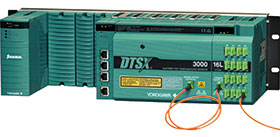
Yokogawa’s latest distributed temperature sensing DTSX3000 solution has set a new standard for the market. Its performance, distance measured, price and functionality, collectively reduce operating costs, increase production and ensure peace of mind for plant owners and operators.
What is distributed temperature sensing?
Distributed temperature sensing (DTS) measures temperature distribution over the length of an optical fibre cable using the fibre itself as the sensing element. Unlike traditional electrical temperature measurement technologies (i.e. thermocouples and RTD), the length of the fibre optic cable is the temperature sensor. Distributed temperature sensing can provide thousands of accurate and precise temperature measurements over a long distance. Compared to traditional electrical temperature measurements, distributed temperature sensing technology presents a cost effective methodology for accurate and high-resolution temperature measurement.
How does it work?
Yokogawa’s DTSX3000 measures temperature and distance over the length of an optical fibre using the Raman scatter principle. A pulse of light (laser pulse) launched into an optical fibre is scattered by the glass molecules as it propagates down the fibre and exchanges energy with lattice vibrations. As the light pulse scatters down the fibre optic cable, it produces stokes signals (longer wavelengths) and anti-stokes (shorter wavelengths) signals. The intensity ratio of the two signal components depends on the temperature at the position where the Raman scatter is produced. This temperature can then be determined by measuring the respective intensities of the stokes and anti-stokes signals. Furthermore, part of the scattered light, known as the backscatter, is guided back towards the light source. The time it takes for the backscatter to return to the light source is used to determine the position of the temperature reading.
Why Yokogawa’s DTSX?
Cost effective: for applications that require numerous temperature points to be measured, it becomes expensive to wire each individual sensor back to a data acquisition station. It therefore becomes much more cost effective and beneficial to acquire accurate and high resolution temperature measurement using distributed temperature measuring technology.
Long distance: it is normally difficult to measure temperature over a long distance using traditional electrical measurement sensors. Apart from the DTSX fibre optic cable having the potential of being deployed over long distances, it can also provide a high-resolution profile, accurate and precise temperature measurement over the measured distance. Yokogawa’s DTSX3000 can measure temperatures up to 50 km.
Reduced electromagnetic interference: like most fibre installations, the DTSX fibre signals are unaffected by electromagnetic interference. As a result, the DTSX technology ensures a more stable and accurate temperature measurement solution even in high electromagnetic environments.
Compact and low power consumption: there are applications (i.e. heap leaching and pipeline leak detection) where installations are isolated from the main plant. For such installations, it becomes costly to supply power to process measurement/control systems. Yokogawa’s low-power autonomous controller Stardom FCN-RTU (field control node remote terminal unit) is the perfect solution. The solar powered, remote terminal unit can be used as the main control system and provides power to the DTSX in such remote applications.
Protection against harsh environments: the outer jacket of the temperature measuring fibre cable can be made from different materials depending on the installation environment. In extreme cases, such as heap leaching where sulphuric acid is used to grow the much needed bacterial colony, the fibre cable can be stainless steel wire armoured to protect it against the corrosive and acidic environment.
General specifications
Yokogawa offers two DTS versions, namely the DTSX3000 and DTSX200. Both products can operate between -40 to 65°C making them ideal for extreme temperature applications. The temperature sensing fibre cable can measure between -220 and 800°C. The DTSX200 version can measure up to 6 km while the DTSX300 can measure up to 50 km and both versions have a spatial distance resolution of 1 m.
Applications
Cable rack monitoring: the temperature measuring fibre cable can be easily deployed along cable tunnels, ducts, trays or rack systems where heat build-up could potentially be a fire hazard, or indicate a conductor over-temperature.
Conveyor system safety monitoring: the DTSX can be used to detect heat build-up along conveyor systems indicating mechanical component failure or potential fire conditions.
Pipeline leak detection: thermal profiles can be used to detect leak locations along pipelines where escaping content creates a thermal variance from normal background temperatures.
Furnace chamber skin temperature monitoring: the DTS technology is well suited to detect furnace chamber or reactor vessel liner deterioration when installed to monitor and profile external wall surface temperatures.
Tunnels, shafts, decline heat and fire detection: excessive heat build-up or fire can be detected and located in tunnels, mining declines and shafts by deploying DTSX systems. Such installation can contribute to shortened emergency response times.
DTS technology is also commonly used for temperature measurement in the bioleaching process where bacteria is used to extract minerals from a heap of ore. It therefore becomes crucial to have suitable and cost effective technology to measure temperature at multiple points and the DTSX becomes the preferred solution for such applications.
For more information contact Christie Cronje, Yokogawa South Africa, +27 (0)11 831 6300, info@za.yokogawa.com, www.yokogawa.com/za
| Tel: | +27 11 831 6300 |
| Email: | yma.info-za@yokogawa.com |
| www: | www.yokogawa.com/za |
| Articles: | More information and articles about Yokogawa South Africa |






© Technews Publishing (Pty) Ltd | All Rights Reserved
 printer friendly version