



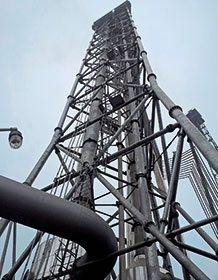
Natural gas flare stacks are used in the petrochemical industry to burn off any gas that is produced in the production plant. These natural gas flare stacks process the flare gas and other exhaust gases, and ensure the safety and stability of the entire process.
Customer requirement
The plant of a major Chinese coal company produces 400 000 tons of acetic acid a year. Flare stacks play a particularly important role here in ensuring the safety of the entire plant. During the production of acetic acid, excess gases must be flared off during specific process incidents. Otherwise the entire plant would be facing an incalculable risk. Conventional natural gas required to ignite the gas flare is also present in the gas flare stack, as well as other explosive gases. Intrinsically safe electronic components must be used in the hazardous area at the flare stacks.
A wide range of different field instruments, such as pressure and temperature transmitters, level transmitters, gas detectors, valve controls, solenoid valves, and other instruments, are used at the gas flare stacks. In all, 44 measuring signals (sensor signals) and 39 control signals (actuator signals) have to be connected in the field to the DCS. In order to ensure the interference immunity of the signals, the customer required galvanic isolation of the individual signals.
The enormous safety relevance of the gas stacks meant that the plant owner placed a great deal of importance on the standard and quality of the electrical components used. However, these components also had to be cost efficient and easy to maintain in spite of the high level of quality and reliability required. The gas flare stacks required the use of intrinsically safe technology due to the explosion protection specified.
The customer also required a redundant connection for the communication between the flare stacks and the DCS. As the flare stacks were located far away from the DCS, it must also be ensured that the data reaches the control system fast enough and vice versa in spite of the long signal distance involved.
Perfect combination
The customer uses two excom remote I/O stations from Turck for the connection of the 83 signals of the gas flare stacks. The system fully meets all the customer›s requirements: The remote I/O station is compact, easy to install and can be implemented with explosion protection in Zone 1. excom can also be implemented with a redundant communication and power supply in order to provide the required level of failsafe performance. The customer was also impressed by the optocouplers used, which enabled the required communication speed to the DCS to be achieved. The optocouplers transfer the Profibus signal to the fibre optic cable for the long transmission section.
An excom station consists of the module rack, power supply unit, gateway and the individual I/O modules. With its diverse I/O modules the system offers outstanding performance and high channel density. With its safety barrier function, the I/O system can connect intrinsically safe field devices directly as the associated equipment. Unlike the standard I/O systems available which are isolated in groups, all I/O of excom come with integrated galvanic isolation for each individual input and thus provide the level of interference immunity required by the customer without the need for external signal isolators.
The excom system uses Profibus DP, a mature and reliable bus protocol which can transfer detailed diagnostic data as well as controlling and monitoring the field instruments. A redundant communication connection and power supply is provided throughout: starting with the power supply units and the gateways, to the optocouplers, right through to the redundant implementation of the DP communication modules of the DeltaV DCS from Emerson. If a field device fails, this is indicated by the DCS or the LED on the excom station. The technicians on site can swap the appropriate device during operation, which ensures that the communication with the field devices is absolutely reliable and fail-safe.
Conclusion
Compared to some other remote I/O solutions, the Turck option was more user-friendly, efficient and reliable for use at the gas flare stacks. The modular structure of excom reduces error sources and considerably simplifies maintenance as well as system expansion. These were the key benefits for the customer.
For more information contact Brandon Topham, RET Automation, +27 (0)11 453 2468, brandon.topham@retautomation.com, www.retautomation.com
| Tel: | +27 11 453 2468 |
| Email: | sales@turckbanner.co.za |
| www: | www.turckbanner.co.za |
| Articles: | More information and articles about Turck Banner Southern Africa |






© Technews Publishing (Pty) Ltd | All Rights Reserved
 printer friendly version