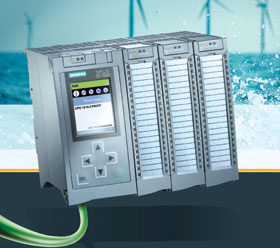
The Siemens Industry Automation Division has developed a new controller for extreme environmental conditions. Siplus S7-1500 has the same performance characteristics as the newest standard controller family Simatic S7-1500 for mid-level and high-end machine and plant automation. Other features of the new controller are reliable operation under extreme medial loads such as humidity, corrosive vapours, salts or dust. In an extended temperature range, the Siplus S7-1500 functions reliably during cold starts as well as in continual operation. This saves energy costs as no additional air conditioning is necessary.
Robust, enhanced modules make it possible to use the system everywhere, from offshore plants and harsh industrial environments to applications at extreme altitudes. The new device is protected against condensation and corrosive gasses, as well as aggressive and saline atmospheres. The Siplus S7-1500 controller has the same performance and efficiency characteristics as the Simatic S7-1500, the new standard controller generation from Siemens. Its characteristic features include outstanding system performance and a host of functions integrated as standard, including motion control, security for maximum possible plant security and safety for safety applications that are easy to implement. Greater efficiency is represented in particular by the innovative design for simple commissioning and safe operation, the configurable diagnostic functions for the plant status and the integration into the TIA Portal for simple engineering and low project costs.
Upgrading alarm systems for critical industries Omniflex Remote Monitoring Specialists
PLCs, DCSs & Controllers
Omniflex’s OMNI16R alarm annunciator platform provides a direct replacement for legacy CSA systems such as MPAS 90 and SA9100, enabling operators in oil and gas, nuclear and power generation to modernise alarm infrastructure without sacrificing the clarity required for safe operations.
Read more...How DCS can step off the hardware obsolescence treadmill Schneider Electric South Africa
PLCs, DCSs & Controllers
Schneider Electric argues that virtualising DCS environments breaks the cycle of hardware obsolescence, giving plant operators a smarter path to lifecycle modernisation without production disruption.
Read more...Loop signature Part 2-6
PLCs, DCSs & Controllers
The Loop Signature series turns to frequency plot theory, explaining Bode open-loop plots and how dynamic gain, phase lag and crossover frequency can be extracted from test data to inform more accurate control loop tuning.
Read more...Luna Rossa partners with Siemens for 38th America’s Cup Siemens South Africa
IT in Manufacturing
Siemens details how Luna Rossa is using digital engineering and simulation tools, from CAD to structural optimisation, to design a faster yacht for the 38th America’s Cup.
Read more...Advancing high-performance motorsport design Siemens South Africa
IT in Manufacturing
Siemens explains how its simulation software is helping motorsport engineering group ORECA speed up vehicle design and optimise composite structures for its Le Mans hypercar programme.
Read more...PC-based control in surgery Beckhoff Automation
Editor's Choice PLCs, DCSs & Controllers
Researchers at the University of Basel are using Beckhoff PC-based control technology to develop a miniature laser robot for minimally invasive bone surgery.
Read more...Siemens and HighByte partner to scale industrial AI Siemens South Africa
IT in Manufacturing Fieldbus & Industrial Networking
Siemens is expanding its Industrial Edge ecosystem through a partnership with HighByte, enabling customers to connect, contextualise and transform data from operational technology and information technology sources to build AI models and applications at scale.
Read more...How the DCS can step off the hardware obsolescence treadmill Schneider Electric South Africa
PLCs, DCSs & Controllers
Ageing servers and unsupported operating systems are quietly eroding the stability of process plants that rely on distributed control systems. Kobus Vermeulen of Schneider Electric explains how virtualising the DCS environment can break the hardware obsolescence cycle without disrupting operations.
While every effort has been made to ensure the accuracy of the information contained herein, the publisher and its agents cannot be held responsible for any errors contained, or any loss incurred as a result. Articles published do not necessarily reflect the views of the publishers. The editor reserves the right to alter or cut copy. Articles submitted are deemed to have been cleared for publication. Advertisements and company contact details are published as provided by the advertiser. Technews Publishing (Pty) Ltd cannot be held responsible for the accuracy or veracity of supplied material.










 printer friendly version