February 2008Analytical Instrumentation & Environmental Monitoring
Measuring concentrations is a routine task in the process industry. There are currently various processes available for measuring the concentration of two-component mixtures of immiscible liquids. From the most common, taking a sample and analysing it in the laboratory, to measurement of density, refraction index, optical absorption, or online analysis.
Automated measurement of concentration in two-component mixtures
Thanks to research carried out by Krohne, there is now another measurement method using the latest time domain reflectometry (TDR) level meters, which relies on the dielectric constant. Finding the dielectric constant of two-component mixtures makes it possible to calculate the proportion of each constituent.
According to Krohne the cost of a TDR level meter is considerably lower than that of the other processes, as much as 10 times lower in the case of online analysis devices, it is an economical and efficient alternative.
TDR level meters are maintenance free, have no moving parts and can also work with suspensions, such as Xylene and water. In this case the Optiflex can also be used for recognising separate layers, for example separations in the batch process.
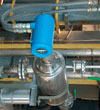
Krohne carried out successful tests at a well-known chemical company in Italy for this method of concentration measuring for two-component mixtures using a TDR level meter. The technicians installed the meter at the outlet for a continuous Xylene distillation unit. A water washing tower is positioned before the distillation column, so that there is still water in the distilled Xylene. Until now the company had been taking a sample every 8 hours and calculating the water content in the laboratory using the Karl-Fischer process.
To save these costs, and to have a continuous analysis, the chemical company decided to measure the dielectric constant using a TDR level meter. First of all a calibration unit was set up, to create a calibration curve. After the concentration curve for water in Xylene was created, the meter was installed into the system. For a relatively small investment, the company has managed to make sampling and laboratory analysis for every shift redundant. Continuous measurement also has clear benefits for process control.
Importance of gas analysis in the petrochemical industry Elemental Analytics
Analytical Instrumentation & Environmental Monitoring
Gas analysis plays a critical role in petrochemical operations, supporting process optimisation, product quality and plant safety. As an experienced and expert gas analysis supplier, Elemental Analytics can provide the correct analyser and sample system package to meet individual plant requirements.
Read more...Fully integrated standalone thunderstorm warning system Senseca
Sensors & Transducers Analytical Instrumentation & Environmental Monitoring
Senseca South Africa has introduced its BTD-1 fully integrated, standalone thunderstorm warning system, which detects lightning by monitoring the background quasi-electrostatic field. The system can generate alerts before the first lightning strike, with a detection raterange of up to 83 km.
Read more...Environmental monitoring with testo Saveris 1
Analytical Instrumentation & Environmental Monitoring
The testo Saveris 1 environmental monitoring system has been in continuous use since 2010 at Jungbunzlauer, a biotechnology company in Germany, providing seamless temperature and humidity data for audit-ready, GxP-compliant processes across laboratories, warehouses and production areas.
Read more...Reliability restored through systemic vibration analysis Wearcheck
Analytical Instrumentation & Environmental Monitoring
Condition monitoring specialist, WearCheck uses a variety of testing techniques to enhance reliability in machinery components and prevent failures.
Read more...Meteorological data logger with up to 32 analogue sensors Senseca
Analytical Instrumentation & Environmental Monitoring
Senseca has introduced its advanced data acquisition system for environmental monitoring, which has a universal data logger for up to 32 analogue, pulse and smart digital sensors.
Read more...Yokogawa’s free chlorine analyser is gold standard for water treatment utilities Yokogawa South Africa
Analytical Instrumentation & Environmental Monitoring
One of the key factors in ensuring safe drinking water is the accurate monitoring of free chlorine residuals. This is where advanced online analysers, such as Yokogawa’s FC800 free chlorine analyser, are becoming increasingly valuable for water treatment operators and municipal utilities.
Read more...Cooling tower bleed control
Analytical Instrumentation & Environmental Monitoring
Cooling towers rely on evaporation to remove heat, but this process also concentrates dissolved solids in the system. Left unmanaged, this buildup can lead to scaling, corrosion and fouling, reducing efficiency and increasing maintenance costs.
Read more...Filters for zero-alcohol wine Parker Hannifin - Sales Company South Africa
Analytical Instrumentation & Environmental Monitoring
The market for zero-alcohol wine is creating fresh opportunities for wine producers, but processing these products creates new contamination challenges. Technical support from an established filtration specialist, such as Parker, can help wineries in overcoming the challenges posed by the increased risk of contamination.
Read more...Remote monitoring solution for sewage plants ifm - South Africa
Analytical Instrumentation & Environmental Monitoring
With ifm’s remote monitoring solution, you can visualise the condition of the submersible pumps in your sewage plant and diagnose issues before they become serious problems.
While every effort has been made to ensure the accuracy of the information contained herein, the publisher and its agents cannot be held responsible for any errors contained, or any loss incurred as a result. Articles published do not necessarily reflect the views of the publishers. The editor reserves the right to alter or cut copy. Articles submitted are deemed to have been cleared for publication. Advertisements and company contact details are published as provided by the advertiser. Technews Publishing (Pty) Ltd cannot be held responsible for the accuracy or veracity of supplied material.










 printer friendly version