GSM/GPRS module simplifies design
September 2007
Fieldbus & Industrial Networking
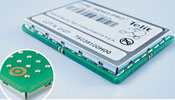
Telit Wireless Solutions recently unveiled the newest addition to its GE product family, the GE863-PRO3 module. Equipped with two powerful microprocessors, this quad-band module is suited for a wide range of applications requiring high processing power. With the same form factor as the compact GE863, tried-and-tested BGA mounting technology and an integrated memory for software applications, the GE863-PRO3 also offers significant cost benefits for the development and production of complex machine-to-machine (M2M) solutions. The module will be available during the fourth quarter 2007.
Thanks to its integrated ARM9 processor, software applications can take full control of the CPU, while the GPRS-based band processor handles time-critical communication tasks. The module can be programmed in Python and C++ programming languages.
"With the GE863-PRO3, Telit becomes the first M2M supplier to offer a dual core concept with independent processors for communication operations and customer realtime applications. This is a crucial advantage over comparable rival products where all applications run on a single CPU," says Dominikus Hierl, president of Telit Wireless Solutions.
The powerful ARM9 processor enables control of realtime applications that require up to 200 MIPS. The Telit GE863-PRO3 is therefore ideally suited to applications requiring high processing power such as point-of-sale terminals, fleet management systems and multimode automated meter reading (AMR) applications.
With its external dimensions of just 41 x 31 x 3,6 mm, the GE863-PRO3 is particularly suitable for applications where a compact form is important.
Fast upgrades and interfaces
Thanks to its integrated FOTA (firmware over the air) solution, the GE863-PRO3 offers the benefits of remote software updates. This function enables system integrators and developers to ensure that the firmware of the product can be upgraded with the latest enhancements and features.
In addition to wireless installation of firmware upgrades, the module also features the following interfaces: SPI, IIC, SD/MMC and USB, allowing reliable connectivity with peripheral hardware or software such as a camera, keyboard, display, WiFi, Bluetooth or ZigBee.
For more information contact Jacqui Saul, RF Design, +27 (0)21 555 8400, sales@rfdesign.co.za, www.rfdesign.co.za
Further reading:
Isolated Modbus gateways with built-in Wi-Fi for industrial IoT applications
Vepac Electronics
Fieldbus & Industrial Networking
Vepac Electronics offers the Sielco Sistemi SS10680 series of isolated Modbus gateways with built-in Wi-Fi, providing three configurations for industrial data acquisition: cloud publishing via MQTT, local USB and FTP logging, and straightforward Modbus TCP to Modbus RTU conversion.
Read more...
XPlanar aids innovation in laser processing
Beckhoff Automation
Fieldbus & Industrial Networking
Aalborg University is among the first in the world to test Beckhoff’s XPlanar intelligent transport system in advanced laser processes, opening the door to faster, tool-free production of metal parts.
Read more...
Belden expands edge computing portfolio with ProLinx Edge Gateway
Fieldbus & Industrial Networking
Belden has released the ProSoft Technology ELX3 ProLinx Edge Gateway, combining operational technology protocol conversion with Docker-based edge application hosting on a single ruggedised hardware platform for deployment in harsh industrial environments.
Read more...
Anybus Communicators are CRA-ready
Industrial Data Xchange (IDX)
Fieldbus & Industrial Networking
HMS Networks has upgraded its Anybus Communicator range to meet new EU cybersecurity rules, giving industrial manufacturers and integrators an easier path to compliance.
Read more...
Remote I/O modules provide flexible options for distributed applications
Fieldbus & Industrial Networking
Dinkle International is now stocking the iO-GRID NEMO industrial-grade remote input/output modules, offering support for five leading industrial Ethernet protocols and a range of discrete channel configurations for distributed automation applications.
Read more...
Local energy solutions rewiring resilience across Africa
News Fieldbus & Industrial Networking
Engineers across Africa are developing practical, scalable energy and mobility solutions supported by the Africa Prize for Engineering Innovation.
Read more...
Daudin expands fieldbus modular remote I/O series
Fieldbus & Industrial Networking
: The Dinkle iO-GRID X modular remote I/O family is now available, offering fieldbus coupler modules for major industrial Ethernet protocols, and over 20 types of I/O modules to help integrators and equipment builders create flexible, efficient control systems.
Read more...
Siemens and HighByte partner to scale industrial AI
Siemens South Africa
IT in Manufacturing Fieldbus & Industrial Networking
Siemens is expanding its Industrial Edge ecosystem through a partnership with HighByte, enabling customers to connect, contextualise and transform data from operational technology and information technology sources to build AI models and applications at scale.
Read more...
Automotive Ethernet media converter
Fieldbus & Industrial Networking
HMS Networks has introduced its first automotive ethernet product under the PEAK brand. The PAE-Media Converter is a compact device designed to connect automotive Ethernet (100BASE-T1 or 1000BASE-T1) with standard Ethernet (100BASE-TX or 1000BASE-T) networks.
Read more...
3D electrical systems design workflow for electromechanical innovation
Siemens South Africa
Fieldbus & Industrial Networking IT in Manufacturing
Siemens has announced new 3D electrical design capabilities within its Capital software, enabling electrical and mechanical engineers to work concurrently in a shared 3D environment to reduce late-stage design changes and accelerate time to market for complex electromechanical products.
Read more...










 printer friendly version