


Fieldbus & Industrial Networking


Gateways for linking different networks

September 2004 Fieldbus & Industrial Networking

Over the past decade automation systems have continued to increase in overall power while at the same time attempting to offer simplicity to the user in terms of configuration and flexibility. Although these systems give the users more options and finer control of their processes, linking to existing or legacy systems for additional control or information can become problematic. Taking the better of one technology (for example controllers) and trying to marry it up with the best of another type of technology (field instrumentation) can become a nightmare for project managers and system integrators. Allowing certain sections of process to carry on running, while new plant is installed is also, in many cases a requirement and critical to production.

What is touted as the ideal solution by North American vendors is not seen that way by vendors from Europe or the Far East and vice versa. Many vendors try to protect their own investment by making it almost impossible for users to communicate to alternate suppliers' equipment. This can then force the customer into buying technology not entirely suitable to the application or alternately, having makes and models from multiple vendors, when they were trying to standardise on one type of system.

Industrial Ethernet, fieldbus versions (in all their different guises), serial protocols, as well as proprietary industrial networks are prevalent throughout the whole of industry. In all fairness each has its rightful place at various levels of the networking layers. All of them do the task they were intended to do. However, some clients live with underperforming control systems due to bottlenecks in data handling. These can be the result of over enthusiastic salesmen or through a misunderstanding of what is actually required.

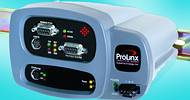
To handle the above types of difficulties, as well as allowing for general interfacing between different network topologies, ProSoft Technology has released its series of ProLinx Gateways. These allow the user to implement interfacing between many of the industrial networks versions being used globally.

Oxley, a Cape Town-based system integrator, recently implemented such a system for the Cape Metropolitan Council (CMC), at its Faure Water Treatment Works.

CMC Faure uses an extensive Modbus Plus Comms network throughout the plant. This network interconnects 33 x Modicon PLC devices and eight x Adroit scada operator stations. CMC recently installed an intelligent centrifuge controller device to further improve its dewatering process as part of the sludge handling facility. The Centrifuge Controller is equipped with a Profibus communication interface. CMC investigated a method of integrating this controller with the rest of the control systems Modbus Plus network.

A 4304-PDPM-MBP ProLinx Gateway, supplied by Throughput Technologies, was used to provide a direct link to the intelligent centrifuge controller. This gave CMC the connection it required with the added benefits of simple installation and integration and full access to many parameters not possible using more traditional discrete signal wiring techniques.

By connecting via the ProLinx gateway, directly from the controller to the MB+ network, the local centrifuge PLC is able to control and access information, while in addition the central control room scada system can also interrogate the device for monitoring (display, alarm, trending and logging). This was done with no need for PLC program modification.

The ProLinx Gateway was commissioned within a day without the need to purchase any additional programming/configuration software or programming hardware or tools. The ProLinx Gateway was configured using simple data terminal software (such as HyperTerminal) running on a standard PC/Laptop.

The family of ProLinx gateways allows connectivity between many dissimilar protocol types. There are currently 144 different combinations of gateways that can establish links between 10 different serial, five different Ethernet and six different speciality protocols (including Profibus, Modbus Plus, Allen Bradley Remote I/O and HART).

For more information contact Bob Petrie, Throughput Technologies, 011 705 2497, [email protected], www.throughput.co.za


Credit(s)


Share this article:
Share via emailShare via LinkedInPrint this page

Further reading:

Why secure industrial communication depends on deployment as well
Fieldbus & Industrial Networking
The Industrial Security Harmonisation Group has released a joint industry perspective highlighting a critical truth in industrial cybersecurity: secure communication is not determined by protocols alone, but by how they are deployed and managed in real-world environments.

Read more...
A single platform for all automation functions
Beckhoff Automation Fieldbus & Industrial Networking
The introduction of TwinCAT in 1996 marked a decisive evolutionary step for PC-based control. Today, the TwinCAT platform combines all automation functions in a strictly deterministic real-time environment, from PLC and motion control through CNC and measurement technology and beyond, to vision, robotics and pioneering AI tools.

Read more...
Loop signature Part 2-4: Feedforward Control: Part 3
Michael Brown Control Engineering Editor's Choice Fieldbus & Industrial Networking
In the previous articles in this series, the basic theory behind feedforward control was discussed, and it was also shown how to apply feedforward in practice. In this article, it will be shown how well feedforward can work in practice by giving a couple of examples.

Read more...
Control Station and Dimension Software partner to connect control performance monitoring with enterprise operations intelligence
Fieldbus & Industrial Networking
Control Station has entered into a strategic technology partnership with Dimension Software, a leading provider of industrial operations management platforms. The collaboration connects Control Station’s PlantESP control loop performance monitoring platform with Dimension Software’s Asset Intellect operations intelligence environment, enabling manufacturers to operationalise control performance insights across their organisations.

Read more...
PCIe digitiser cards for optimal GHz signal acquisition and analysis
Vepac Electronics Fieldbus & Industrial Networking
The addition of two new PCIe Digitiser cards from Spectrum Instrumentation extends the company’s flagship M5i series to deliver optimal GHz signal acquisition and analysis capabilities.

Read more...
Precise, synchronised control for automated steel mesh handling system
Fieldbus & Industrial Networking
Automation specialist Hambi Maschinenbau has developed a world-first system that automates the cutting, handling and stacking of heavy reinforcing steel mesh – a task that previously required up to six human operators.

Read more...
Loop signature Part 2-3: Feedforward Control: Part 2
Michael Brown Control Engineering Editor's Choice Fieldbus & Industrial Networking
Feedforward control tuning is not nearly as critical as feedback tuning, and fairly simple models are usually fine for the purpose in hand.

Read more...
Upgrading radiological surveillance systems in nuclear facilities
Omniflex Remote Monitoring Specialists Fieldbus & Industrial Networking
Nuclear plant operators face an uncomfortable reality. Many of the control and monitoring systems still in use today were never designed to support the full operational lifespan of the facilities they serve.

Read more...
Next-level CAN Software enables easy access to CAN XL
Industrial Data Xchange (IDX) Fieldbus & Industrial Networking
With the release of its PCAN-Explorer 7, PEAK delivers a major update that adds full support for CAN XL, multiple symbol files per connection, Python scripting and flexible licensing including floating licenses.

Read more...
Loop signature Part 2-2: Feedforward Control: Part 1
Michael Brown Control Engineering Fieldbus & Industrial Networking
Feedforward control is a powerful technique that can dramatically improve control variance in cases where load changes cause big deviations from setpoint and the actual process dynamics are too slow to allow the feedback controller to operate fast enough to catch these disturbances.

Read more...


While every effort has been made to ensure the accuracy of the information contained herein, the publisher and its agents cannot be held responsible for any errors contained, or any loss incurred as a result. Articles published do not necessarily reflect the views of the publishers. The editor reserves the right to alter or cut copy. Articles submitted are deemed to have been cleared for publication. Advertisements and company contact details are published as provided by the advertiser. Technews Publishing (Pty) Ltd cannot be held responsible for the accuracy or veracity of supplied material.


© Technews Publishing (Pty) Ltd | All Rights Reserved

