


Analytical Instrumentation & Environmental Monitoring


Realtime mineral quantifier

July 2004 Analytical Instrumentation & Environmental Monitoring

Blue Cube Systems is offering a new mineral quantifier. The MQi is designed for installation directly into a stream of dry minerals.

Making use of Blue Cube's unique MMMC (minute-by-minute mineral composition) technology, the MQi can determine the mineral composition in a mineral beneficiation plant circuit.

Pieter de Waal, executive director of the company, based in Technopark, Stellenbosch, says the information provides continuous feedback to operators and management - a valuable tool. "Being able to assess a plant's performance on a minute-by-minute basis makes it possible to substantially improve production efficiency and makes higher recoveries of the valuable minerals possible," he says.

Other benefits include improved plant stability, more consistent grade control and improved flow sheets. According to Francois du Plessis, co-inventor of the MQi, the MMMC technology is based on an optical scanner that detects the 'fingerprint' of minerals flowing through the in-line scanning head. "The complex optical signal is then processed by a spectrometer and converted to a digital format. The dedicated MMMC software, developed by Blue Cube Systems, compares the scan data to the previously stored optical profiles of the minerals expected to be present in the circuit. The MQi will typically display the mineral composition at least every minute and as frequently as every 10 seconds. This enables plant operators to adjust their mineral separation equipment for optimal performance. It also provides industry-standard output signals, which can be tied directly into a plant's scada (supervisory control and data acquisition) systems."
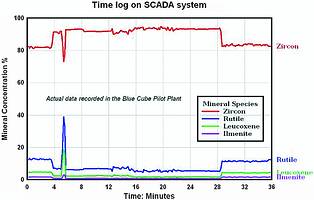
A time log of mineral concentrations captured in the Stellenbosch pilot plant

Most mineral beneficiation plants separate and concentrate minerals on the basis of some physical property, such as magnetic properties, conductivity, specific gravity or surface characteristics. De Waal says that it is difficult to quickly determine the composition of a mixture of minerals on the basis of physical properties. The laboratory procedures are too slow to provide adequate feedback or feed-forward for effective process control.

Conventional chemical or X-ray analytical techniques can determine the chemical composition very effectively, but provide very little information on physical characteristics - which are related to the mineral, not the chemical, composition. To date, reliable mineralogical analysis has only been possible through slow and expensive scanning electron microscope (SEM) techniques or by microscopic assessment. The MMMC technology is a substantial improvement on current systems and provides a valuable new tool that can effectively control and optimise mineral separation plants.
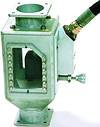
The MQi scanner head, ready to mount in a mineral transfer pipe

Project engineer and co-inventor Van Wyk du Plessis, who was responsible for developing the MQi, expressed great satisfaction with the final product. "Extensive field testing has shown that the careful selection of components and attention to detail in the MQi's robust design makes it eminently suitable for efficient operation in the harsh conditions encountered in an industrial plant."

Blue Cube Systems works hand-in-hand with each client's mineralogists and geologists to identify the types of minerals encountered in their operations. The relevant optical fingerprints are then captured in the MMMC calibration software. The MQi is equipped with a communications device - either a modem or a GPRS - through which remote calibration or software updates can be downloaded. The company offers an ongoing support programme to all clients. It also offers consulting services to assist clients in optimising their plants using MMMC technology. De Waal points out that the company still supplies the MQ-200 bench-top mineral quantifier, based on the same technology.

The MQi mineral quantifier is set to be officially released at the Mineral Processing 2004 conference at the Lord Charles Hotel, Somerset West from 4 to 6 August.

For more information contact Helani Schreuder, Blue Cube Systems, 021 886 7134, [email protected], www.bluecube.co.za


Share this article:
Share via emailShare via LinkedInPrint this page

Further reading:

AMETEK expands 993X gas analyser series with explosion-proof enclosures
Analytical Instrumentation & Environmental Monitoring
AMETEK Process Instruments has added ATEX and IECEx Zone 1-certified explosion-proof enclosures to its 993X series of gas analysers, enabling reliable installation in Zone 1 hazardous locations where purge gas is unavailable.

Read more...
Why medical device leak testing matters for South Africa's MedTech future
ATEQ South Africa Analytical Instrumentation & Environmental Monitoring
As South Africa works to grow local medical technology manufacturing, non-destructive leak and flow testing is becoming a strategic quality assurance tool, helping manufacturers verify device integrity, meet regulatory requirements and improve production efficiency.

Read more...
Moving forward with reverse osmosis
Analytical Instrumentation & Environmental Monitoring
Rising water costs and pressure on infrastructure are changing the way industries view reverse osmosis. G-Chem Aquacare is developing tailored, containerised solutions that make the technology more accessible for South African industry.

Read more...
Meteorological data logger with up to 32 analogue sensors
Senseca Analytical Instrumentation & Environmental Monitoring
Senseca has introduced its advanced data acquisition system for environmental monitoring, which has a universal data logger for up to 32 analogue, pulse and smart digital sensors.

Read more...
Importance of gas analysis in the petrochemical industry
Elemental Analytics Analytical Instrumentation & Environmental Monitoring
Gas analysis plays a critical role in petrochemical operations, supporting process optimisation, product quality and plant safety. As an experienced and expert gas analysis supplier, Elemental Analytics can provide the correct analyser and sample system package to meet individual plant requirements.

Read more...
Fully integrated standalone thunderstorm warning system
Senseca Sensors & Transducers Analytical Instrumentation & Environmental Monitoring
Senseca South Africa has introduced its BTD-1 fully integrated, standalone thunderstorm warning system, which detects lightning by monitoring the background quasi-electrostatic field. The system can generate alerts before the first lightning strike, with a detection raterange of up to 83 km.

Read more...
Environmental monitoring with testo Saveris 1
Analytical Instrumentation & Environmental Monitoring
The testo Saveris 1 environmental monitoring system has been in continuous use since 2010 at Jungbunzlauer, a biotechnology company in Germany, providing seamless temperature and humidity data for audit-ready, GxP-compliant processes across laboratories, warehouses and production areas.

Read more...
Reliability restored through systemic vibration analysis
Wearcheck Analytical Instrumentation & Environmental Monitoring
Condition monitoring specialist, WearCheck uses a variety of testing techniques to enhance reliability in machinery components and prevent failures.

Read more...
Yokogawa’s free chlorine analyser is gold standard for water treatment utilities
Yokogawa South Africa Analytical Instrumentation & Environmental Monitoring
One of the key factors in ensuring safe drinking water is the accurate monitoring of free chlorine residuals. This is where advanced online analysers, such as Yokogawa’s FC800 free chlorine analyser, are becoming increasingly valuable for water treatment operators and municipal utilities.

Read more...
Cooling tower bleed control
Analytical Instrumentation & Environmental Monitoring
Cooling towers rely on evaporation to remove heat, but this process also concentrates dissolved solids in the system. Left unmanaged, this buildup can lead to scaling, corrosion and fouling, reducing efficiency and increasing maintenance costs.

Read more...


While every effort has been made to ensure the accuracy of the information contained herein, the publisher and its agents cannot be held responsible for any errors contained, or any loss incurred as a result. Articles published do not necessarily reflect the views of the publishers. The editor reserves the right to alter or cut copy. Articles submitted are deemed to have been cleared for publication. Advertisements and company contact details are published as provided by the advertiser. Technews Publishing (Pty) Ltd cannot be held responsible for the accuracy or veracity of supplied material.


© Technews Publishing (Pty) Ltd | All Rights Reserved

