



The scenario in the past
The power generation industry has traditionally used a large variety of control platforms and instruments from different suppliers to monitor and control its plants. This was more by compulsion than by choice, due to various reasons which caused a power generation plant to look like a technical museum – with the operations and maintenance personnel having to face the brunt. Only in exceptional cases, were there ‘all round experts’ who were trained to tackle the challenges created by divergent technologies, and their OEMs.
Typically, many instruments and control systems remained black boxes, performing the desired functions for as long as they could. Having the necessary spares available for such a wide variety of instruments remained a concern and a challenge. The consequence of all these factors affected the plant’s operational efficiency and availability, while collectively affecting both the top and bottom lines of the power generation companies.
A change in the thought process
Several concepts emerged as counter measures which received popularity in the oil and gas industry. Firstly, complete due diligence is required to be done at the beginning of a project during the conception phase. This results in the selection of a main automation contractor (MAC). All package suppliers and EPC contractors are then directed to supply the same control system and the selected MAC vendor is also involved in designing the most efficient and ‘best fit’ solution for the plant. The MAC vendor actively participates during the front-end engineering design (FEED) stage and is an active stakeholder in the design and deployment philosophy of the plant. Instrument selection, control philosophy, plant and equipment protection, HMI and alarm design philosophy, amongst others, are developed by the MAC vendor in consultation with the plant owner and independent consultants.
However, in the case of older plants, the situation may be different. The instrument and control system suppliers can be given the complete turnkey responsibility of the instrumentation and control of the plant. This has been the case in most of the control and instrumentation rehabilitation initiatives Yokogawa has undertaken recently. Hence, these projects have historically received the benefit of a homogenous solution.
What are the benefits to the owner?
An holistic design approach offers several benefits to the owner versus a piecemeal approach:
• Active participation of the vendor in the FEED stage to optimise design.
• Uniformity in design and implementation.
• Maximising the benefits of automation and asset utilisation.
• Single window benefit for life cycle support services.
• Minimising inventory for spares.
• Streamlined training and resource management for maintenance staff.
• Improvement of operational excellence by utilising common productivity tools across instruments and control systems.
How is the market evolving?
Process control automation suppliers are experts in the field of instrumentation and process control. Products and services encompassing all aspects and levels, starting from level 1 through to level 3 are available from such suppliers. The solutions are developed, tested and enhanced continuously with active feedback from the customers (mainly end-users), while deploying the latest technology.
The instrumentation and control assets of any process plant (including power plants) are extremely important towards achieving direct benefits in terms of plant availability, improvement of operational efficiency and effectiveness, as well as the overall safety of the plant and its equipment.
The benefits of an integrated offering for instrumentation and control for the entire power plant, prompted control system suppliers to enhance their capabilities by offering an ‘end to end’ solution. Their technical superiority and range of solutions generally include basic measurement instrumentation, panel instruments and conventional control platforms like DCS, safety systems, PLC/RTU and scada. These capabilities are further expanded to include many new areas including asset management, operational excellence, advanced alarm analysis, operator training simulators, advanced control systems and optimisation, capabilities to integrate electrical monitoring and control systems (integration of IEDs through standard electrical device protocol – IEC61850), as well as turbo machinery control capabilities. This comes bundled with consultancy services for superior design.
The latest addition to the portfolio is the design and implementation service capability for another critical element of industrial automation and control – cyber security. In current times, it is extremely important to design and deploy network security measures compliant to international standards like ISA99/ IEC62443.
Thus the entire portfolio of solutions for instrumentation and control of critical facilities like power generation plants are best understood by the experts who own the responsibility of design and implementation.
Integrated solution: Yokogawa leads by example
Yokogawa’s products and solutions cover the entire spectrum of instrumentation and control at a power generation plant.
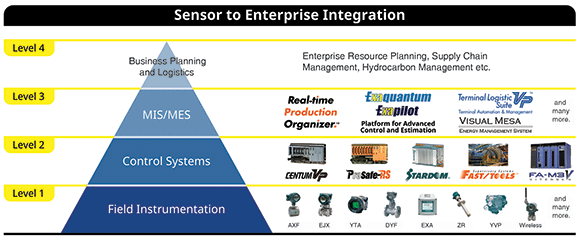
At level 1, the wide range of pressure, flow, temperature and level transmitters provide the basic building blocks of instrumentation. They are designed for fast response and high accuracy measurements, required for the critical control loops in a power plant. Apart from measuring the basic plant process parameters for monitoring and control, the transmitters are equipped with complete diagnostic functionality, made available through digital protocols like HART, Profibus and Foundation Fieldbus. They may be physically wired up to the plant DCS, or deployed using digital bus technologies. Yokogawa also provides a wide range of wireless transmitters using the latest ISA100 protocol.
Yokogawa engineers and consultants are available to help customers identify the optimal design and selection of technology and instruments. It also provides an integrated solution for steam water analysis systems, which is used to monitor the chemical quality of the water-steam cycle. In addition to liquid sensors, Yokogawa also provides an assortment of gas analysers, critical for use in gas density measurement, fuel quality measurement and complete continuous emission monitoring system.
Yokogawa’s level 1 range also includes test and measurement instruments (calibrators, oscilloscopes, power analysers and OTDRs), which are an integral part of the electrical and instruments laboratory.
The Centum VP DCS and Prosafe Safety System, as an integrated control and safety system, typically occupies level 2 of the pyramid. In some cases, a combination of Yokogawa’s PLC/RTU (Stardom/FA-M3) and scada (FAST/TOOLS) are also used, especially for small package control systems. In both cases, the integration of these platforms is seamless. Centum VP and Stardom are both equipped with fast-acting modules, capable of performing the special functions, required for turbine governor control and protection. The capability to integrate electrical IEDs in the power plants’ HV/MV/LV switchgear through IEC61850, results in Yokogawa’s control platform becoming an integrated platform for electrical monitoring and control systems.
At level 3, we find Yokogawa’s Exaplog, Exapilot and Exaquantum, which provide the asset excellence platforms for operator guidance, plant wide data historian and the plant information management system. Advanced alarm management software like AAS Suite further enhances the offering in this space.
Yokogawa’s team of network security experts’ design and supply solutions to make the entire control system secure to prevent against network intrusion or cyber attack.
Conclusion
Convergence of technologies and platforms are changing the scenario in all industries. Power generation plants can take advantage of the expertise of an industrial automation specialist company like Yokogawa to achieve significant benefits. A well-designed framework, supported by a wide range of products and services, provides the opportunity of a one-stop automation supplier reality today.
For more information contact Christie Cronje, Yokogawa South Africa, +27 (0)11 831 6300, [email protected], www.yokogawa.com/za
| Tel: | +27 11 831 6300 |
| Email: | [email protected] |
| www: | www.yokogawa.com/za |
| Articles: | More information and articles about Yokogawa South Africa |






© Technews Publishing (Pty) Ltd | All Rights Reserved
 printer friendly version