



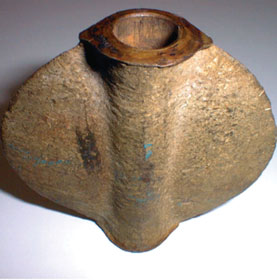
Corrosion is the gradual destruction of materials (usually metals) by chemical reaction with their environment. It comes in many different forms and can be classified by the cause of the chemical deterioration of a metal. Corrosion degrades the useful properties of materials and structures including strength, appearance and permeability to liquids and gases. It can be concentrated locally to form a pit or crack (localised corrosion), or it can extend across a wide area more or less uniformly corroding the surface (uniform attack corrosion).
Certain conditions, such as low concentrations of oxygen or high concentrations of species such as chloride, can interfere with a given alloy’s ability to re-form a passivising film. In the worst case, almost all of the surface will remain protected, but tiny local fluctuations will degrade the oxide film in a few critical points. Corrosion at these points will be greatly amplified, and can cause corrosion effects of several types, depending upon conditions.
Uniform attack corrosion, also known as general attack corrosion is the most common type of corrosion and is caused by a chemical or electrochemical reaction that results in the deterioration of the entire exposed surface of a metal. Ultimately, the metal deteriorates to the point of failure. This kind of corrosion accounts for the greatest amount of metal destruction by corrosion, but is considered as a safe form of corrosion, due to the fact that it is predictable, manageable and often preventable.
Unlike uniform attack corrosion, localised corrosion specifically targets one specific area of the metal structure, ending up as pitting, crevice corrosion or stress corrosion cracking. This form of corrosion is more dangerous and destructive due to its latent incubation and quick propagation. Pitting is encountered most frequently in metallic materials of technological significance such as carbon steel, low alloy and stainless steels, nickel base alloys, aluminum, copper, and many other metals and alloys.
Pitting results when a small hole, or cavity, forms in the metal, usually as a result of de-passivation of a small area. This area becomes anodic, while part of the remaining metal becomes cathodic, producing a localised galvanic reaction. The deterioration of this small area penetrates the metal and can lead to failure. This form of corrosion is often difficult to detect due to the fact that it is usually relatively small and may be covered and hidden by corrosion-produced compounds.
Corrosion pits will continue to grow, since the interior of a pit is naturally deprived of oxygen and locally the pH decreases to very low values and the corrosion rate increases due to an autocatalytic process. In extreme cases a thin film pierced by an invisibly small hole can hide a thumb sized pit from view. These problems are especially dangerous because they are difficult to detect before a part or structure fails. Pitting remains among the most common and damaging forms of corrosion in passivated alloys.
In desalination plants for instance, where severe corrosion due to high chloride concentrations occurs, only alloys having a specific Pitting Resistance Equivalent Number (PREN) are used. PREN is a measurement of the corrosion resistance of various types of stainless steel. In general: the higher PREN-value, the more corrosion resistant the steel.
The PREN-value is calculated using the following formula: PREN = 1 x %Cr + 3.3 x %Mo + 16 x %N. Steels with PREN-values above 32 are considered corrosion resistant to seawater.
A special form of pitting corrosion is worm hole corrosion, which does not spread laterally across an exposed surface, but penetrates at 10 to 100 times the rate of general corrosion, usually at an angle of 90° to the surface.
Worm hole corrosion of discs made of Super Duplex can take place, despite PREN value being above 32. This is mostly due to poor Super Duplex casting methodology, impurities on the metal surface (e.g. iron particles release when flame cutting or welding in the proximity but often due to insufficient passivation. It is essential that valve discs and components made out of super duplex are acid pickled to remove impurities that may lead to such corrosion in service.
The effects of crevice corrosion are similar to pitting, but it occurs at a specific location. This type of corrosion is often associated with a stagnant micro-environment, like those found under gaskets, inside cracks and seams and underneath washers and clamps. Acidic conditions or a depletion of oxygen e.g. due to stagnant media in such areas can lead to this form of corrosion.
In case of galvanic corrosion dissimilar metals and alloys have different electrode potentials, and when two or more come into contact in an electrolyte, one metal acts as anode and the other as cathode. The electro potential difference between the dissimilar metals is the driving force for an accelerated attack on the anode member of the galvanic couple. The anode metal dissolves into the electrolyte, and deposit collects on the cathodic metal.
If corrosion problems are isolated to the valve only, it is the main reason to replace a metal bodied, rubber lined butterfly valve within a process plant. All possible forms of corrosion can take place, all leading to valve failure. These include crevice corrosion at the shaft primary sealing point due to oxygen depletion (stagnant media), which subsequently deteriorates the metals further, damaging seals and progressing to secondary shaft seal failure and finally media entering the shaft area where conditions for galvanic corrosion prevail. This is then seen as shaft breaking and leakage out the top shaft where a gearbox or actuator is fitted.
Beside the choice of the right material, the finish of metallic discs at all sealing points – including the valve shaft at primary and secondary sealing areas – is having a high importance in terms of pitting corrosion resistance. Metal surfaces that appeared less well finished corroded much faster than others with a good finish.
Corrosion protection of valve disc by coating discs with corrosion resistant synthetic materials such as Halar is often used, even though misadvised. Such protection generally is having a coating thickness of 0,3 to 0,6 mm, which in theory appears very good. But a coated disc is ultimately fully reliant on the total and complete encapsulation of the disc. Any breach of surface continuity will result in corrosion of the core metal (usually cast iron). Spark testing at factory level can verify continuity, however handling, installation, or any practice on site that is less than perfect can lead to coating damage and ultimate breakdown.
A much better performance is achieved by coating metals with thermoplastic materials such as polyethylene or PFA, which are having much stronger mechanical resistance, not only due to that fact that they are used in thicknesses of min. 1,5 to 3,0 mm.
Corrosion often occurs where media makes its way between the outside diameter of the liner and the valve body. This often occurs when installation between flanges is not done accurately.
This form of failure is often seen to be external leakage between the pipe flange and valve body. This can happen with GRP flanges that have a tendency to distort (GRP flanges are not as accurately finished as are metallic flanges) and therefore not provide uniform sealing across the return edge of the liner.
In conclusion, and in order to prevent all effects caused by the various types of corrosion, Gemü recommends:
• Using materials in direct contact to the media which are appropriate.
• Avoid situations of stagnant media in the system, and install valves properly (never upside down; in case of quarter-turn valves preferably with shaft in horizontal position).
• Make sure not to have different materials in contact to the media (e.g. low quality valves using pins to fix valve disc to shaft) so to prevent galvanic corrosion.
• Use quality materials being having a good surface finish.
• In case disc coating is necessary, thermoplastic overmoulding is providing the safest solution.
• In order to avoid outside corrosion make sure flange-to-valve connection is perfect.
Most important is exact knowledge of the working conditions, in order to design and recommend best suitable valve technology. Gemü is not only offering valves and solutions of highest quality, but also is available to offer its expertise in order to design best cost/performance solutions.
For more information contact Claudio Darpin, Gemü Valves Africa, +27 (0)11 462 7795, claudio.darpin@gemue.co.za, www.gemu-group.com






© Technews Publishing (Pty) Ltd | All Rights Reserved
 printer friendly version