



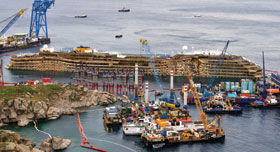
The Costa Concordia cruiseliner capsized over a year and a half ago off the coast of the Italian island, Giglio. In a daring and unprecedented engineering feat led by South African master mariner, Nick Sloane, the vessel was recently pulled upright during a complicated 19 hour operation. Sloane, senior salvage master for Titan Salvage, led an international operation made up of specialists in a wide range of engineering disciplines including ballast, design, computer and hydraulics engineers, ROV pilots and strandjack specialists. Technews editor Kim Roberts had fun catching up with Sloane somewhere between the Orange River and a Somerset West golf course to get the full story.
How the salvage operation unfolded
Once the 114 000 ton, 290 metre ship was anchored and stabilised to prevent her slipping down the steep sea floor, the next phase of this complex and risky engineering operation was to pull her upright using a process known as parbuckling. The ship was then lowered onto underwater platforms with the help of massive caissons attached to the port side which helped provide the ballast.
Supercomputers
Three supercomputers were used to run simulations of the event, requiring the largest computer model of a ship ever coded. The algorithms for this powerful model had to test what would happen to every component during flotation, monitor the stressors as the ship was rotated, and predict whether there would be structural failure.
“We worked with Overdick, a marine engineering company based in Hamburg, and engineers built up a finite element model of the Concordia from scratch,” said Sloane. “The software they used measures the forces through the hull to see what is happening with buckling and deformation. It needed 940 000 points of reference to model the hydrodynamics and took 43 days to run data for the first seven degrees of parbuckling alone. This told us how far the rocks had penetrated the side of the ship.”
The bow and stern were saved
A complicating factor was the ship’s location as she was balanced between two spurs of rock on a steep underwater slope. “The model also told us that the bow and stern were about to fall off,” continued Sloane. “Think of the ship as three rugby fields with the middle one balanced on two pinnacles. We had to fill up the valley between with 18 000 tons of grout to form a mattress, but meanwhile the forward rugby field was still suspended in deep water with all that weight. We couldn’t build a platform for the bow so we installed two blister tanks with a buoyancy of about 4000 tons next to the indentation to support it like a neck brace.”
Six huge steel and concrete platforms were anchored underwater for the Costa Concordia to rest on once it was righted. Sloane explained that the original plan was to have three large platforms for the midsection of the ship, but they had to build another three under the stern. “To save the stern we knew we had to extend the grout mattress. Scottish company FoundOcean profiled the grout and when turned, the stern rested on this mattress and rolled almost in a half moon shape across the grout to rest on the platforms. That is what saved the stern.”
Less than 1% torsion
Parbuckling uses rotational leverage to roll a ship or large object into an upright position. A concern during the salvage was preventing rotational torque from becoming a transverse force moving the ship sideways. “It was essential as we got her off the reef that we kept the sections of the hull parallel to each other to avoid the twists and torsions that would have destroyed her,” added Sloane. “We had five remotely operated underwater vehicles (ROVs) in the water at a time with accelerometers and gyroscopes on the ship itself to monitor any motion as the boat parbuckled. We managed to keep the twist torsion to less than three quarters of a degree between stern and bow over three rugby fields throughout the operation – a pretty impressive achievement.”
Massive hydraulic strandjacks
On the inshore side there were 11 towers with massive hydraulic strandjacks mounted on the tops of the retaining turrets. These were attached to chains that passed under the hull and fixed to the port side of the wreck. On the other side, cables anchored to the seabed and passing through more strandjacks were attached to the caissons and the underwater platform. The advantage of the strandjack is its ability for precision control. Computers controlled the tightening of each one to give operators more control over the delicate process.
This holdback system was used for balancing purposes during the parbuckling. First, motorised winches on the towers began turning, and the 114 000 ton mass was dragged slightly shoreward. The ship didn’t budge until 6000 tons of force was applied. Once the ship was freed off the rocks, other cables and winches connecting the caisson side of the ship with cranes on the outer edge of the platform and on barges provided an additional pull that helped the ship straighten-up. This was a critical phase during which the forces involved had to be balanced carefully to rotate the wreck without deforming the hull.
Gravity did the work
The caissons consisted of huge, hollow watertight boxes welded to the exposed side of the ship. The idea was to let gravity do most of the work. Once the ship started turning, they were flooded with seawater to act as a counterweight and provided a downward pull on that side of the ship, causing it to roll slowly into an upright position, coming to rest safely on the grout mattress and huge metal platforms.
All controlled from a barge
All commands and signals, including activation of strandjacks, opening and closing of the caisson valves and information about the position of the wreck, were communicated to and from the control room via umbilicals.
“There were umbilicals going to every ballast tank and strandjack and these were bundled over the bow to the control room,” said Sloane. “We used an electro-pneumatic system with compressed air for ballast control to monitor how much ballast water was needed in the caissons. The ballast tank valves were pneumatically operated while the strandjacks were hydraulically operated. The control room was on a barge tied to the bows of the Concordia and acted as the operations base for the control systems.
“We also had a swinging platform with four hydraulically powered units, spare fuel tanks and two generators and we could top up the fuel tanks and change generators, all remotely from the control room. As we parbuckled the platform swung out in an arc and maintained a horizontal plane.”
What next?
The hull is now resting on the false bottom at a depth of about 30 metres and the ship will have to be floated to a point where she can be towed away. When asked what’s next Nick joked, “Well, they didn’t think we could do the last one. In the next stage we need to get 56 chains underneath the Concordia whereas we used 22 for the parbuckling holdback system. We have already simulated the refloat and now we can update the model with the known damage and assess the situation.”
More caissons will be fixed to the starboard side of the hull to stabilise it. A pneumatic system will be used to empty the water from the caissons on both sides of the wreck, pumping in compressed air. The ship will then be towed to a port to be scrapped.
Parbuckling is not a new technique but the project had a lot of unknowns about the structure of the Concordia and how she would respond. “A lot of what we did has been done before, but not on this scale and with so many things happening at one time – it’s huge,” concluded Sloane.
For more information visit www.theparbucklingproject.com
| Tel: | +27 11 543 5800 |
| Email: | [email protected] |
| www: | www.technews.co.za |
| Articles: | More information and articles about Technews Publishing |






© Technews Publishing (Pty) Ltd | All Rights Reserved
 printer friendly version