




In wind power applications, the number of windmills ranges from just a few to hundreds that cover a large area. The wind turbines are scattered and usually lined up in multiple rows to accommodate the wind direction as well as turbulence.
Redundant Ethernet network connections are an ideal solution for bringing windmill nodes together and for creating a reliable communication network for remote data collection, equipment control, and adjustments to windmill settings. Such redundant networks must possess a fast recovery time – the order of milliseconds. Because of the distances between windmills, wind power networking systems require fibre-optic cabling for long range transmissions. Fibre cable also ensures expansion capability so that future turbines can be conveniently added in the future.
System requirements
* Redundant Ethernet infrastructure with secure data communication and fast fault recovery.
* Cost-saving deployment to reduce cabling and time.
* A highly scalable network that supports easy and hassle-free network expansions.
* Fibre-optic cabling for long-distance and noise-immune transmissions.
* Network devices with rugged design for reliable wind farm operations.
The Moxa solution
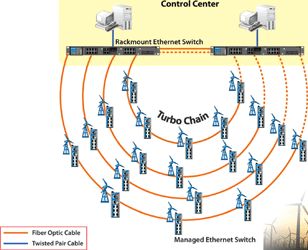
A multiring fibre network with simpler cabling to form a remote centralised control system that is well suited for wind farm applications that cover vast areas and long distances. Moxa’s managed Ethernet switches support Turbo Chain redundant technology, which allows users to build unlimited multiring connections for a highly available windmill network infrastructure. Unlike traditional coupling technology, Moxa Turbo Chain is practical since it enables flexible connections, easy expansions, and saves on cabling, additional Ethernet ports, and time. Even with unlimited multiring connections, the system can still provide reliable network redundancy with a recovery time under 20 ms. Users simply link the wind turbines together into a switch-chain and then connect back to the control centre directly. Redundant Turbo Chain networks can be easily extended into any segment for future expansions.
Moxa’s EDS-408A three fibre series products are managed Ethernet switches with five Ethernet and three fibre ports. Two of the fibre ports are for creating a Turbo Chain redundant network, and one fibre port is for up-linking to the wind turbine for connecting an unmanaged Ethernet switch. This unmanaged Ethernet switch connects to either a PLC, serial device sever, or an Ethernet I/O to collect and control real-time information such as the wind directions, wind speeds, and shaft rotation speeds. In addition, the EDS-408A features an extended MTBF, a wide operating temperature range, high reliability, and performance that is rugged enough for harsh windmill applications.
Moxa products
EDS-408A 3 Fibre Series
8-port industrial managed Ethernet switch with three fibre ports.
* 3 100BaseFX fibre ports (multimode/single-mode, SC/ST connectors).
* Turbo Ring, Turbo Chain, and RSTP/STP for Ethernet redundancy.
* Supports QoS, port-based VLAN, SNMPv1/v2/v3, RMON.
* -40 to 75°C operating temperature range.
* Redundant power inputs and high EMI immunity.
IKS-6726 Series
24+2G-port industrial rack mount Ethernet switch.
* Turbo Ring and RSTP/STP for Ethernet redundancy.
* Isolated redundant power inputs with universal 24/48 VDC or 110/220 VAC power supplies.
* Various media modules offered: RJ45, fibre and SFP ports.
* -40 to 75°C operating temperature range.
| Tel: | +27 11 781 0777 |
| Email: | info@rjconnect.co.za |
| www: | www.rjconnect.co.za |
| Articles: | More information and articles about RJ Connect |






© Technews Publishing (Pty) Ltd | All Rights Reserved
 printer friendly version