



The concept of factory automation and instrumentation system as a standalone is not the future information is the future."That, at any rate, is according to streamworks'CEO Russell Kleyn. Streamworks, which bills itself as a supply chain management and industrial IT solutions company, listed on the stock exchange in may last year. Since than it has made some interesting leaps in the SI world in terms of its aquisitions, the growing of its national base and the projects it has taken on.
The primary focus of the Streamworks Group is on harnessing the benefits offered by industrial information technology in order to maximise production in South African factories, particularly those competing internationally. Industrial IT remains as the core focus within the group, but as a natural progression with its client base, there is also a move towards providing solutions and services in the sector of supply chain management systems, which is rapidly assuming huge importance worldwide.
From their beginnings at the bottom of the technology tree, Streamworks now play across a fairly wide field. The scope of their work encompasses the planning and scheduling of manufacturing and related logistics, demand forecasting, raw material procurement, work-in-process, warehousing, distribution and transportation across multiple national and international locations.
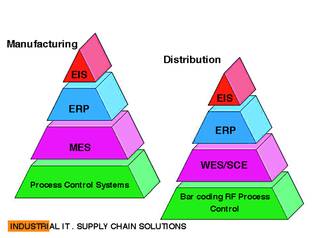
Streamworks' plans and activities in moving up the technology tree lie at the heart of Kleyn's confident statement. If one takes the manufacturing and distribution chains then they are seen to be essentially similar in terms of the way they operate. In 1992 Streamworks began in the manufacturing side of the process and moved into distribution after being involved in a dark warehouse project. Says Kleyn: "It began as a straight automation-type project and had become very different at the end. The dark warehouse job began with us working in the automation systems side of things and landed up with us moving up the technology tree into the MES side, as well as across into the distribution side of the client's business. That was when we first started to realise how much change could occur in the future of systems integration."
Streamworks at present is mainly involved in the bottom two tiers of the technology tree - MES and factory automation on the manufacturing side and warehouse execution systems/supply chain execution and barcoding systems on the distribution side of things. Kleyn, however, sees an unfolding concept in terms of the future of systems integration and his company has already gained some experience and expertise in ERP.
'The concept,' he says, "of instrumentation systems as a standalone is not the future - information is the future. I see systems integration of the future as being IT combined with engineering and technology skills. Technicians and engineers in the future will need to know how to use a multimeter as well as being able to develop web pages.
"The ultimate goal of systems integration should be an Internet-enabled, business to business e-commerce. I believe the Internet is going to drive this whole process. We are already seeing a situation with on-line ordering in which a major on-line book supplier could not meet their delivery requirements. The fact that they had no warehouse proved problematic because it turned out that they frequently could not rely on their suppliers, who let the loop down. In this scenario, even if the suppliers do perform, the delivery process is also frequently problematic. At present, most suppliers in general cannot handle electronic queries and do not know where in the chain a particular widget is."Kleyn says it is crucial to extend the logic of integration outside the boundaries of the manufacturer to include suppliers and customers. According to him, the supply chain should embrace a total network of organisations with different processes and activities, but which are linked in their endeavour of placing products and services in the hands of the consumer.
The mission of logistics management is to plan and coordinate all the activities necessary to achieve overall quality and service at the lowest costs. Logistics is the link between the market place and the operating activity of the business and the scope of logistics spans everything from management of raw materials through to the delivery of the final product to the consumer. It also coordinates information flow at every stage of the process. Kleyn foresees a systems integration future in which this information flow sees a blurring between the presently-accepted 'boundaries' between the different technology layers.
He elaborates: "The principle of convergance is that the de facto standard of the future is Internet-enabled equipment of all types. For example a PLC is either Ethernet or Internet enabled and you can program or access a PLC over the Internet. The result, from a business point of view, is that IT now requires knowledge of the business implications of what a factory is producing. In other words, factories are moving towards being an IT issue as opposed to an engineering issue."
Kleyn sees the concepts of ERP and supply chain management being driven right down to low level electronics in the manufacturing process. He also points out that South Africa will have to follow in the steps of international standards, which demand that each component is able to be traced back to its origin so that it can be determined precisely where any fault in a finished product occurred. From a consumer point of view, you are looking at a future in which, for example, you can pick up a tin of fruit off the supermarket shelf and have immediate access to a wide variety of information about that tin and its contents. This could include factors such as where the fruit came from, what pesticides were used on that particular crop, pertinent information about the tinning and preserving process and so on.
It is all part of a future in which Kleyn sees the boundaries disappearing in the business IT system, from the top right the way down to the tin in the factory and later on the shelf. "It's a merging both horizontally and vertically" he clarifies. "I believe we'll see the technology boundaries blurring from top to bottom, as well as horizontally between corporates, with the boundaries being similarly blurred there between those who see themselves as being purely on the manufacturing side and those who are positioned on the distribution side. Presently, there are companies that handle the factory automation side, and other companies that handle distribution, marketing or accounting systems. The Streamworks Group specialises in creating systems to look after the entire process - from tracking the goods in the raw materials warehouse, through the full manufacturing process, to the finished goods warehouse and far beyond."
Saying that the trick is learning to adapt to changing markets, Kleyn also believes that forming business partnerships between system integrators and clients is also going to become of key importance. Such business partnerships could take the form of being transaction-based, gainshare-based, lease operated or contractual.
If you look at the example of having a transactional-based system, the partnership could work as follows: instead of charging clients a once-off fee for installing a supply chain management system, the system integrator instead charges transaction-based fees on finished goods leaving the warehouse. This has several benefits for both client and SI:
* The cost of the system increases when business is good and reduces when budgets are tight.
* Downtime affects the SI as badly as it does the client, which ensures a total commitment to making sure that the system works.
* Capital investment by the client can be varied by structuring the percentage of the transaction fee.
Kleyn adds further that clients are requiring 15 to 20 years support from their system integrators, in other words a real partnership. All in all, his ideas certainly provide food for thought. He ends on a modest note: "Smoke and mirrors," he says, "it's still all just smoke and mirrors."
But the question left hanging in the air is: for how much longer?






© Technews Publishing (Pty) Ltd | All Rights Reserved
 printer friendly version