



Many areas of the industrial sector are undergoing transformation, as robots, vehicles and control systems connect to the Internet. This networking trend is enabling unprecedented levels of automation, not only at the factory level, but in all business processes.
The term ‘networking’ can cover different levels of communication, each with different needs. As a result, different levels can use a specific, often tailored network, based on requirements such as volume, transmission, security and determinism of data. Based on functionality, industrial communications networks can be classified into three general levels: field/device level (sensors, electrical drives, etc.), control level (PLCs, motion controllers, etc.) and process/company level (scada, ERP, etc.).
The advent of the IoT and Industry 4.0 has added the ‘cloud’ to the networking landscape. Remote, secure, yet easily available data in the cloud supports a possible widespread future for highly automated companies, one that is already becoming a necessary prerequisite for companies that want to be competitive and efficient in an increasingly challenging market.
Networks are the enabler for smart sensors
One of the critical elements lies in the speed with which changes are taking place. The evolution of fieldbus provides a good example. The adoption of buses compared to traditional, analog interfaces took several years to be accepted as a new standard. In fact, there are still companies that prefer the old way of doing things. We are now moving on to the adoption of real-time Ethernet buses, but at a seemingly higher speed than the previous step.
Many new and exciting technologies are now available and the union between the IT and industrial automation worlds is taking place. This is giving rise to scenarios unattainable until a few years ago. Networking, in its broadest sense, is the enabling element of the new industrial revolution.
There are different levels of communication and each requires different hardware and software features. Smart factories are looking to get a lot smarter, more flexible and dynamic, so networks need to respond to these goals. The high performance and reliable communication technologies that are entering the market will outperform those currently in use. These technologies will make it possible to transfer large amounts of data in real time or with minimal delay, connect a large number of individual devices in a very reliable way and with the highest data security standards. Increasingly, wireless technologies are being used more and more; both within the plant and for remote connectivity.
In order to achieve the potential of modern networks, all levels of communication need to be involved. With Industry 4.0, the boundaries of the different levels shift from what is currently in place. The field level remains a dedicated layer, but the devices on it will incorporate more and more intelligence including smart sensors that are able to perform many processes autonomously.
Many of the efforts to develop IoT platforms have focused on the enterprise level in a top-down approach. Although indispensable, this level actually only collects about 10% of the data, therefore limiting the ability to support predictive maintenance and component performance optimisation. Unless a discrete IoT system is used for the remaining 90% of critical component data, enterprise systems cannot exploit their potential to truly transform business activities. Discrete IoT systems can provide immediate value regardless of enterprise level systems, while supporting their long-term objectives.
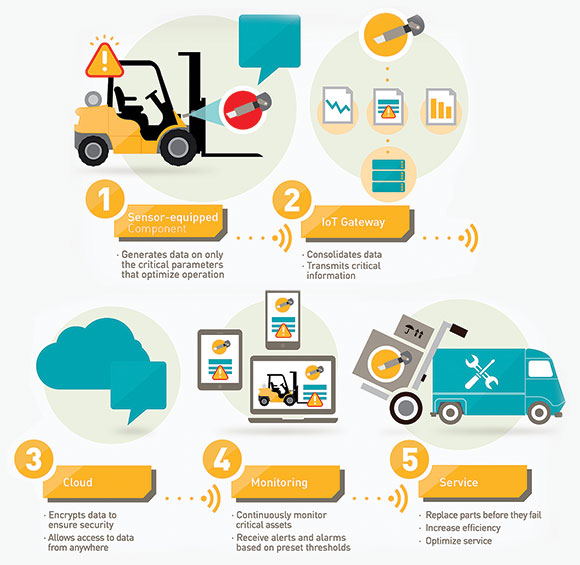
The Parker solution
With its centralised strategy coined ‘Voice of the Machine’, Parker is an example of a company developing and implementing its own IoT solution that supports extensive autonomous monitoring and control. The strategy comprises hardware including smart sensors and IO-Link, plus a common set of standards, principles and best practices.
From a technological perspective, companies such as Parker have focused efforts on minimising the challenges that have prevented industry operators from exploiting the IoT to solve operational problems, such as downtime, predictive maintenance and maintenance time itself. Although the IoT can still be considered to be in its relative infancy, the technology has reached a point of evolution that can provide significant value in many industrial applications.
For more information contact Lisa de Beer, Parker Hannifin SA, +27 11 961 0700, lisa.debeer@parker.com, www.parker.com/za
| Tel: | +27 11 961 0700 |
| Email: | parker.southafrica@parker.com |
| www: | www.parker.com/za |
| Articles: | More information and articles about Parker Hannifin - Sales Company South Africa |






© Technews Publishing (Pty) Ltd | All Rights Reserved
 printer friendly version