



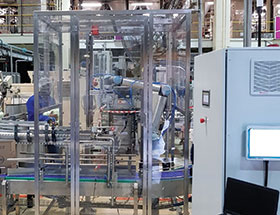
A client of Hybrid Automation produces multiple products that are exported throughout the world. The plant is constantly under pressure to meet customer requirements and relies heavily on automation to keep up with orders.
The legacy production line consisted of a manual system, where products were physically taken off the shrink line, and manually packed into boxes. This resulted in inefficient operations due to shift changes and the maximum speed with which products could be packed by hand. Hybrid Automation, with its acknowledged experience in industrial automation and control, was approached by this blue-chip company to upgrade its production line.
Desired results
To measure the success or failure of the project, Hybrid Automation was tasked with a list of objectives. Included were speed requirements, measurable by shrinks per minute, safety requirements and operator accessibility. The speed requirements were determined by the previous method of manual packing increased by an appropriate factor. This is a crucial aspect, as there was a minimum target requirement to justify the allocation of funds.
In a production environment speed can be both friend and foe. Although case packing at high speed is good for productivity, it may pose a threat to the operators near the machinery. For the solution to be deemed safe to operate, the client provided several safety guidelines that had to be followed.
The last aspect was that of operator accessibility. The solution had to be simple to operate and minimise the risk of human error. It was also required to work with minimum human intervention.
Getting the buy-in and other challenges
A project of this magnitude needs approval by various departments within the client organisation. As discussed earlier, time is a critical factor. Therefore, management had to be persuaded that the solution would pay for itself through an increase in overall productivity. The finance department also had to be convinced that the proposed new production method was more cost-effective than the existing one.
As with any project, there were several challenges. The first was the variety of products that the solution needed to accommodate. This led to the implementation of change parts, which were to be labelled for easy identification by the operators. Initially parts were 3D printed to aid the operators make guide adjustments for the line. However, this was later solved by the implementation of fixed rulers in conjunction with the explanatory documentation.
The next was mechanical design challenges regarding the box closing device. Initial designs had free moving rollers that were not driven, but this led to the problem where the end of line packed box always needed another behind it to keep the flow going. This was solved by adding driven belts on the side to help boxes through the closing device. This meant that even a single packed box from the line could be handled without a manual purge.
In order to get all relevant parties on board, it had to be proved that the solution was faster and more cost-efficient than manual packing, as well as easy to operate with minimal human intervention. This was done by putting the solution through its paces in a factory acceptance test performed by the client to ensure that all requirements had been met.
Solution implementation
In order to determine the most effective solution, the team brainstormed ideas in-house, but with constant critique and input from the end user. After extensive research and deliberation, it was determined that the best solution for this application was Universal Robots’ UR10 cobot. The pick-and-place speed as well as precision of this cobot allowed for all standards and regulations to be met with great effect.
Progress was measured daily by the amount of product being bottled, packaged and packed away into boxes. The results were then analysed and compared to previous figures from before the implementation of the cobot. Consultations and technical support were provided as and when required, and installation and commissioning were completed within one month.
The benefits
The primary goal achieved within this project was an increase in packaging volume, which allows a faster production pace and therefore a higher turnover by the end user.
However, the speed and accuracy that comes with this cobot solution requires constants within its environment. In order for continuous precision, the path taken by the product should be tailor-made to ensure consistency. In order to achieve success, consistency is key – from the collating of products to the shape of boxes.
The versatile functionality of the cobot proved an effective way of achieving the desired results, making it a serious contender as a solution in future projects of this nature.
For more information contact Hybrid Automation, +27 31 573 2795, info@hybridautomation.co.za, www.hybridautomation.co.za
| Tel: | +27 31 573 2795 |
| Email: | info@hybridautomation.co.za |
| www: | www.hybridautomation.co.za |
| Articles: | More information and articles about Hybrid Automation |






© Technews Publishing (Pty) Ltd | All Rights Reserved
 printer friendly version