



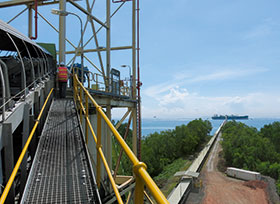
Frankfurt-based Continental Engineering Services (CES) has been operating worldwide as an independent provider of engineering services since 2006. Together with ContiTech Transportbandsysteme, based in Northeim, CES has developed two different electronic belt monitoring systems in the Conti Protect series for integrated conveyor systems.
The first system was termed Splice Elongation Measurement (SEM). It detects serious faults in the splices between the segments of the conveyor belts, which can be up to 10 cm thick, 4 m wide, and 10 km long. The second is the Belt Rip Detection (BRD) system, which can detect emerging longitudinal slits in a conveyor belt at an early stage. Both monitoring systems stop the conveyor in the event of an emergency, and also enable remote maintenance by ContiTech personnel, if required. In this way, it is possible to optimise operating costs, increase system availability and reduce the risk of accidents.
Reliably capturing test signals at high conveyor speeds
Both systems are based on the electromagnetic induction effect. For the BRD system, conductor loops are vulcanised into the conveyor belt. They transmit a high-frequency test signal between a transmitter and a receiver. If such a loop is damaged, the signal on the receiver side fails; the system control detects this and automatically stops the conveyor. In this way, it is possible to reliably detect emerging longitudinal slits at several monitoring points during conveyor operation, even at full belt speed. SEM involves precision length measurement of the splices, which are the connections between the conveyor belt segments, weighing up to 40 tons. Steel bands integrated in the joints generate the induction effect.
For SEM, the number of conveyor belt segments, usually around 50 of them, defines the number of measuring points. For the BRD system, conductor loops should ideally be provided every 50 metres, although in some cases they may be 100 to 200 metres apart, depending on the application. Conveyor speeds of up to 40 km/h make great demands on data acquisition and sampling rates. BRD logs around 2000 values per second, and SEM logs up to 400 000 values per second for high-precision measurement of length down to a fraction of a millimetre, taking into account the unavoidable vibrations of the conveyor belt.
Control technology must be fast, precise and robust
SEM already met the enormous demands on data processing speed back in 2010, with the help of PC-based control technology from Beckhoff. Hans Christian Enders from the CES Industrial Solutions division explains: “Of crucial importance is EtherCAT, which enables high-performance, real-time Ethernet communication down to the I/O level. The Distributed Clocks and Timestamp functionality in XFC form the basis for extremely precise data acquisition. Based on our excellent experience with SEM, we decided to use Beckhoff technology again for the BRD system.”
The technology not only offers outstanding performance, it is also very robust. Enders continues: “We have been using Beckhoff technology for many years and under the most difficult conditions, including high EMC, dust and vibration loads, large temperature fluctuations and high humidity. We have never experienced a technical problem. In a copper mine at an altitude of 3000 metres in Chile, for example, the control technology is exposed to extreme temperature conditions and particulate matter. What’s more, the system passed this endurance test not only within the IP67-rated control cabinet, but also exposed, as the door is often left open for weeks on end. The BRD system also copes with extreme temperatures and high humidity, such as in an opencast coal mine in Borneo. The built-in CP6202 Panel PC with IP 65-protected front causes no trouble at all, not even when subjected to cleaning or as a result of EMC originating from the large, multi-megawatt drives.”
Fast data communication and fast engineering
The CP6202 Panel PC with 15” touchscreen is used for the control system, equipped with TwinCAT automation software and TwinCAT PLC HMI for visualisation. The modular I/O level features EtherCAT Terminals, including an EL3702 XFC analog input terminal with oversampling. Special oversampling data types enable multiple scans of process values within a communication cycle and the transfer of all data in an array. The so-called oversampling factor refers to the number of samples within a communication cycle.
In the conveyor belt monitoring systems, the oversampling value is 100, i.e. 100 samples per 1 ms cycle time. This makes it possible to transfer huge amounts of data – 2000 and 400 000 signals per second respectively for the BRD and SEM systems – to the Industrial PC with exceptional processing speed. Enders mentions another advantage: “The EtherCAT communication is not only extremely powerful, but it also supports communication via fibre optic cables. This is particularly important for us, in view of the fact that in some of our installations the measuring points can be several hundred metres away from the control cabinet.”
Speed also played a major role in the development of the SEM. For the first system, the company only had half a year available, including sensor development. Enders continues: “TwinCAT was very helpful. Thanks to the efficient programming interface and the use of existing software components or function blocks, we were able to reduce the development time drastically. Additional benefits include simplified troubleshooting using the TwinCAT scope functionality, enabling single-step debugging and user-friendly curve display and signal analysis. In this way, correct hardware installation can be verified quickly, a particularly important factor during commissioning.”
Scalability and openness of the control system
In addition to the speed and real-time capability of the PC-based control technology, CES also benefited from its scalability and system openness. Enders explains: “The control technology can easily be adapted to individual customer requirements. For example, it is quite straightforward to integrate a client data structure based on Profibus or CAN via the appropriate I/O terminals, without restrictions in terms of the EtherCAT communication required for the actual data processing.”
By nature, PC-based control technology also demonstrates openness by leveraging IT technologies. For example, remote maintenance for the conveyor systems installed around the world can be implemented without great effort, based on established tools such as TeamViewer. This results in significant savings in time and travel expense. Via the TwinCAT SMTP server, it is possible to integrate webcams for visual monitoring of measuring points. Enders sees further potential for the future: “With the transition to TwinCAT 3, we will benefit from the integration in Visual Studio. A first application written with this development tool already exists before we started using TwinCAT 3. We use it in the context of our industrial radar sensors and will make this solution even more efficient and valuable as we expand our use of TwinCAT 3.”
For more information contact Kenneth McPherson, Beckhoff Automation, +27 (0)11 795 2898, [email protected], www.beckhoff.co.za
| Tel: | +27 11 795 2898 |
| Email: | [email protected] |
| www: | www.beckhoff.com |
| Articles: | More information and articles about Beckhoff Automation |






© Technews Publishing (Pty) Ltd | All Rights Reserved
 printer friendly version