



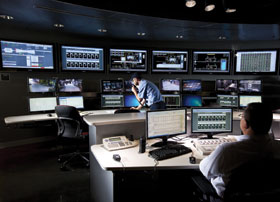
Operator driven reliability (ODR) is being followed by several industries that encourage more ownership of equipment maintenance for process operators. The rewards are better reliability and lower costs. However, for ODR to work more effectively, operators need more on-the-spot information about the soundness of the machinery that they operate. To give process operators a sense of ownership of the equipment and the sureness to make corrective action, real-time and time-trended information about machinery condition is needed in an easy to understand format. With this, operators can be the first line of defence against failure. They can make adjustments and keep on running in a cautious, measured way or take action to solve more serious problems. That sureness to take action is now aided by condition monitoring based in a Valmet DNA distributed control system.
The analyses of machinery vibrations and process pulsations are now integrated in DCS systems and used by process operators as well as maintenance staff. In the past, the user interface terminals of separate condition monitoring systems were often remote from the operators’ primary activity area or used primarily in the maintenance shop. Now, the unified system uses common user interfaces so it’s right in the centre of action. Also, the I/O hardware, signal processing hardware and software, configuration tools, trending and alarming functions are the same.
First-alert, faster repairs
Over the years, quality measurements and controls, then machinery controls and drive controls have been integrated step-by-step in distributed control systems. Machinery condition monitoring was the next logical step, as described by Erkki Jaatinen, a Valmet product manager, at the 2011 Tappi PaperCon conference. With these tools, he says that process operators can now evaluate machinery condition alongside the usual process control, machinery control and quality control functions. Maintenance staff can follow up and use additional diagnostic tools that pinpoint a specific machine component problem.
This integration comes at a time when maintenance and production departments are developing programmes to coordinate their efforts to ensure that production goals are met and maintenance is focused on well-defined needs. ODR is part of that. The DCS condition analysis function will help mill staff to target maximum process uptime and cost-effectiveness.
Why include operators in equipment care? First, the operators are there when production is up and running, 24 hours per and 7 days a week, so they see problems right away. With this first-alert responsibility the partnership between operations and maintenance will improve. This cooperation will mean that preventive maintenance programmes will be much more cost effective and mill profitability will improve.
A similar fostering of operator initiatives for machinery maintenance was triggered when interlock logic and its diagnostic help pages were included in DCS systems a number of years ago. Operators were then able to find and sometimes correct the root causes of machine halts or alert maintenance staff to the needed repairs. A British paper mill operations manager described the benefits: “Now operators can identify the specific causes of a halt themselves. This means that the time to repair is definitely better.” Online condition monitoring in the DCS offers comparable benefits.
‘à la minute’ diagnosis
The analyses include mechanical system vibrations, process pulsation, roll cover condition and fabric-induced vibrations that have a direct impact on quality and safety. It’s ‘à la minute’ diagnosis. Operators can react faster to developing problems like roll cover corrugations, calendar barring, critical polymer roll hot spots and severe vibration conditions that might lead to premature failure and safety problems. Press section vibration analyses indicate roll or felt condition and pinpoint, through STA analysis, which one is the culprit for nip vibrations. Moreover, operators can make on the fly adjustments of felt tension and cocking to reduce vibration and extend felt life.
It is particularly important to follow roll nip, fabric and cover induced vibration levels over several weeks or months since the fabric replacement cycles and some roll cover re-grinding intervals are often measured in months, not years. They can be much shorter if trouble develops. However, with advance notice and pre-emptive action, the destruction of a felt or roll cover could be avoided. “This allows us to minimise the downtime by minimising the damage,” says a paper mill superintendent.
The vibration measurements can be used to evaluate the nip vibrations of new and re-ground polymer covered rolls. Excessive vibration can lead to cover cracking. It’s better to be safe than sorry and certainly less expensive, so operators can isolate a problem roll and decide the best time to change it to avoid quality problems, expensive and hazardous cover damage or failures.
The predictive maintenance value is as valid as ever. Troubleshooting tools allow maintenance staff to provide timely service and avoid future failures. Detective techniques like envelope analysis pinpoint a fault in a specific bearing or gearbox component, giving plenty of advance warning so the repairs are focused on those components during a scheduled shutdown. Advance warning indeed; a maintenance specialist said that he can see a bearing problem coming three months in advance.
This dual role, involving operators and maintenance staff, is a key justification since the benefits of improved uptime supplement the rewards of timely and effective maintenance. Better machine operation and less unplanned and costly downtime add up.
High cost of failure
There are many maintenance-sensitive components other than rolls in a paper production line, including motors, bearings and gearboxes. Altogether, there can be several hundred monitored points. Some, like bearings in the dryer section, are critical since they are normally inaccessible for regular manual checking, it’s difficult or impossible to see if they have problems and the cost of failure is high.
In the pulp mill, the situation is a bit different since most equipment operates at a much lower speed than in the paper mill and runnability is not an issue. Nevertheless, the monitoring of some low speed equipment like washers and the lime kiln may be warranted if problems can go undetected for lengthy periods. Avoiding downtime is always a key goal in any part of a mill. Turbines, used in many mills today, fit into a different category since monitoring and emergency shutdown procedures are required absolutely to protect the equipment.
Continuous monitoring of the myriad of pumps, fans and associated drive equipment in a pulp mill may be warranted area by area if unexpected failures are costly. However, rather than hard-wired systems, the emerging technology for portable, wireless monitoring may be a cost-effective complement to traditional walk-around maintenance routes in a pulp mill. The use of smartphones, cloud computing and augmented reality techniques such as smart glasses are now being developed and tested by Valmet. When those techniques are fully developed on-the-spot visualisation and solution of just-beginning maintenance problems, anywhere from the chip conveyors to the wrap line will be possible. The capabilities and technology tools of predictive maintenance continue to evolve.
For more information contact Hugh Heine, Valmet, +27 (0)31 502 9350, [email protected], www.valmet.com






© Technews Publishing (Pty) Ltd | All Rights Reserved
 printer friendly version