



Fieldbus & Industrial Networking


Wireless system for Shell petrochemical plant

Technews Industry Guide - Wireless 2014 Fieldbus & Industrial Networking Industrial Wireless

Shell Eastern Petroleum (SEPL) recently completed its ethylene cracker complex (ECC) as part of its ‘Houdini’ project in Singapore.

One of the key features of the project is that this is a deployment in an oil & gas environment, where wireless technology is being used to get secure mobile access to Process Control systems. Shell wanted to get mobile access to all process data via WLAN at defined places in the refinery to drive efficiencies. Another important consideration was that all relevant parts of the solution had to be certified to comply with ATEX/IEC60079.

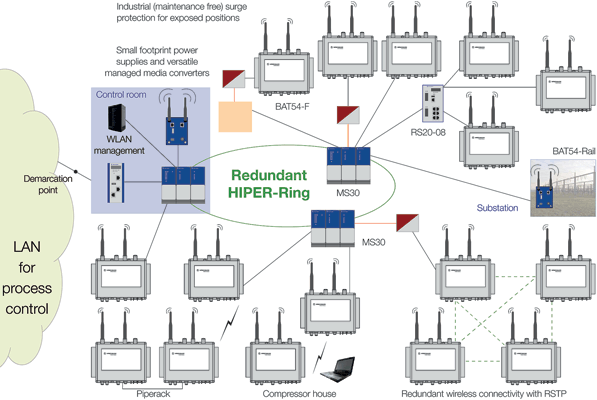
Working closely with main automation contractor Yokogawa, the Belden team took on the design and build of a complete WLAN solution, consisting of a wireless distribution system incorporating 90 Hirschmann BAT54-F X2 access points for the ECC and multiple antennas, linked across a redundant fibre ring backbone.

Pioneering the technology

The application required a full range of Hirschmann WLAN products including outdoor access points together with accessories, antennas, surge arrestors, managed switches, media converters and Industrial HiVision. For enhanced security, the Eagle firewall was used at the demarcation point to the process LAN. To build the backbone, Belden’s Profinet copper and fibre optic cables, as well as Lumberg Automation Ethernet M12 connectors for all Ethernet devices. At locations where wired LAN access was difficult, connectivity was established by applying cost effective and easy to manage wireless point to point links.

A specific challenge for Belden was to provide all equipment with proper ATEX/IEC60079 certification for the challenging conditions found on this project. Olaf Schilperoort, product manager for Hirschmann wireless devices says, “Shell knew what they wanted and we quickly found a common level of understanding. We also saw the great chance to become pioneer for WLAN solutions in these harsh environments and so we developed a new product according to the specifications set out by Shell.”
Delivering the solution

The Belden project team planned the system at the Belden Competence Centre and it was here that the first factory acceptance test (FAT) involving the complete system was conducted. These comprehensive tests included hardware, software, documentation and the overall system functionality including roaming capability.

The test proved successful and with Shell’s approval, the entire set-up was moved to Singapore for the integrated FAT to ensure that it functioned seamlessly as part of Yokogawa´s overall control system – again the test proved successful.

Peter Beerepoot, responsible for instrumentation process control for the entire Houdini project says, “Our initial thoughts during the front end engineering and design phase, was that wireless would give us a number of key benefits. So we considered substitution of local panels, which we believed would bring us advantages in terms of cost reduction and increased efficiency. However, it is always difficult to test a new system in an existing plant. Here we were given the opportunity to develop a complete infrastructure. Today, we not only have the proof that the Belden system works, but because the coverage is better than we originally expected, we are now looking at options to maximise our usage of the system even further. The Belden Team delivered excellent work and proved to be a reliable partner throughout the project.”

Conclusion

By successfully delivering this project, Belden has demonstrated that it offers a complete solution for scalable, redundant LAN and WLAN architectures for the process industry. In this case, the solution encompassed an entire WLAN system with ATEX certification and full project management and service that has provided the customer with both improved operational efficiency and cost reductions. Belden will continue to work on this project to deliver service programs and further expand the network for better WLAN coverage and new services like Ex zone certified wireless video for safety and surveillance applications.

For more information, contact Cliff Nel, IAC, +27 (0)12 657 3600, [email protected],


Credit(s)


Share this article:
Share via emailShare via LinkedInPrint this page

Further reading:

Why secure industrial communication depends on deployment as well
Fieldbus & Industrial Networking
The Industrial Security Harmonisation Group has released a joint industry perspective highlighting a critical truth in industrial cybersecurity: secure communication is not determined by protocols alone, but by how they are deployed and managed in real-world environments.

Read more...
A single platform for all automation functions
Beckhoff Automation Fieldbus & Industrial Networking
The introduction of TwinCAT in 1996 marked a decisive evolutionary step for PC-based control. Today, the TwinCAT platform combines all automation functions in a strictly deterministic real-time environment, from PLC and motion control through CNC and measurement technology and beyond, to vision, robotics and pioneering AI tools.

Read more...
Loop signature Part 2-4: Feedforward Control: Part 3
Michael Brown Control Engineering Editor's Choice Fieldbus & Industrial Networking
In the previous articles in this series, the basic theory behind feedforward control was discussed, and it was also shown how to apply feedforward in practice. In this article, it will be shown how well feedforward can work in practice by giving a couple of examples.

Read more...
Control Station and Dimension Software partner to connect control performance monitoring with enterprise operations intelligence
Fieldbus & Industrial Networking
Control Station has entered into a strategic technology partnership with Dimension Software, a leading provider of industrial operations management platforms. The collaboration connects Control Station’s PlantESP control loop performance monitoring platform with Dimension Software’s Asset Intellect operations intelligence environment, enabling manufacturers to operationalise control performance insights across their organisations.

Read more...
PCIe digitiser cards for optimal GHz signal acquisition and analysis
Vepac Electronics Fieldbus & Industrial Networking
The addition of two new PCIe Digitiser cards from Spectrum Instrumentation extends the company’s flagship M5i series to deliver optimal GHz signal acquisition and analysis capabilities.

Read more...
Precise, synchronised control for automated steel mesh handling system
Fieldbus & Industrial Networking
Automation specialist Hambi Maschinenbau has developed a world-first system that automates the cutting, handling and stacking of heavy reinforcing steel mesh – a task that previously required up to six human operators.

Read more...
Loop signature Part 2-3: Feedforward Control: Part 2
Michael Brown Control Engineering Editor's Choice Fieldbus & Industrial Networking
Feedforward control tuning is not nearly as critical as feedback tuning, and fairly simple models are usually fine for the purpose in hand.

Read more...
Upgrading radiological surveillance systems in nuclear facilities
Omniflex Remote Monitoring Specialists Fieldbus & Industrial Networking
Nuclear plant operators face an uncomfortable reality. Many of the control and monitoring systems still in use today were never designed to support the full operational lifespan of the facilities they serve.

Read more...
Next-level CAN Software enables easy access to CAN XL
Industrial Data Xchange (IDX) Fieldbus & Industrial Networking
With the release of its PCAN-Explorer 7, PEAK delivers a major update that adds full support for CAN XL, multiple symbol files per connection, Python scripting and flexible licensing including floating licenses.

Read more...
Loop signature Part 2-2: Feedforward Control: Part 1
Michael Brown Control Engineering Fieldbus & Industrial Networking
Feedforward control is a powerful technique that can dramatically improve control variance in cases where load changes cause big deviations from setpoint and the actual process dynamics are too slow to allow the feedback controller to operate fast enough to catch these disturbances.

Read more...


While every effort has been made to ensure the accuracy of the information contained herein, the publisher and its agents cannot be held responsible for any errors contained, or any loss incurred as a result. Articles published do not necessarily reflect the views of the publishers. The editor reserves the right to alter or cut copy. Articles submitted are deemed to have been cleared for publication. Advertisements and company contact details are published as provided by the advertiser. Technews Publishing (Pty) Ltd cannot be held responsible for the accuracy or veracity of supplied material.


© Technews Publishing (Pty) Ltd | All Rights Reserved

