Analytical Instrumentation & Environmental Monitoring


OMSA launches non-nuclear continuous in-line density meter

December 2012 Analytical Instrumentation & Environmental Monitoring

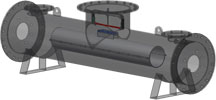
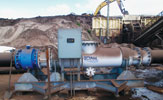
With major benefits to the mining, sewage treatment and power generation industries, OMSA has launched the DM3 non-nuclear, in-line, continuous density meter that calculates density by measuring direct mass over a known volume within a flow tube.

The DM3 was originally designed to replace obsolete technologies for the mining and dredging industries, and has proven to be safer and more cost effective than potentially hazardous nuclear techniques or inefficient auto-sampling methods. OMSA says it is offering this advanced technology to the local industry in response to growing customer demand.

Principle of application

The DM3 offers a non-nuclear way to measure mining and dredging slurries and avoids the administrative and technical problems associated with nuclear devices. These include: compliance with Department of Health regulations; use of special safety equipment (Occupational Safety & Health Act); performing wipe tests; being part of National Nuclear Regulator and DMR surveys; employment of costly radiation officers; mitigation of health hazards as well as costly transportation and disposal issues.

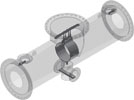
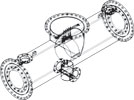
DM3 interrogates mass per unit volume at 110 times per second, giving a response time of 45 milliseconds to any changes in the media density. In a mass flow system, this brings a new dimension of savings due to long term accuracy. The device interrogates a representative and continuous sample accounting for density variation across the diameter and metres in length of the measured media. It measures abrasive media easily due to its resilient natural rubber lined flow tube with customised options for high pressure and extreme temperature applications.
Applications

Developed by US based Sciam Worldwide, the meter has been utilised by a zircon slurry in Florida to calculate the percentage of dry solids, as well as by a phosphate mine for establishing the density of phosphate sludge. Accuracy has increased by more than 2,5%, giving substantial financial savings and a parallel increase in safety and efficiency.

The DM3 is insensitive to plant vibrations, noise, vacuum and temperature. Mineral beneficiation plants in southern Africa including coal, copper, diamonds, iron ore, gold platinum, uranium and zinc would find it suitable for tailings measurement as well as providing accurate control of plant efficiency and competent metal accounting.

For power generation plants, by-products such as fly ash slurry can be measured with greater confidence enabling energy savings with respect to pumping energy, water savings and pond size. By installing a DM3 density meter on the coal ash slurry pipeline, power plant operators have access to data for the density, wet or dry specific gravity and percentage dry solids of the slurry. When combined with the data received from a recommended volumetric flowmeter installed downstream from the density meter, the operators can then analyse the mass flow rate and totalised mass flow of slurry into the ponds. This way, an up to minute record can be kept of how much coal combustion waste is being produced as well as how much is on site in the ponds at any given time.

In wastewater treatment, better knowledge of input to sewage treatment plants and output sludge density can be used to improve operating efficiency particularly with respect to chemical dosing and biological oxygen demand. A DM3 unit is currently being used to measure biosolids removed from a wastewater treatment plant at a large city in the USA.

DM3 installations are used around the world to improve the efficiency of operations in many diverse industries such as pulp & paper, food & beverage and oil & gas production.

During the long-term life of its flow tube, the DM3 requires no periodic downtime for maintenance, except an occasional on-site calibration check. This is quickly achieved by running water through the unit without taking it out of the pipeline. No test weights are required, just a three second push of a button for a complete system diagnostic check. If acceptable this revalidates the original calibration, uniquely and directly to international weight standards

Each unit is custom designed and certified by CE, UL, NTEP and IECEE with directly NIST traceable measurements and in an environmentally friendly unit.

For more information contact Jan Grobler, OMSA, +27 (0)11 793 7421, jan@omsa.co.za, www.omsa.co.za




Share this article:
Share via emailShare via LinkedInPrint this page

Further reading:

Getting the chemistry right
Analytical Instrumentation & Environmental Monitoring
Grace’s European production site has relied on analogue compression load cells from Minebea Intec for decades, with the long-proven measurement concept now serving as the reference for new silo projects as the company expands its capacity.

Read more...
Why measurement matters in smelting
Endress+Hauser South Africa Analytical Instrumentation & Environmental Monitoring
South African smelters returning to operation after energy constraints face new demands for tighter control, better visibility and environmental compliance. Endress+Hauser explains how modern measurement technology supports safer, more efficient furnace operation and local beneficiation.

Read more...
Sun tracking with pinpoint precision
Senseca Analytical Instrumentation & Environmental Monitoring
Senseca has introduced the SEMS-2000 solar energy measurement system, a 2-axis solar tracker with pinpoint sun-pointing accuracy that automatically monitors direct, global and diffuse irradiance for unattended outdoor solar installations.

Read more...
AMETEK expands 993X gas analyser series with explosion-proof enclosures
Analytical Instrumentation & Environmental Monitoring
AMETEK Process Instruments has added ATEX and IECEx Zone 1-certified explosion-proof enclosures to its 993X series of gas analysers, enabling reliable installation in Zone 1 hazardous locations where purge gas is unavailable.

Read more...
Why medical device leak testing matters for South Africa's MedTech future
ATEQ South Africa Analytical Instrumentation & Environmental Monitoring
As South Africa works to grow local medical technology manufacturing, non-destructive leak and flow testing is becoming a strategic quality assurance tool, helping manufacturers verify device integrity, meet regulatory requirements and improve production efficiency.

Read more...
Moving forward with reverse osmosis
Analytical Instrumentation & Environmental Monitoring
Rising water costs and pressure on infrastructure are changing the way industries view reverse osmosis. G-Chem Aquacare is developing tailored, containerised solutions that make the technology more accessible for South African industry.

Read more...
Meteorological data logger with up to 32 analogue sensors
Senseca Analytical Instrumentation & Environmental Monitoring
Senseca has introduced its advanced data acquisition system for environmental monitoring, which has a universal data logger for up to 32 analogue, pulse and smart digital sensors.

Read more...
Importance of gas analysis in the petrochemical industry
Elemental Analytics Analytical Instrumentation & Environmental Monitoring
Gas analysis plays a critical role in petrochemical operations, supporting process optimisation, product quality and plant safety. As an experienced and expert gas analysis supplier, Elemental Analytics can provide the correct analyser and sample system package to meet individual plant requirements.

Read more...
Fully integrated standalone thunderstorm warning system
Senseca Sensors & Transducers Analytical Instrumentation & Environmental Monitoring
Senseca South Africa has introduced its BTD-1 fully integrated, standalone thunderstorm warning system, which detects lightning by monitoring the background quasi-electrostatic field. The system can generate alerts before the first lightning strike, with a detection raterange of up to 83 km.

Read more...
Environmental monitoring with testo Saveris 1
Analytical Instrumentation & Environmental Monitoring
The testo Saveris 1 environmental monitoring system has been in continuous use since 2010 at Jungbunzlauer, a biotechnology company in Germany, providing seamless temperature and humidity data for audit-ready, GxP-compliant processes across laboratories, warehouses and production areas.

Read more...


While every effort has been made to ensure the accuracy of the information contained herein, the publisher and its agents cannot be held responsible for any errors contained, or any loss incurred as a result. Articles published do not necessarily reflect the views of the publishers. The editor reserves the right to alter or cut copy. Articles submitted are deemed to have been cleared for publication. Advertisements and company contact details are published as provided by the advertiser. Technews Publishing (Pty) Ltd cannot be held responsible for the accuracy or veracity of supplied material.


© Technews Publishing (Pty) Ltd | All Rights Reserved