System Integration & Control Systems Design


Control loop: Case History 140 - Report after optimisation exercise

February 2015 System Integration & Control Systems Design

There is a particular continuous process plant in South Africa that takes base layer control loop optimisation extremely seriously. (Many other plants unfortunately do not, which to me is terribly sad.) I do a lot of work for that plant and spend several weeks every year with a team of their advanced control engineers working on analysing and optimising loops that have been identified as not working well and causing problems.

A new approach

In the past, my reports have been passed on to other relevant departments including C&I maintenance, process engineers and management. Due to the fact that people in these other departments have little understanding of practical control, the reports have often not been properly understood or the problems fully appreciated. On my last visit, it was decided firstly that selected personnel from the other departments would attend the optimisation work relevant to their plant sections, and secondly, that the reports should now be fully illustrated, with respect to how we analysed the problems, and presented at a meeting to heads of the other departments. In addition to this, selected personnel from these other departments will also attend my courses on practical control, which are very different from most other courses on control, and give a really good understanding of what happens in real life in control loops.

We have decided for at least the interim period to publish these reports in parts in this series of articles in SA Instrumentation and Control. Previously we have tried to put quite a lot of detail into the articles resulting for ­reasons of space requirements in the figures being relatively small. These articles will each show only one or two of the items in the report.

The reports not only contain problems, but also successes that highlight the improvements that can be obtained by a control loop that is working and responding properly. Some of these successes of extremely slow loops have been illustrated by accurate simulations, as it would have taken an extremely long time to do recordings of both the original and final performance.

Real world example

This particular article will show one such success, but with a relatively small problem.

Figure 1 shows the as ‘As Found’ closed loop test on this flow loop which the operators were complaining about as being ‘very jumpy’. The test shows the loop running in automatic with the original tuning and responding to several step set-point changes. It can be seen that the loop was in fact completely unstable.
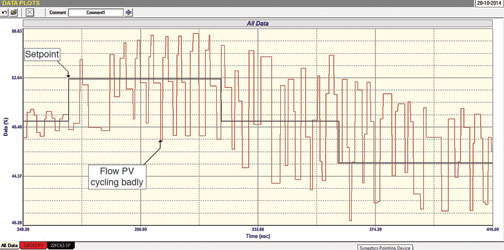
Figure 1.
Figure 1.

Figure 2 is an open loop test and shows firstly that the valve is suffering from negative hysteresis which causes it to overshoot when its direction is reversed. This can result in instability in automatic and is caused by either an underpowered actuator or a positioner problem. Secondly, the test shows that the valve is about four times oversized. This is determined by the magnitude of the changes of the PV compared to those in the change of PD (controller output). (Oversized valves increase control variance and amplitude of cycling by the oversize factor.)
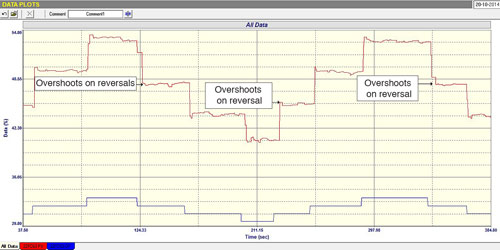
Figure 2.
Figure 2.

It was decided to tune the controller using the step responses shown in Figure 2. Surprisingly enough given the valve problems, the relatively good control shown in Figure 3 was obtained. There is still a small amplitude sporadic cycle occurring, which will only be eliminated when the cause of the negative hysteresis is determined and eradicated. The main cause of the original massive cycling was due to bad tuning.

The next article will feature more from this report.
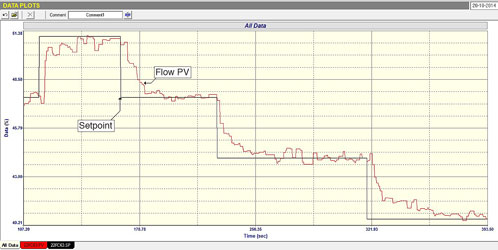
Figure 3.
Figure 3.

Michael Brown’s next course series in Johannesburg will take place on 20 February.

Michael Brown is a specialist in control loop optimisation with many years of experience in process control instrumentation. His main activities are consulting, and teaching practical control loop analysis and optimisation. He gives training courses which can be held in clients’ plants, where students can have the added benefit of practising on live loops. His work takes him to plants all over South Africa and also to other countries. He can be contacted at Michael Brown Control Engineering cc, +27 (0)82 440 7790, [email protected], www.controlloop.co.za


Credit(s)


Share this article:
Share via emailShare via LinkedInPrint this page

Further reading:

Loop signature Part 2-4: Feedforward Control: Part 3
Michael Brown Control Engineering Editor's Choice Fieldbus & Industrial Networking
In the previous articles in this series, the basic theory behind feedforward control was discussed, and it was also shown how to apply feedforward in practice. In this article, it will be shown how well feedforward can work in practice by giving a couple of examples.

Read more...
Loop signature Part 2-3: Feedforward Control: Part 2
Michael Brown Control Engineering Editor's Choice Fieldbus & Industrial Networking
Feedforward control tuning is not nearly as critical as feedback tuning, and fairly simple models are usually fine for the purpose in hand.

Read more...
PCS Global
System Integration & Control Systems Design
Project and industry: PCS Global led a digital infrastructure initiative in a southern African data centre setting, aiming to merge several essential operational systems into one cohesive platform. ...

Read more...
Seamless migration from ET 200M to ET 200SP HA for future-ready automation
System Integration & Control Systems Design
Project and industry: Moore Process Controls undertook a modernisation initiative spanning the mining, petrochemical, and oil & gas sectors. This project involved upgrading legacy Siemens ET200M I/O ...

Read more...
Loop signature Part 2-2: Feedforward Control: Part 1
Michael Brown Control Engineering Fieldbus & Industrial Networking
Feedforward control is a powerful technique that can dramatically improve control variance in cases where load changes cause big deviations from setpoint and the actual process dynamics are too slow to allow the feedback controller to operate fast enough to catch these disturbances.

Read more...
Proconics Modernises Refinery Tank Automation with Compliance-Focused, Brownfield Upgrades
System Integration & Control Systems Design
Project & Industry Proconics was engaged to modernise automation and SCADA systems across a refinery tank farm. The project involved complex brownfield integration, aligning new automation with existing ...

Read more...
Project & Industry
System Integration & Control Systems Design
Project: Upgrading essential automation and SCADA systems at a coal mine.    Outcome: A modern, stable automation and SCADA environment with reduced technical debt and easier support, ready for expansion. ...

Read more...
Major digital transformation project for Isuzu Motors
System Integration & Control Systems Design
Isuzu Motors South Africa, in partnership with NoMuda and S4 Integration, has kicked off a major two-year digital transformation project to modernise its production environment.

Read more...
Loop Signature Part 2-1: Loop signatures and process transfer functions
Michael Brown Control Engineering Fieldbus & Industrial Networking
The previous series of loop signature articles dealt with the basics of control loop optimisation, and concentrated on troubleshooting and ‘SWAG’ tuning of simple processes. In this new series, consideration will be given to dealing practically with more difficult issues like interactive processes, and with processes with much more complex dynamics.

Read more...
Modernising Vertical Filter Press Machines with Future-Focused Control Systems
System Integration & Control Systems Design
Project and Industry Pressure Filter Specialists approached us to modernise vertical filter press machines for the Minerals and Metals industry. The goal was to improve reliability, reduce downtime, ...

Read more...


While every effort has been made to ensure the accuracy of the information contained herein, the publisher and its agents cannot be held responsible for any errors contained, or any loss incurred as a result. Articles published do not necessarily reflect the views of the publishers. The editor reserves the right to alter or cut copy. Articles submitted are deemed to have been cleared for publication. Advertisements and company contact details are published as provided by the advertiser. Technews Publishing (Pty) Ltd cannot be held responsible for the accuracy or veracity of supplied material.


© Technews Publishing (Pty) Ltd | All Rights Reserved