



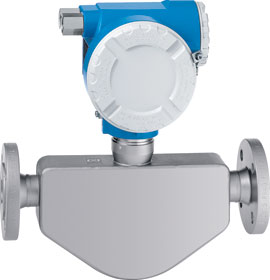
Liquefied Petroleum Gas (LPG) normally occurs as liquid natural gas when crude oil is being pumped from significant depths, or is obtained as a by-product in the crude oil refining process. LPG is liquid at a low pressure and can be stored and transported in suitable containers. However, it has a very high temperature expansion coefficient and therefore reacts to temperature fluctuation with a corresponding change in volume. In certain countries this factor is not taken into account when unloading or dispensing LPG, in other words, no appropriate, temperature-dependent correction factor is applied. This generally results in less than favourable terms for consumers.
Multivariable flow measurement
The above problem was recognised by Endress+Hauser and resolved through the development of LPGmass – a new meter designed specifically for unloading and dispensing LPG according to the Coriolis measuring principle. This makes it possible to fulfil the customer demand for temperature compensation. As a multivariable Coriolis flow meter, the LPGmass measures several process variables simultaneously: Mass flow, fluid density and fluid temperature. This means it is possible to display the measured full scale value in volumetric units as well as using conversions internal to the device together with the temperature compensation or by taking the API table into account.
The LPGmass is the first flowmeter to integrate the internationally recognised API table 53 (API = American Petroleum Institute) to take the temperature expansion coefficient into account. The LPGmass was developed primarily for two highly typical and frequently occurring applications:
* Refuelling vehicles via fuel dispensers.
* Distributing LPG by truck to small consumers such as small and medium-sized companies and private residences.
The large range of nominal diameters from DN 8 to DN 40 allows the customer to select the most suitable measurement device for the application and flow rates:
* Refuelling vehicles DN 8, DN 15, DN 25.
* Unloading trucks DN 25, DN 40.
The LPGmass in dispensers
Measuring devices with piston technology are commonly used today for measuring the liquefied gas volume dispensed. However, these normally need to be completely overhauled every two or three years, or after a specific volume of liquefied gas has been dispensed. As the LPGmass does not have any moving parts or seals of any kind, considerable savings of time and money can be expected over the long term.
The LPGmass on trucks
In various parts of the world liquefied gas (LPG) is used both for cooking and for heating. This is indicated by the large tanks often seen standing in the open air behind the buildings in question. However, it is worth bearing in mind that a large number of these tanks are also partially buried underground. These types of tanks are filled using small and medium-sized trucks which in turn are filled on centrally located transfer points. The new LPGmass has been designed especially for these kinds of applications, so that all trucks can be fitted with such devices.
The device sets new standards because safety and reliability during operation are always given top priority when handling liquefied gas:
* High operational safety due to production quality.
* Space saving design is the ideal replacement for piston dispensers.
* Integrated temperature sensor as standard and API conversion table for volume correction for standard volume measurement.
* High level of resistance to vibration, e.g. for operation on trucks.
* No moving parts or seals.
* Excellent measuring accuracy thanks to traceable, accredited calibration facilities.
* Ex approvals.
* Numerous custody transfer approvals for commercial transactions.
As varied as applications with LPG are, there is a range of process connections to suit: flange (DIN, ANSI, JIS) and VCO couplings can be ordered for standard versions. For the signal output (communication), a pulse output – either with a phase shift of 0°, 90° or 180° or a Modbus connection with a status output can be selected.
Simple and safe commissioning
The ‘FieldCare’ configuration and service software from Endress+Hauser is a simple, dependable way to commission measuring instruments and to modify device parameters. The “Fieldview” add-on module also allows users to visualise measuring data, to display the data in graphical form and evaluate the data for diagnostic purposes. This means that operators of LPG systems can gain insights into the dispensing process and can optimise this process or track down irregularities if required. Characteristic process parameters and device data can be printed, archived or sent via e-mail using FieldCare, for example to complete customer documentation or in service cases.
For more information contact Frans van den Berg, Endress+Hauser, +27 (0)11 262 8000, info@za.endress.com, www.za.endress.com
| Tel: | +27 11 262 8000 |
| Email: | info.za.sc@endress.com |
| www: | www.endress.com |
| Articles: | More information and articles about Endress+Hauser South Africa |






© Technews Publishing (Pty) Ltd | All Rights Reserved
 printer friendly version