



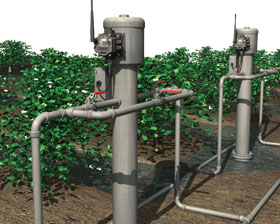
Wireless technology was once limited by factors that included inadequate bandwidth, early integrated circuit design and insufficient power management technology. Improvements to today’s wireless networks allow robust monitoring and control even in remote and harsh applications or classified areas. New systems enable cost-effective monitoring that is scalable down to a single point.
Today, improvements in RF technology make wireless an ideal solution for a wide variety of applications such as field-based agribusiness and water management systems, which use wireless networks to improve water use, increase efficiencies and reduce manual measurements. Process measurements such as operational status, level, temperature, and other crucial information can now easily be monitored and controlled remotely.
Remote I/O monitoring
Today, many remote monitoring solutions are available that offer reliable wireless communication in a single, inexpensive unit. A radio and I/O terminal contained within a single housing that is rated for outdoor use eliminates the need for any additional enclosure. These new wireless industrial I/O devices are easy to install, and then uninstall and move to a new location as monitoring requirements change.
With the radio, power controller, I/O terminals, and RTU components included within a single, water-resistant housing, fewer mechanical and wiring issues need to be incorporated into a maintenance schedule, resulting in valuable time and cost savings without sacrificing capabilities. A single wireless I/O device can collect both digital and analogue sensor readings and forward this data to a central collection point for analysis.
Power management systems
To accommodate remote monitoring needs in locations without power, optimised wireless I/O devices using advanced power management technology can operate from a single battery pack for several years. This extended life span is achieved by putting the entire system in low-power mode, allowing the system to consume almost no power.
The power management system can be configured to sample the sensor and report data at predefined intervals. These can be set from a few samples per second to a few samples per hour with the longer sampling intervals corresponding to longer battery life. Often a five to 10 year battery life can be achieved by optimising the sample and report rates. With power options that include solar panels or battery packs, radio devices can now be installed over a wide geographical area, extending the range of data collection substantially.
Cost effective scalability
Now that multiple sensors can be connected to a single radio node and dozens of radio nodes can exist within a single radio network, hundreds of sensor readings can be aggregated into a single gateway device before being forwarded to a host-controlled system for analysis.
Further extending this wireless I/O network are serial data radios, backhaul devices that receive serial data from another serial data radio, or a serial connection to a gateway, and forward the data to another serial device miles away. Chaining data radios can expand this network indefinitely.
This backhaul architecture enables limitless scaling for everything from single-point data collection to 10 000 data point applications while retaining the cost advantage associated with minimal wiring for power or I/O transmission. Wireless technology enables remote monitoring solutions that were previously unaffordable or impractical to install.
Agribusiness applications
In agribusiness, the most common reasons for adopting wireless monitoring systems are improving crop quality and reducing labour costs. Tasks that previously required constant human intervention can be replaced by installations of solar or battery powered sensors, nodes and gateways. The most common use for wireless sensor networks is the monitoring of soil moisture levels to control irrigation systems.
For these applications, remote sensors can be used to monitor and report the moisture levels of the soil back to a central control location, notifying personnel that irrigation is required before crops are damaged. With this constant automatic monitoring, wasted water is minimised without harming the crops.
To this end, vineyards are adopting wireless technology for a range of tasks that include monitoring environmental conditions such as soil moisture and pH levels in the fields and controlling the dispensing of fertilisers and insecticides. In the processing facilities, wireless sensor networks are used to gather tank level data, control flow of liquids and analyse the relative humidity and temperature within the storage rooms. Wireless nodes using pressure and flow sensors monitor the irrigation system and transmit data back to the gateway or control centre. These wireless systems can notify personnel immediately when a component fails or when the irrigation system is unable to meet established performance parameters.
For more information contact Rodney Topham, RET Automation, +27 (0)11 453 2468, [email protected], www.retautomation.com
| Tel: | +27 11 453 2468 |
| Email: | [email protected] |
| www: | www.turckbanner.co.za |
| Articles: | More information and articles about Turck Banner Southern Africa |






© Technews Publishing (Pty) Ltd | All Rights Reserved
 printer friendly version