



When air behaves like fuel
Air is one of the most overlooked contaminants in lubrication systems. It is invisible, it is everywhere, and under normal conditions, it does not seem particularly harmful. When air becomes entrained in oil, existing as tiny, unstable bubbles, it creates the perfect conditions for one of the most destructive degradation mechanisms in lubrication. Under pressure, air does not behave like a harmless contaminant, it behaves like fuel.
What microdieseling is
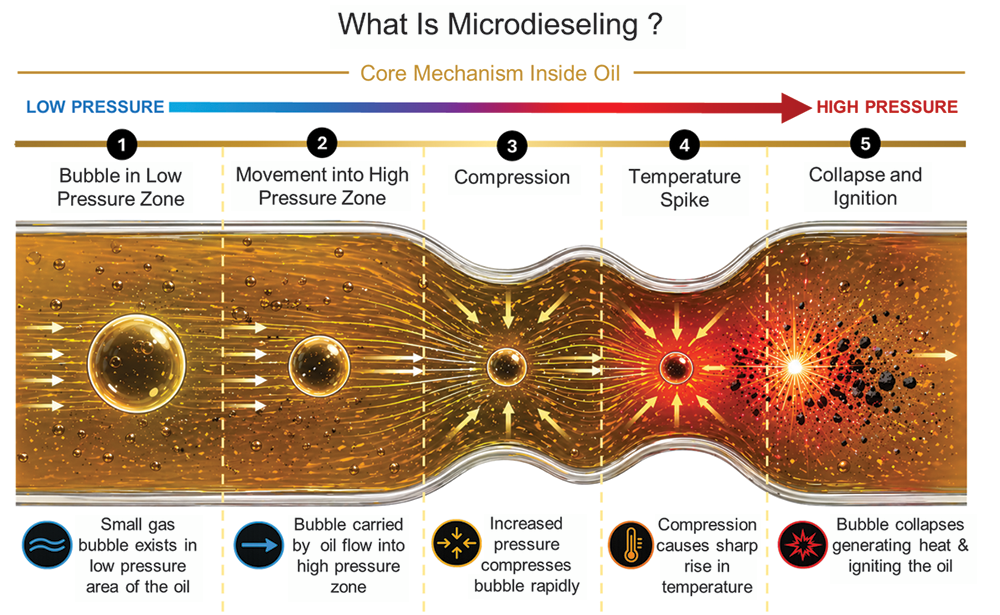
Microdieseling is a form of pressure-induced thermal degradation also known as compressive heating. It occurs when entrained air bubbles move from a low-pressure zone to a high-pressure zone within a system. As this happens, the bubbles are rapidly compressed. Because this compression occurs faster than heat can dissipate, a process known as adiabatic compression, the temperature inside the bubble rises dramatically. In many cases, these temperatures exceed 1000°C. At this point, something remarkable and destructive happens: the oil surrounding the bubble does more than degrade, it burns.
Diesel combustion on a microscopic scale
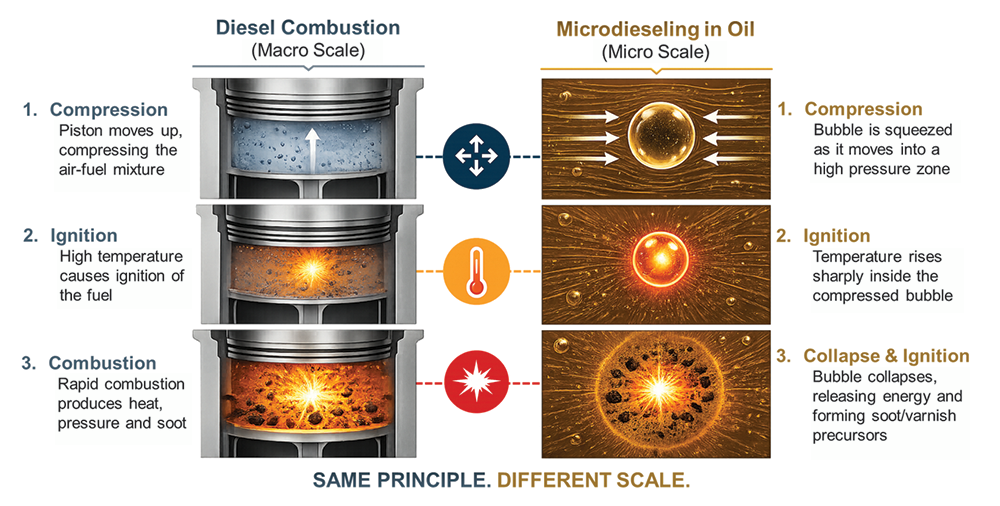
The term microdieseling is no exaggeration. It is called dieseling because it mimics the combustion process of a diesel engine on a microscopic scale. Just as in a diesel engine, compressed air leads to ignition, but in this case, the fuel is the oil itself. As the bubble collapses, the surrounding oil is exposed to extreme localised temperatures and the bubble interface becomes carbonised, resulting in partial combustion. The result is the formation of carbon soot, tars, sludge and varnish-type resinous deposits. As in a diesel engine, this combustion is incomplete, leaving behind solid carbon by-products that contaminate the oil and deposit on surfaces.
Why the damage varies
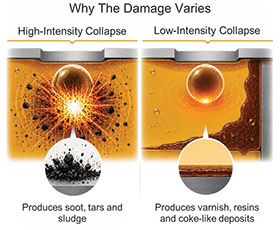
Not all microdieseling events are equal. The intensity of the bubble collapse, specifically the implosion pressure, determines the type of degradation products formed. High-intensity collapse tends to produce combustion-related by-products such as soot, tars and sludge. Lower-intensity events are more likely to produce varnish, resins and coke-like deposits. This explains why some systems experience heavy soot loading and rapid oil darkening, while others suffer from varnish, sticky deposits and valve stiction. Different conditions, same root cause.
More than oil degradation
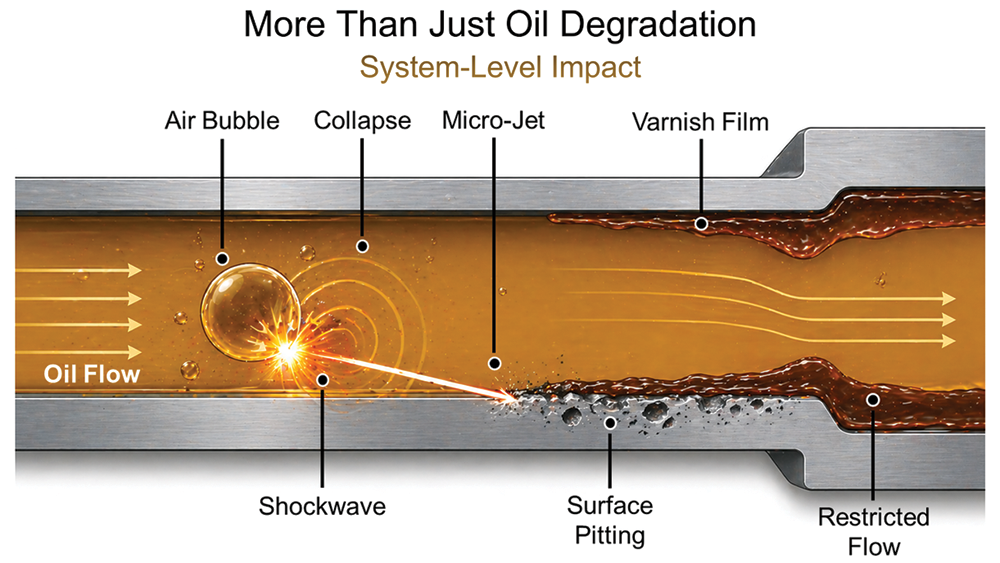
Microdieseling does more than damage the oil, it affects the entire system. Each collapsing bubble generates extreme local temperatures, shockwaves and micro-jets of oil. Over time, these repeated micro-events lead to surface pitting and erosion, increased wear, valve sticking from varnish deposits, and reduced efficiency with sluggish system response. In hydraulic systems, the presence of air further reduces the oil’s ability to transmit pressure, resulting in a familiar spongy behaviour. While the explosions may be microscopic, the consequences are anything but.
What causes microdieseling
For microdieseling to occur, two key ingredients are required: air in the system and a rapid change in pressure. Air can enter or form in oil through several routes:
• Suction-side leaks
• Low oil levels
• Turbulence and agitation
• Contamination or poor handling practices
Air can also form when dissolved air comes out of solution due to pressure drops. Rapid pressure changes are commonly created by:
• Flow restrictions and orifices
• Cavitation conditions
• Valve operation, both opening and closing
• Pumps, especially across suction and discharge zones
Microdieseling often occurs in the same regions where cavitation is present, but with an important difference: cavitation collapses bubbles while microdieseling ignites them.
Detecting microdieseling through oil analysis
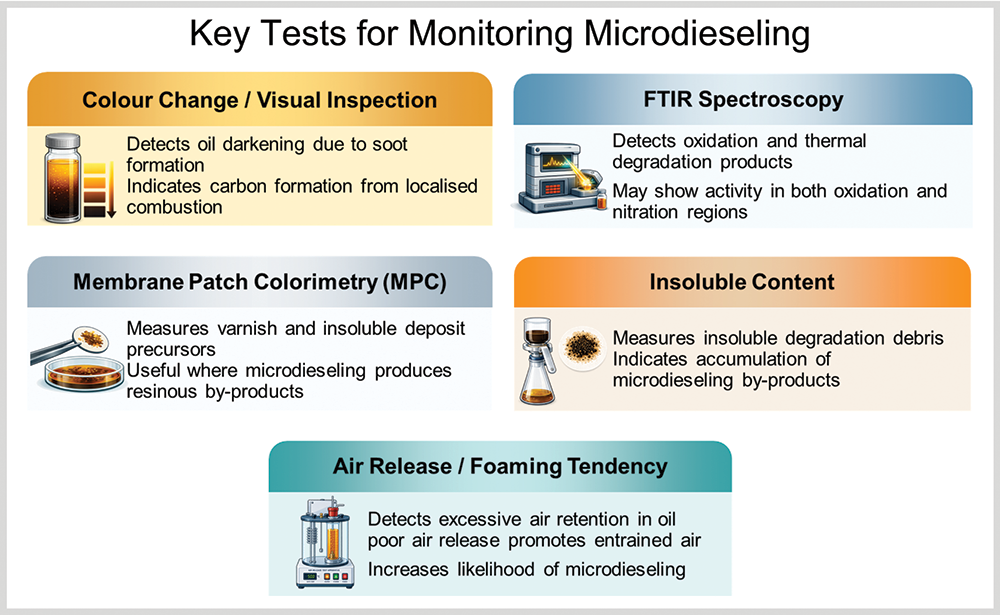
Microdieseling is often a hidden problem, but it leaves behind a distinct signature. Unlike other degradation mechanisms, it combines elements of thermal stress, oxidation and combustion, resulting in a unique mix of indicators. Rapid oil darkening from soot formation, increased insoluble content, elevated oxidation levels and high varnish potential are all common signs. The challenge is that many of these indicators appear later in the degradation process, making early detection difficult without targeted analysis and a clear understanding of the underlying mechanism.
The real problem
It is tempting to treat microdieseling as an oil failure, but it is not. Microdieseling is fundamentally an air-management problem. As long as air is present in the system and subjected to rapid pressure changes, the conditions for these microscopic combustion events will exist. Control the air and you control the problem.
Tiny air bubbles drifting through the oil may look harmless, but under the right conditions they become something far more destructive, collapsing, igniting and releasing bursts of energy powerful enough to degrade the oil, damage components and shorten equipment life. In lubrication, it is often the smallest things that cause the biggest problems, and when it comes to microdieseling, these tiny bubbles are anything but harmless.






© Technews Publishing (Pty) Ltd | All Rights Reserved
 printer friendly version