



From a stable source to a changing supply picture
South Africa’s inland gas market has been built around natural gas produced from the onshore Pande-Temane fields in Mozambique. The gas is processed and compressed at the Central Processing Facility and transported through the ROMPCO pipeline to Secunda, from where it enters the network serving industrial customers. For many plants, this relatively consistent supply has allowed burners, boilers and gas engines to be commissioned around a familiar gas-quality envelope.
That assumption now needs to be revisited. Sasol has stated that natural-gas production from Mozambique is declining and has proposed methane-rich gas (MRG) from Secunda as a limited bridge from July 2028 to June 2030. The proposal is subject to regulatory approval and the investment decisions needed for implementation. LNG is being developed in parallel as a longer-term option. Biomethane and other renewable or synthetic gases may also become part of a more diverse southern African gas market over time, although their injection into the Sasol network is not confirmed.
The practical consequence is clear. Gas from different sources can have different calorific values, Wobbe Index, relative densities and constituent profiles. A contractual average supplied by a producer is useful, but it does not replace measurement at the industrial user’s point of use, particularly during a transition or blending period.
Why calorific value is only half the answer
Calorific value describes the heat released by a defined quantity of gas. For burner interchangeability, the more useful first indicator is the Wobbe Index. The upper Wobbe Index is the higher calorific value divided by the square root of the gas’s relative density to air. All values must be compared at the same reference conditions.
For a fixed burner nozzle and an unchanged gas-pressure differential, thermal input is approximately proportional to Wobbe Index. A lower-Wobbe gas can therefore under-fire the process. The gas valve may reach its limit, furnace temperature or steam output may fall, excess oxygen may rise and flame stability can deteriorate. A higher-Wobbe gas can produce the opposite problem, including over-firing, a rich air-fuel ratio, increased carbon monoxide or NOx, overheating and flame impingement.
Restoring the same heat input may require changes to gas pressure, valve or actuator maps, air-fuel ratio, oxygen trim, nozzle orifice or the burner itself. As a useful screening relationship, the required pressure differential changes approximately with the square of the Wobbe ratio, which is why a modest change in Wobbe Index can demand a more noticeable pressure adjustment. Final settings must always be established through burner-OEM review and site recommissioning. The principle is to measure the gas before adjusting the process, because the gas supplier’s nominal value cannot show the exact quality, rate of change or transient blend arriving at a specific plant.
Gas engines need a wider view
Wobbe Index is essential, but it is not a complete gas-engine compatibility test. Reciprocating engines are also sensitive to methane number, hydrogen and carbon-monoxide content, ethane and higher hydrocarbons, flame speed, stoichiometric air requirement and knock margin. A change that appears acceptable on Wobbe Index alone may still require a different fuel-valve map, lambda target, ignition timing, knock-control strategy or output derating.
This is especially important at sites operating engine-generators above about 500 kW, where fuel flow, lost production and equipment risk are material. The 500 kW level is not a scientific cut-off, and smaller units must also remain within their approved fuel envelope, but it is a sensible priority point for continuous gas-quality monitoring and OEM engagement. The RGQ 5 does not provide details of gas components. Where this is required, the RMG RGC7 gas chromatograph can be considered.
A compact alternative to assuming gas quality
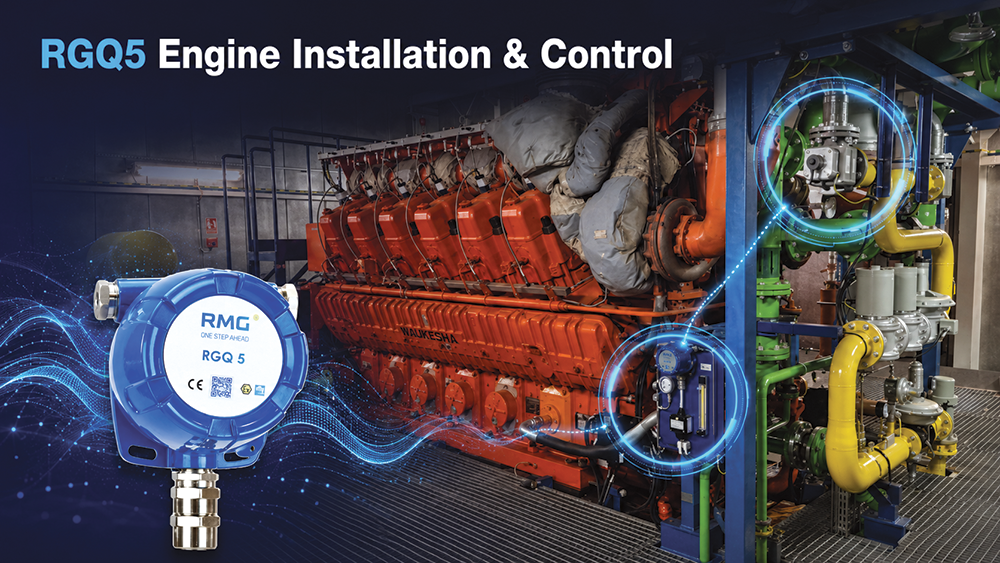
The RMG RGQ 5 is a compact correlative gas-quality analyser designed for continuous measurement of combustible gases. Instead of separating every component as a process gas chromatograph does, it combines patented dynamic-viscosity measurement with MEMS-based thermal conductivity, gas-pressure and gas-temperature measurement, plus optional infrared sensing. A mathematical correlation model, built from a database of gas compositions, calculates combustion properties in line with recognised industry methods.
The instrument updates calculated values for upper and lower Wobbe Index, higher and lower calorific value, density, relative density, compressibility, stoichiometric air-fuel ratio and methane number. Depending on the selected sensor version, hydrogen and carbon-dioxide mole fractions are also available. RMG states a measurement uncertainty not exceeding 1% of measured value within the specified gas envelope, with a tighter figure for the RGQ 527 OIML variant.
The stand-alone sensor is approximately 150 x 145 x 125 mm and weighs 2,6 kg. It uses a small sample flow of about 30 ml/min through 1/4-inch NPT connections. A packaged mounting-plate version adds filtration, pressure regulation and an adjustable bypass, accepting sample-gas inlet pressure up to
16 bar(g), while the stand-alone device requires 10 to 100 mbar(g). Power demand is below 2 W from a 24 V DC supply. Outputs are available through 4 to 20 mA and RS-485 Modbus RTU, allowing straightforward connection to a PLC, DCS or SCADA system. Explosion-protected configurations and ATEX/IECEx approvals are available for appropriate installations.
The correlation approach also avoids the continuous carrier-gas utility and sample combustion associated with some analytical methods. With no moving parts in the sensor principle and a very small sample demand, the unit is well suited to distributed plant monitoring where a full analyser shelter may be difficult to justify.
Turning measurement into control
A one-second data update is useful only when it is translated into a safe operating philosophy. At a burner installation, the Wobbe signal can be trended, alarmed and used to select a validated gas recipe, while flue-gas oxygen trim closes the combustion loop. At a gas engine, the measured Wobbe Index and methane number can support selection of an OEM-approved fuel map, together with defined limits for ignition timing, lambda, power and knock control. Automatic adjustment should remain inside verified equipment limits, and the analyser is not a substitute for OEM approval.
Specify the analyser against the actual gas
The RGQ 5 is offered in variants for conventional natural gas, renewable gas and hydrogen-containing mixtures. The proposed minimum, normal and maximum gas composition must be checked against RMG’s published concentration range and the selected correlation model. In particular where an MRG stream contains carbon monoxide or other constituents outside the standard published envelope, Energas and RMG should confirm suitability, and a customised correlation model or gas chromatograph may be required. The RGQ 5 provides fast gas-quality and combustion parameters with selected component outputs, but it does not deliver a full compositional analysis. Used within its approved gas envelope, it gives operators the information needed to replace assumption with measurement, and make evidence-based decisions about combustion control.
Prepare before the fuel changes
South Africa’s approaching gas transition is not only a supply issue, it is an instrumentation and control issue at every affected plant. Industrial users should request the guaranteed gas-quality envelope and expected transition rate, establish how the data will reach their control systems, obtain equipment-OEM approval, and define the commissioning and fallback plan before the first change in fuel arrives. For large burners and gas-engine power plants, the compact RMG RGQ 5 offers a practical way to monitor Wobbe Index and related combustion properties at the point where they matter. It cannot remove the need for sound combustion engineering, but it can ensure that burner and engine adjustments are based on the gas actually being used, protecting performance, efficiency and process safety.
For more information contact Energas Technologies,






© Technews Publishing (Pty) Ltd | All Rights Reserved
 printer friendly version