



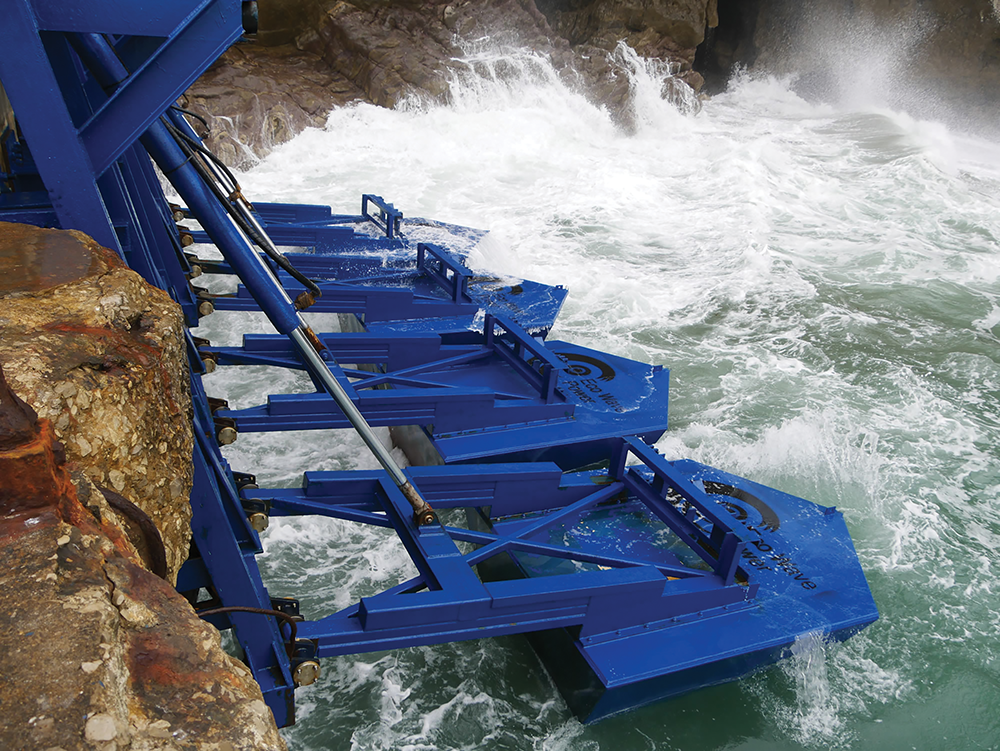
A feasibility study has identified the potential for an 8,3 MW wave energy power station at the Port of Ngqura in the Eastern Cape, using the port’s existing breakwater infrastructure.
The study was completed by the Swedish wave energy technology company, Eco Wave Power in collaboration with Africa Great Future Development (AGFDL). It assessed site conditions, wave resource availability and a preliminary system configuration for an onshore wave energy installation at the deep-water port.
The findings indicate that the Port of Ngqura could be suitable for the deployment of Eco Wave Power’s technology, subject to further engineering development, permitting processes and commercial assessments. The proposed project would use existing coastal structures rather than requiring a separate offshore platform, potentially reducing some of the civil and marine construction requirements associated with wave energy developments.

Wave energy has long been viewed as a potentially useful addition to renewable energy systems in coastal countries, although the sector has faced challenges in demonstrating long-term reliability, controlling installation costs and operating equipment in harsh marine conditions. Technologies mounted on existing breakwaters, jetties and other coastal infrastructure may offer an alternative approach by improving access for installation and maintenance while avoiding some of the complexity of offshore deployments.
Eco Wave Power’s technology is designed to generate electricity from the movement of waves through floaters attached to marine structures. As waves rise and fall, the motion of the floaters drives a hydraulic system that transfers energy to an onshore conversion unit. The company has focused on installations located close to shore where equipment can be accessed more easily than conventional offshore wave energy systems.
At Ngqura, the feasibility study examined the available wave resource and the potential to integrate the system along the port’s breakwater. The assessment also considered preliminary system configuration and the suitability of existing marine infrastructure for wave energy generation. Further work would be needed to determine the final number of units, electrical equipment, grid connection arrangements, maintenance access and expected energy yield.
The Port of Ngqura is adjacent to the Coega Special Economic Zone, one of South Africa’s major industrial development areas. Its deep-water facilities, exposed breakwater, and proximity to industrial and logistics infrastructure make it an ideal location for the first commercial-scale onshore wave energy project in the country.
AGFDL will now review the results of the feasibility study in detail. Once this process has been completed, the two companies will jointly assess possible next steps, including project structuring, regulatory requirements, development timelines and the commercial framework needed to advance the project.
South Africa’s coastline extends for more than 2800 km, offering a substantial potential resource for wave energy. While solar and wind power have become the dominant renewable technologies in the country, wave energy could eventually contribute to a more diversified energy mix, particularly in coastal areas where generation can be located close to ports, industrial zones and electricity demand centres.
Wave energy may also complement other renewable sources. Solar output is limited to daylight hours, while wind generation varies according to weather conditions. Wave conditions are influenced by different meteorological systems and may provide a generation profile that is not always aligned with either solar or wind output. However, the extent to which wave energy can contribute meaningfully to South Africa’s electricity system will depend on project costs, long-term equipment performance, grid connection requirements, and the ability of developers to secure finance for early projects.
The Ngqura project is not the only possible wave energy development under consideration in South Africa. AGFDL has begun discussions with stakeholders in East London to assess suitable locations for a second wave energy power station.
The South African feasibility study adds to Eco Wave Power’s international project pipeline, which the company says represents 404,7 MW of projects under development. The company operates a grid-connected wave energy power station at Jaffa Port in Israel and is progressing projects in the United States of America, Portugal, Taiwan and India. In the United States of America, Eco Wave Power recently launched an onshore wave energy pilot station at the Port of Los Angeles in collaboration with Shell Marine Renewable Energy.
For South Africa, the Port of Ngqura study represents an early, but significant, step in assessing whether wave energy can move from a largely experimental technology to a practical part of the country’s renewable energy landscape. The next phase will determine whether the technical potential identified at the port can be translated into a permitted, financed and operational power station.
For more information contact Eco Wave Power, info@ecowavepower.com, www.ecowavepower.com






© Technews Publishing (Pty) Ltd | All Rights Reserved
 printer friendly version