



Volga manufactures low and medium voltage electrical panels, armoured busbars, automation, electrical centres and high and medium voltage substations that meet global quality standards. The company’s mission is to make life simpler by integrating technology, infrastructure and energy, ultimately promoting digital transformation for its customers in Brazil and worldwide. Volga is known for being first-to-market with technology innovations that delivers exceptional customer value and minimises use of energy and materials.
Challenge
Manually hardwiring a control panel is time-consuming and labour-intensive, resources that system integrators like Volga and their customers can ill afford. Every wire must be routed and secured correctly to prevent faults and comply with safety and operational standards. Yet manual wiring is often slow, error-prone and inefficient, making it difficult for panel builders to optimise production and meet tight deadlines, especially on high-volume orders.
“In Brazil, it’s not uncommon for customers to wait before making their final decision to invest in equipment, and by doing so, the delivery date becomes critical,” said Carlos Leopoldo, commercial director at Volga. “Having a technology solution that improves the delivery date, is simple to install and easy to maintain will help to close some deals.”
Rockwell aimed to eliminate these challenges through an innovative EtherNet/IP in-cabinet solution that would reduce the time and resources needed for controls project engineering, testing and panel wiring. To validate the solution’s performance and value, Rockwell asked their system integrator partners in the United States of America and Japan to assist with proof of time savings testing. Rockwell Automation system integrator partner, Volga accepted the time-study mission.
Solution
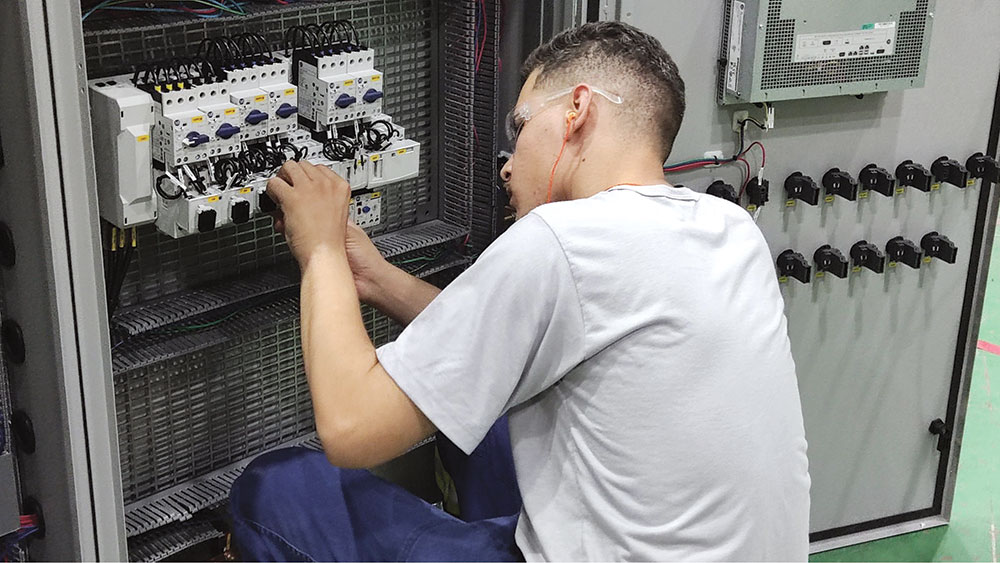
Volga’s team performed the time study in its onsite test area over a three-day period. To compare the time needed for the different wiring methods, the team first assembled a hardwired panel composed of six direct online motor starters, PLC and I/O modules and 800F operators, all interfaced with 1492 terminal blocks. Prior to the test, the team had already routed the cables using CAD software, cut the cables and stripped the ends, and inserted the marking system on Panel 1, so the test was limited to wiring the controls circuits.
The Volga team then assembled Panel 2 of the same composition using the new EtherNet/IP in-cabinet solution. During the time test for Panel 2, the team installed the single pair of flat cables and connectors, the remaining control circuit wiring, pre-wiring and detailing. Time was tracked per clock time stamp, and video and images were recorded. After the time study, Volga’s team was asked for their impressions of the process and the solution.
Result
According to the Volga time study, hardwiring the control circuits for Panel 1 took 20 hours and five minutes. Completing the control circuits in Panel 2 with the EtherNet/IP in-cabinet solution took only six hours and 39 minutes. That’s a 66% reduction in wiring time. These results align with other time studies conducted in the United States of America and Japan, which indicated an up to 80% reduction in wiring time.
“The EtherNet/IP in-cabinet solution will increase our productivity,” says Leopoldo. “When you extend this concept to a large motor control centre or panels with a lot of cables, it will have a huge impact in the assembly process.”
“The feedback from our team was very positive,” Leopoldo added. “They said that the technology was easy to use and didn’t require a lot of materials. Perhaps even more importantly, they believe the connections are very strong.”
Connectivity that’s more sustainable
“For some of our customers, sustainability is their top priority,” said Leopoldo. “We’ll be discussing this technology with them because it reduces cabling and copper use, which lowers environmental impact.”
By using the EtherNet/IP in-cabinet solution instead of traditional hardwiring, system integrators can build panels that are 36% smaller, 32% lighter and require significantly less wire and copper.
The EtherNet/IP in-cabinet solution delivers other important advantages as well:
• Increased panel builder productivity
• Reduced engineering time
• Reduced control wiring complexity
• Reduced troubleshooting and wiring errors.
“Our promise to customers is to make their lives simpler. It’s part of our values at Volga. We want to be the first with this new technology because it puts that promise into action.”
| Tel: | +27 11 998 1000 |
| Email: | mjunius@rockwellautomation.com |
| www: | www.rockwellautomation.co.za |
| Articles: | More information and articles about Rockwell Automation |






© Technews Publishing (Pty) Ltd | All Rights Reserved
 printer friendly version