



In today’s warehouse and logistics landscape, flexibility is essential. Manufacturing and material handling are changing faster than ever. Pressures such as labour shortages, changing product mixes and demand fluctuations create bottlenecks and downtime, while material handling can account for up to 25% of manufacturing labour costs and 15% of overall manufacturing costs.
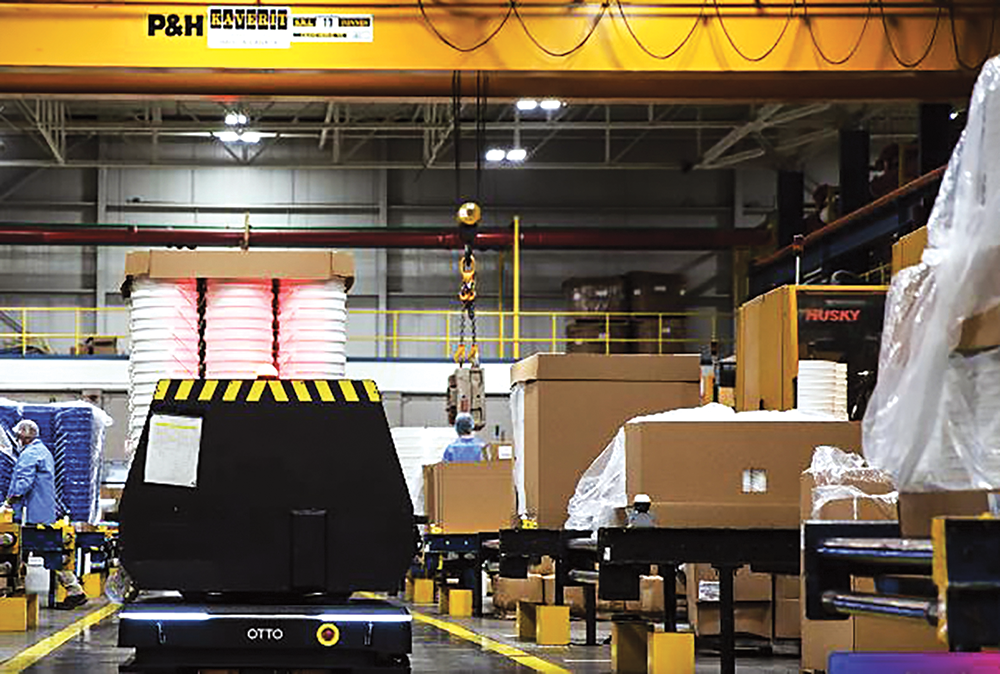
As a result, companies are seeking ways to move materials differently, and let them adjust to less staff and greater demand variation. One trend is flexible, AI-driven material handling. Facilities are shifting from fixed approaches and investing in systems that adapt to unpredictable demand, shifting just-in-time manufacturing and fulfilment needs. While several technologies provide flexibility, autonomous mobile robots, or AMRs, offer a range of practical advantages.
What AMRs are
AMRs are intelligent, self-driving material handling vehicles capable of making real-time decisions in complex and dynamic environments. Unlike automated guided vehicles, or AGVs, that follow a fixed path guided by QR codes or magnetic tape, AMRs move independently. Using AI sensors, cameras and advanced algorithms to interpret their environment, AMRs generate their own path and detect and avoid obstacles. This self-navigation capability makes AMRs more flexibly deployed in manufacturing or warehousing than AGVs or fixed conveyors, making them well suited to dynamic material handling environments.
Improving productivity
Because AMRs are not on a fixed navigation path, operators can adjust material handling workflows as operational needs change. Using AMRs in multiple applications also unlocks new workflows for material handling automation. An autonomous forklift can handle lane clearing and dock-to-dock transport, while flatbed AMRs are ideal for lineside delivery and finished goods takeaway. This flexibility extends further by sharing AMRs across different facilities and redeploying them on demand.
AMRs can improve a facility’s overall productivity by operating continuously for six or more hours without recharging, resulting in steady material flow. Manufacturers can begin their material handling journey by piloting one or two AMRs to confirm their value and build momentum for broader automation. Deployed as a fleet, the benefits increase significantly. AMRs help improve workplace safety, optimise material flow and fill labour gaps. Assigning AMRs to repetitive tasks lets facilities shift employees to more valuable decision-making roles, improving both operational efficiency and morale. In tight hiring markets, AMRs help facilities remain operational while driving efficiency.
Fleet management software
Fleet management software coordinates the right AMR for the right task at the right time. It configures traffic rules on a centrally managed map distributed to all AMRs in the facility. It also acts as the integration point for facility systems, transferring instructions from enterprise resource planning, warehouse management or manufacturing execution systems to the fleet, enabling AMRs to perform material transfers with facility equipment.
Robust fleet management software includes data and analytics tools to help analyse the system, proactively identify risks and improve material flow. A solution dashboard communicates system health in real time, from visualising key performance indicators to spotting bottlenecks and drilling down into specific AMRs or actionable tasks.
AMRs and the digital strategy
AMRs are powerful sources of data within a digital operation. Real-time performance data lets operators visualise material flow efficiency quickly. This data can be analysed to drive facility-wide improvements, and by integrating it with enterprise systems, end-to-end performance can be optimised. For example, telemetry data can improve order prioritisation when urgent tasks are not being completed on time. Advanced analytics can also indicate ways to reduce congestion and return to planned throughput when bottlenecks cluster in specific areas.
Combining data from AMRs and the rest of the facility can inform end-to-end performance optimisation. A digital twin of the facility can be constructed to test different approaches with zero risk, identifying small changes with large impact.
AMRs allowed Mauser Packaging Solutions to increase throughput sixfold compared to their legacy AGV system. Faurecia Interior Systems improved safety and achieved an 11-month return on investment. With a comprehensive AMR fleet, OTTO Motors by Rockwell Automation helps manufacturing and warehousing leaders implement the right AMR solution for their material handling needs. For companies seeking broader digital solutions support, Kalypso, a Rockwell Automation business, helps develop end-to-end solutions to meet connected production goals.
| Tel: | +27 11 998 1000 |
| Email: | [email protected] |
| www: | www.rockwellautomation.co.za |
| Articles: | More information and articles about Rockwell Automation |






© Technews Publishing (Pty) Ltd | All Rights Reserved
 printer friendly version