



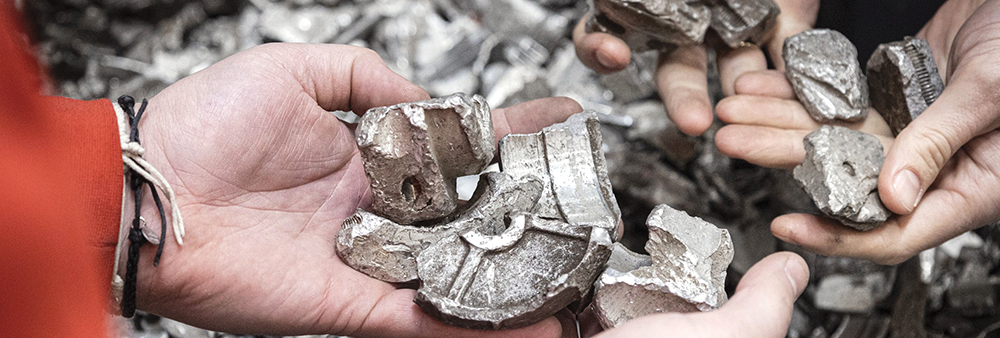
In the metal recycling industry, companies are increasingly challenged to not only improve the efficiency of their processes but also to raise the quality and purity of the sorted materials to new levels. REDWAVE is the centre of excellence for recycling and sorting technologies within BT-Systems, and has achieved another milestone for the metal recycling industry with its latest generation of XRF sorting machines. By integrating proven spectral analysis technology into its market-leading REDWAVE XRF sorting system, the company is unlocking new opportunities for metal recycling, particularly in aluminium recovery. This system enhancement now enables the processing of a wide range of material streams, including ZORBA, e-scrap, used beverage cans and mixed metal fractions, while ensuring the accurate identification of aluminium alloys with high purity and quality.
Revolutionary flexibility and cost efficiency
BT-Systems’ powerful REDWAVE XRF sorting machines have long been successfully used for separating aluminium and heavy metals such as copper, zinc, brass and lead. Until now, aluminium could only be separated based on accompanying elements like copper or zinc, making the precise identification and sorting of various aluminium alloys challenging. These technological limitations are now a thing of the past.
By combining spectral analysis with XRF fluorescence technology in one REDWAVE sorting system, a broader spectrum of material composition can now be analysed. Not only are individual element signals (peak-based analysis) detected, but the entire spectrum is utilised, resulting in significantly more precise alloy separation. Unlike other technologies, this system is equally effective with materials that have contaminated surfaces, making it suitable for nearly all materials. This advancement opens up entirely new possibilities in aluminium separation, and significantly improves material purity and recycling quality. The integration of REDWAVE spectral analysis into the REDWAVE XRF sorting system offers a multitude of benefits for companies in the metal recycling sector.
Maximised material purity and value creation
Improved material quality through the concentration of aluminium alloys such as 6060/6063 or the sorting of aluminium series 1xxx–7xxx increases market value and opens access to highly lucrative markets. These include the growing demand for primary aluminium and specialised alloys, particularly in the automotive industry. Recycling companies can now deliver premium materials to high-value buyers, maximising their value creation.
Reduction of contaminants
Spectral analysis enables the detection of contaminants often found in aluminium streams such as plastic, rubber or wood. These unwanted materials are removed in a single step, resulting in cleaner end products and reduced reprocessing costs.
Increased flexibility and cost efficiency
A key advantage of the new REDWAVE XRF sorting system is its flexibility. One machine is sufficient to meet a wide range of sorting requirements. With a single machine, companies can separate heavy metals, stainless steel alloys and now aluminium alloys. This efficiency reduces the need for multiple machines and associated operating costs, while also accelerating processing speed. Businesses can optimise their entire recycling workflow, achieving higher productivity with lower energy consumption.
Futureproof design
The REDWAVE XRF technology’s ability to adapt to new material requirements and market changes provides long-term investment security. By analysing the entire spectrum, the system is equipped to handle new materials and challenges, ensuring flexibility to meet future recycling demands.
Competitive advantage and higher margins
Companies that extend their capabilities from conventional heavy metal sorting to the sorting of aluminium alloys can achieve ‘primary aluminium’ specifications, strengthening their market position and securing higher margins.
The future of metal recycling
The future of metal recycling holds tremendous opportunities, driven by the increasing demand for recycled aluminium in the automotive, construction and electronics industries. Sustainability initiatives and mounting pressure to reduce CO2 footprints are putting recycled materials in the spotlight. Additionally, the recycling of incinerator bottom ash, which contains valuable metals, is gaining importance as many of these materials have previously been underutilised.
Technological innovation is a key factor in the sector’s progress, enabling companies to not only enhance their efficiency but also contribute significantly to the circular economy. Advanced technologies like the REDWAVE XRF sorting system with spectral analysis unlock new potential in metal recycling.
Mecosa is the sole business partner for REDWAVE in southern Africa.
| Tel: | +27 11 257 6100 |
| Email: | [email protected] |
| www: | www.mecosa.co.za |
| Articles: | More information and articles about Mecosa |






© Technews Publishing (Pty) Ltd | All Rights Reserved
 printer friendly version