There is so much terminology related to stationary batteries and it’s hard to know what everything means. So, what is the difference between jars and straps?
What is a jar?
A stationary battery jar is a container that holds the cell or group of cells and electrolytes. It is also commonly referred to as a battery case or cell case. Jars are typically made out of some kind of thermoplastic substance. However, hard rubber is sometimes used as well. If the battery contains nickel-cadmium cells, the jar may even be made out of steel. Vented lead-acid batteries normally have transparent jars to allow for plate and sediment inspection.
What is a strap?
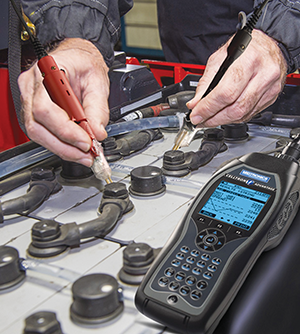
A stationary battery strap is a component in a cell that joins plates of like polarity in parallel. It is an electrical conductor that is made of copper. It typically has a lead or tin plating for lead-acid cells. Nickel-cadmium cells require a different connector. They are typically made with nickel-, cadmium- or tin-plated copper, or even steel bar. Occasionally for lead-acid batteries the strap may be insulated with copper wire or lead (with or without a copper insert), depending on the manufacturer’s specifications.
Stationary batteries
Transportation batteries function as start/stop batteries. The primary discharge occurs when the vehicle is started. After that, it spends the rest of the drive time recharging. Motive power batteries do not operate this way. Instead of only being used to start the machinery, there is a continual discharge. Stationary batteries are used constantly while in operation and used until depleted, or until the job is done, and then recharged after use.
Franklin Electric Grid Solution electrical system testing technology is used by six major automotive manufacturing facilities in South Africa in on-vehicle equipment, recording events that may lead to battery or electrical system failure. In addition to this, two leading South African battery manufacturers and distributors have committed to using the Midtronics technology in their facilities and distribution outlets.
Stepping up switchgear manufacturing in South Africa
Electrical Power & Protection
With South African switchgear demand growing at 7 to 12% annually driven by the energy transition and mining sector investment, WEG Africa is expanding from assembly into full local manufacturing of medium-voltage switchgear, motor control centres and modular substations.
Read more...Africa’s net-zero ambition must become operational Schneider Electric South Africa
Electrical Power & Protection
Schneider Electric’s Rohit Chashta argues that the biggest gap in Africa’s green transition is not ambition but execution, and outlines how advisory services, bankable project roadmaps, digital visibility and SF6-free switchgear can turn sustainability commitments into measurable progress.
Read more...Infrared thermometers for electrical, industrial and HVAC applications Comtest
Maintenance, Test & Measurement, Calibration
: Comtest, distributor of Fluke test and measurement equipment, explains how handheld infrared thermometers are transforming maintenance in electrical, industrial and HVAC environments, with three measurement strategies and a wide range of practical applications.
Read more...High-efficiency half-brick DC-DC converters Vepac Electronics
Electrical Power & Protection
The Supreme series half-brick DC-DC converters from Vepac Electronics use synchronous rectification for high conversion efficiency, in a six-sided metal case built to withstand harsh industrial and transportation environments.
Read more...Zinc-based batteries power a more sustainable energy future
Electrical Power & Protection
Zinc-based batteries are gaining ground as a safe, recyclable and cost-effective energy storage option, from consumer electronics to grid-scale systems. The International Zinc Association’s Simon Norton explains why zinc is well placed to support the clean energy transition.
Read more...Energas introduces lower-cost German gas genset for South African market
Electrical Power & Protection
Energas Technologies will supply R Schmitt Enertec’s new Energy Line genset to the South African market, offering German-engineered gas-to-power generation of 400 to 500 kW at a lower entry cost through focused standardisation and a simpler standalone architecture.
Read more...ACTOM plays key role in large transmission substation project in Swellendam ACTOM Electrical Machines
Electrical Power & Protection
ACTOM has been appointed to engineer, procure, construct and commission the 1000 MVA main transmission substation for the Overberg Wind Farm in Swellendam, one of the largest substations of its kind in South Africa.
Read more...Reliable power conversion from high-voltage DC buses Conical Technologies
Electrical Power & Protection
The MEAN WELL DDRH-240 from Conical Technologies is a high-reliability DIN-rail DC-DC converter with a wide 250 to 1500 V DC input range, deriving stable low-voltage power directly from high-voltage DC buses in renewable energy, storage, charging, railway and industrial installations.
Read more...AES maintains a strong value and safety stance on boiler retrofits
Electrical Power & Protection
AES Commercial Director Dennis Williams explains when a boiler retrofit makes more sense than replacement, outlines the range of efficiency and emissions upgrades available, and draws the line at safety: a boiler not legally signed off is shut down, no exceptions.
Read more...The grid needs to become more intelligent Schneider Electric South Africa
Electrical Power & Protection
South Africa’s power grid is becoming bidirectional and far more dynamic as distributed energy resources proliferate. Schneider Electric’s Nishandra Bajinath explains why digitalisation, DERMS and aggregation are essential to keep this increasingly complex grid stable and efficient.
While every effort has been made to ensure the accuracy of the information contained herein, the publisher and its agents cannot be held responsible for any errors contained, or any loss incurred as a result. Articles published do not necessarily reflect the views of the publishers. The editor reserves the right to alter or cut copy. Articles submitted are deemed to have been cleared for publication. Advertisements and company contact details are published as provided by the advertiser. Technews Publishing (Pty) Ltd cannot be held responsible for the accuracy or veracity of supplied material.










 printer friendly version