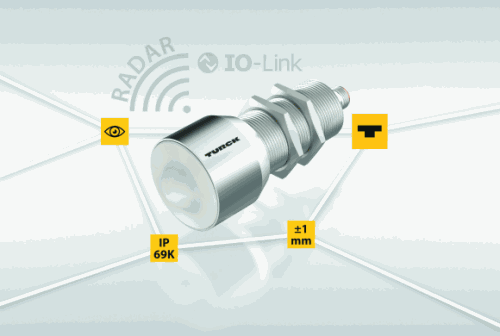
Turck Banner has introduced robust radar sensors for distance measurement up to 15 metres for rugged application areas in factory automation as well as in outdoor or mobile applications. The rugged 122 GHz devices with protection to IP67/69K are shock-resistant up to 100 G and are therefore suitable for distance measurement in application areas such as in port logistics, in which optical or ultrasonic sensors are unsuitable due to their limited range or disturbance factors such as dust, wind or light.
With a shock resistance of 100 G and a stainless steel housing, Turck Banner’s distance radar sensor is ideal for rugged outdoor applications.
The browser-based Turck Banner Radar Monitor parameter user-interface simplifies the setup of the DR sensors by means of the real-time display of the signal curve – especially when setting filters to suppress interfering signals or in complicated mounting situations. When mounted in direct proximity to each other, the FMCW measuring principle of the devices prevents any mutual interference between the signals.
All DR-M30-IOL sensors are provided with IO-Link as well as an analogue and switching output, in which the analogue output can also be configured as a second switching output. In conventional applications, the devices can also be operated without IO-Link. Three different lens configurations enable optimum device selection according to the application, depending on whether a short and wide, a medium or a long and narrow detection field is required.
Telco sensors for harsh environments
Sensors & Transducers
Telco sensors are designed to operate where moisture, particulate contamination and surface fouling would disable conventional sensors, with a range including an adjustable five-metre infrared proximity sensor for harsh industrial environments.
Read more...The data-driven path to sustainable manufacturing ifm - South Africa
Editor's Choice Sensors & Transducers
Smart automation is closing the gap between operational efficiency and environmental responsibility, and the data to do it is already inside the plant. With ifm’s sensing and digitalisation technologies, manufacturers can turn machine intelligence into measurable sustainability gains.
Read more...Expanding visibility in mining operations Emerson Automation Solutions
Editor's Choice Sensors & Transducers
Advances in wireless communications, condition monitoring and sensing technologies are helping mining operators extend measurement into previously under-monitored areas, improving equipment reliability, process performance and water stewardship.
Read more...Fiber-optic amplifiers for precise object detection ifm - South Africa
Sensors & Transducers
The OCF fibre-optic amplifier detects even the smallest or most transparent objects in confined spaces, making proven fibre-optic technology easier and more user-friendly than before.
Read more...Distance sensor for confined spaces ifm - South Africa
Sensors & Transducers
The O6D100 from ifm has been designed as a powerful all-rounder for typical applications in object detection, distance measurement and positioning.
Read more...Optimise sludge treatment and reduce operational costs Endress+Hauser South Africa
Sensors & Transducers
Endress+Hauser’s inline measuring devices, the Proline Teqwave MW 300 and the Proline Teqwave MW 500, determine the total solids content of wastewater directly through microwave transmission.
Read more...Inclination sensors for motion control ifm - South Africa
Sensors & Transducers Motion Control & Drives
The JBC dynamic inclination sensor from ifm offers accurate angle measurement in the most demanding conditions, filtering out motion disturbances such as vibrations, shocks and vehicle dynamics to deliver reliable inclination values via IO-Link or programmable switch outputs.
Read more...Fully integrated standalone thunderstorm warning system Senseca
Sensors & Transducers Analytical Instrumentation & Environmental Monitoring
Senseca South Africa has introduced its BTD-1 fully integrated, standalone thunderstorm warning system, which detects lightning by monitoring the background quasi-electrostatic field. The system can generate alerts before the first lightning strike, with a detection raterange of up to 83 km.
While every effort has been made to ensure the accuracy of the information contained herein, the publisher and its agents cannot be held responsible for any errors contained, or any loss incurred as a result. Articles published do not necessarily reflect the views of the publishers. The editor reserves the right to alter or cut copy. Articles submitted are deemed to have been cleared for publication. Advertisements and company contact details are published as provided by the advertiser. Technews Publishing (Pty) Ltd cannot be held responsible for the accuracy or veracity of supplied material.










 printer friendly version