



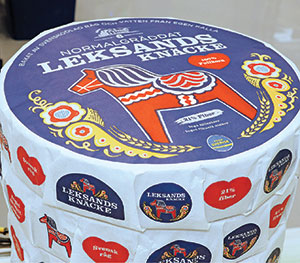
In the town of Leksand in central Sweden, Leksands Knäckebröd is Sweden’s largest producer of traditional round crisp bred with ifm electronic as its automation partner. While the recipes are still the same as they were100 years ago, the production process is completely different. Production is automated according to the latest state-of-the-art technology with sensors from ifm electronic monitoring the processes from the supply of ingredients to the dispatch area.
Capacitive sensors
The main ingredients of crisp bread are rye meal and finely ground rye and wheat flour. They are supplied to the mixing tools via various pipes. Capacitive sensors monitor the supply at the pipes or the level in the temporary storage tanks. Capacitive sensors are distinguished by detecting different materials – even through tank walls, unless they are of metal. If a pipe is no longer completely filled with flour, the capacitive sensor detects this state and sends a switching signal to the controller. Often, several capacitive sensors are used on storage tanks or silos, for example at the very top, to signal a possible overflow in time or at the very bottom of the silo to signal a critical empty state.
Potentiometers are used to adjust the sensors after installation, with the switch point adjusted depending on the wall thickness of the pipe and the type of medium to be detected. The new KI6000 sensors from ifm can be set precisely, since they have a unique LED signal display for the perfect switch point setting. The 12-point LED display makes it easier for the user to set the optimal switch point, which is in the centre of the display. The green LEDs on either side of the switch point indicate the reliability of the switch point. Deposits, material changes, etc. are directly displayed on the sensor and the user can perfectly readjust the switch point as needed. This means that an imminent error can be detected in good time and avoided.
O6 photoelectric sensor
Diffuse reflection sensors are installed at various places in production to monitor the flow of material on conveyor belts. These are, for example, individual slices of crisp bread and also completely packed products in the dispatch area. In most cases, the ifm diffuse reflection sensors of type O6 are used at Lecksands Knäckebröd. Their optical performance is excellent and they are distinguished by a noise-immune background suppression, while the range of up to 200 mm is independent of the object colour.
The compact O6 WetLine is perfectly sealed and the two setting potentiometers are fitted with a double seal. These compact powerful units can also be supplied as through-beam and retro-reflective systems. The stainless-steel housing with protection rating IP68/IP69K ensures reliable use even under severe conditions. The O6 sensors are now also available as versions with IO-Link, allowing the range, sensitivity, light-on/dark-on modes, switching delay or deactivation of the operating elements to be set remotely.
MID flow sensor
Besides the grain, water is an elementary part of the crisp bread dough where a magnetic-inductive flow meter from ifm is used. These units feature high accuracy, measurement dynamics and repeatability and are suited for conductive media from 20 μS/cm. The 4-digit alphanumeric LED display is highly visible and besides the volumetric flow, the units also measure temperatures from -10-70°C. The robust compact housing, use of resistant materials and pressure rating up to 16 bar allow flexible use. Using the IO-Link technology, process values are not only available via the analog output, but also digitally. Conversion losses during measured value transmission are a thing of the past. Saving all sensor parameters not only allows an easy replacement of sensors but also a simple and quick configuration and remote parameter setting. The user is well prepared for Industry 4.0 with the new IO-Link functionality.
At Leksands, reliable and long-life sensors from ifm have been used for many years. In fact sensors older than 25 years can be found at some places in the plant. In the future, they intend to tackle new challenges in automation with ifm as the preferred partner.
| Tel: | +27 12 450 0400 |
| Fax: | +27 12 450 0412 |
| Email: | [email protected] |
| www: | www.ifm.com/za |
| Articles: | More information and articles about ifm - South Africa |






© Technews Publishing (Pty) Ltd | All Rights Reserved
 printer friendly version