


System Integration & Control Systems Design


Giving back control to RCL Foods’ Pongola plant

July 2018 System Integration & Control Systems Design

RCL Foods’ Pongola sugar mill is situated in northern KwaZulu-Natal and was operating a proprietary DCS that was installed in 1980. This obsolete and antiquated system resulted in unacceptable production delays due to excessive downtime, aggravated by a lack of production information and limited diagnostics.

The client requested Control Software Solutions (CSS) to institute a phased-in system that would allow the RCL team to run the plant with minimal support. In addition, it needed to be scalable, it had to provide detailed trip diagnostics and sufficient production information to ensure the optimisation of the process by process engineers, as well as being equipped with an effective disaster recovery plan. “It was essential that there was an adequate knowledge transfer to the RCL employees to ensure that they could take over the running of the system, allowing them to maintain and expand it as needed in the future. Aligned to this was the requirement for the system to provide a 25% improvement in lost time availability, together with an increase in production throughput,” says CSS’s Pieter Venter.

Scalability was a driving factor, since the project was planned to take place in various phases over an eight-year period. A number of other requirements outlined by RCL included the improvement of software standards with additional functionality in terms of industry-specific control modules; a user-friendly interface; redundancy in order to secure plant control and information; and intuitive reporting that was easily accessible and with traceability throughout the system.

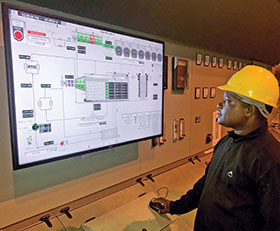
The solution provided by CSS included System Platform, which would unify all of RCL’s applications and its management in a central hub and InTouch for supervisory interface, together with Historian for data storage and Historian Client for system diagnostics and production analysis. WIS and FLOW software is used for production efficiency reporting, TOP Server provides device connectivity (including for legacy systems) and Unity allows for all PLC configuration. Systems diagnostics and first-up alarming was built into critical control areas of the plant to assist in root cause analysis. In addition, the project team had to develop and document the plant control philosophy from the existing software and old plant manual, as this did not exist.

Once control documentation was finalised, all software coding was performed off site with regular remote collaboration taking place with RCL systems and operation personnel. Technical review meetings ensured the alignment with customer expectations and the CSS solution. Full system simulation was natively built into the system to assist during the FAT testing, which was conducted with the entire team from RCL’s operations, training, maintenance and systems departments. Plant operators were trained in the simulated environment, thereby allowing them to become a part of the commissioning team with a resultant reduction in the time to start-up.

Not only was there a requirement for a new system, but furthermore for old data on the existing system to be transferred to this new system. CSS used the TOP Server OPC DA Driver to extract the legacy data, thereby allowing them to present unified reports on information from both the old and new systems.

The implementation of the new system has contributed immensely to the extremely attractive statistics between 2015 and 2017:

• 40% improvement in lost time availability.

• 20% increase in cane crushed vs budget.

• 39% increase in sugar production vs budget.

• 0,7% reduction in bagasse moisture to boilers.

• Almost zero unplanned blackouts.

“There was a visible improvement in the working relationship between the production and maintenance personnel. All the noted benefits contributed to the plant being awarded two improvement awards from the RCL Group In 2017,” says Venter.

For more information contact Pieter Venter, Control Software Solutions, +27 (0)31 914 0040, pieterv@cs-solutions.co.za, www.cs-solutions.co.za


Credit(s)


Share this article:
Share via emailShare via LinkedInPrint this page

Further reading:

How certified industrial automation channels become co-creators in the AI era
Schneider Electric South Africa System Integration & Control Systems Design
As industrial automation becomes software-driven and AI-enabled, the role of channel partners is shifting from equipment supply to outcome-based consulting, software integration and lifecycle services that require continuous certification and capability development.

Read more...
Why integration defines the next competitive edge in pulp and paper
System Integration & Control Systems Design
ABB’s Arvin Ramjee argues that fragmented automation, assembled from different suppliers at different stages of a plant’s lifecycle has become one of the pulp and paper industry’s most overlooked commercial risks, and that true integration, rather than surface-level connectivity, is what delivers measurable business value.

Read more...
Integrated automation enhances water treatment at dairy facility
Process Dynamics System Integration & Control Systems Design
Process Dynamics delivered the electrical, instrumentation, control and automation integration for an advanced water treatment and reverse osmosis system at a major South African dairy processing facility, achieving a 50% reduction in the client’s water utility costs.

Read more...
Intelligent process control is reshaping cement production in Africa
System Integration & Control Systems Design
Advanced process control, predictive analytics and automation are helping African cement producers cut energy use and stabilise output as they contend with rising electricity costs and tighter margins.

Read more...
Schneider Electric’s Alliance Programme turns system integrators into trusted technology partners
Schneider Electric South Africa System Integration & Control Systems Design
: Schneider Electric’s Alliance Partner Programme is helping system integrators across Africa move beyond one-off projects and build the skills and service models needed to become long-term industrial technology partners.

Read more...
Process Dynamics – Integrated Automation for Dairy Water Treatment
Process Dynamics System Integration & Control Systems Design
   Project and industry Process Dynamics delivered the electrical, instrumentation, control and automation integration for an advanced water treatment and Reverse Osmosis (RO) system at one of South Africa’s ...

Read more...
New SI programme strengthens Schneider Electric’s partner ecosystem
Schneider Electric South Africa System Integration & Control Systems Design
Schneider Electric’s SI Energise 2.0 programme offers system integrators a competency-based framework to develop deeper expertise in EcoStruxure and AVEVA software, enabling them to deliver full-lifecycle industrial automation solutions.

Read more...
AI and smart solutions for underground proximity detection systems
System Integration & Control Systems Design
Booyco Electronics explains why fitting proximity detection systems underground is far more complex than installing sensors, and how integration, data and intelligent analytics are helping mines manage the challenge.

Read more...
Why cloud-ready BMS is reshaping building operations
Schneider Electric South Africa System Integration & Control Systems Design
Smart sensors and non-contact radar are reshaping industrial measurement, feeding connected platforms that predict failures before they happen.

Read more...
Flotation system modernisation for a gold processing and mineral recovery plant.
Moore Process Controls System Integration & Control Systems Design
Moore Process Controls has successfully modernised a gold processing plant's flotation control system, replacing obsolete I/O hardware with Schneider Electric's latest M580 X80 platform.

Read more...


While every effort has been made to ensure the accuracy of the information contained herein, the publisher and its agents cannot be held responsible for any errors contained, or any loss incurred as a result. Articles published do not necessarily reflect the views of the publishers. The editor reserves the right to alter or cut copy. Articles submitted are deemed to have been cleared for publication. Advertisements and company contact details are published as provided by the advertiser. Technews Publishing (Pty) Ltd cannot be held responsible for the accuracy or veracity of supplied material.


© Technews Publishing (Pty) Ltd | All Rights Reserved

