Pilot project to optimise material flow
September 2026
IT in Manufacturing
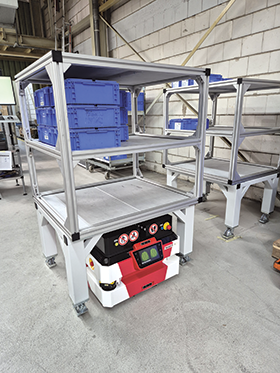
WEBER-HYDRAULIK has commissioned autonomous transport robots at its Güglingen site in Germany. The vehicles handle internal material transport between the high-bay warehouse, the small parts warehouse and the assembly areas. The aim of the project is to make logistics processes more efficient, improve supply reliability and relieve staff of repetitive transport tasks.
With the deployment of these autonomous transport robots, WEBER-HYDRAULIK is launching a pilot logistics project for the entire group. The vehicles transport small parts containers autonomously along defined routes, responding flexibly to traffic conditions and co-ordinating their journeys with one another. A central fleet management system co-ordinates operations and ensures a smooth flow of materials.
“You can think of the system as a combination of rail-guided transport and an autonomous domestic robot. The vehicles are networked with one another and co-ordinate their journeys independently,” explains Chris Gulyasch from the supply chain management department, overseeing the group-wide optimisation of logistics processes.
The robots are currently responsible for transporting small and medium-sized load carriers and moving materials between warehouse areas. Loading and unloading continues to be carried out by staff at designated handover points such as assembly lines or Kanban racks.
A key component of the system is its integration into the existing Kanban process. Using RFID technology, material movements are automatically recorded and posted directly into the SAP system. This creates transparent material flows while reducing manual postings and triggering replenishment deliveries as required.
The groundwork for the autonomous transport solution has been laid in Güglingen over the past few years, with the modernisation of the high-bay and small parts warehouses forming the basis for its implementation under real production conditions.
“Our aim is to ensure a stable and efficient supply, even during staff shortages. At the same time, we are reducing manual transport routes and easing the workload on our staff in their day-to-day work,” says Gulyasch.
The current expansion involves connecting the high-bay and small parts warehouses, with further steps planned to extend the system to additional areas and other sites. Through this project, WEBER-HYDRAULIK is building a scalable, automated material supply system for the group.
For more information contact WEBER-HYDRAULIK, +49 7135 71 10907, kerstin.adam@weber-hydraulik.com, www.weber-hydraulik.com
Further reading:
Accelerating pharmaceutical digital compliance and operational efficiency
Schneider Electric South Africa
IT in Manufacturing
Cosmos Limited, one of Kenya’s leading pharmaceutical manufacturers, has partnered with Schneider Electric to implement an integrated monitoring, energy management and digital validation platform that has improved operational visibility, data integrity and regulatory compliance readiness.
Read more...
AI data centres, nature and innovation
Schneider Electric South Africa
IT in Manufacturing
Artificial intelligence is driving unprecedented demand for data centre capacity, with liquid cooling now central to managing the heat generated by high-density GPU clusters. Schneider Electric examines how next-generation data centres can balance performance with environmental responsibility.
Read more...
Siemens powers next-generation reusable spacecraft development
Siemens South Africa
IT in Manufacturing
A European aerospace startup focused on reusable space systems, has adopted Siemens Xcelerator software to connect engineering disciplines, reduce rework and accelerate spacecraft development, cutting the path from concept to flight hardware to nine months for its orbital demonstration capsule.
Read more...
How to navigate the high-stakes economics of AI infrastructure
IT in Manufacturing
Nearly 60% of data centre operators are expected to adopt liquid cooling within five years as AI workloads drive demand for higher rack densities. Understanding the full financial picture of liquid cooling, from capital investment to long-term operational savings, is now essential.
Read more...
Protecting the digital mine
RJ Connect
IT in Manufacturing
As mining becomes increasingly connected and automated, cyber threats are emerging alongside the benefits of digitalisation. RJ Connect and provides rugged networking, edge computing and cybersecurity technologies from MOXA to help protect critical mining operations from evolving attacks.
Read more...
SICK launches AI-powered 3D quality inspection
SICK Automation Southern Africa
IT in Manufacturing
SICK has combined deep learning with 3D height data analysis in its Nova machine vision platform.
Read more...
Predictive maintenance is the critical enabler for AI data centre liquid cooling systems
IT in Manufacturing
As liquid cooling becomes essential for AI data centres, predictive and condition-based maintenance are emerging as critical enablers of thermal stability. Schneider Electric argues that the infrastructure is already generating the data needed and the question is whether operators are equipped to use it.
Read more...
Siemens software scales with Simple Energy EV development
Siemens South Africa
IT in Manufacturing
: Simple Energy, an Indian electric two-wheeler manufacturer, has expanded its use of Siemens Xcelerator software to manage complex vehicle variants and enterprise-level bills of materials, accelerating product development as its EV portfolio scales.
Read more...
ESG as a growth lever
RS South Africa
IT in Manufacturing
Leading organisations are treating ESG not as a compliance obligation but as a practical tool for operational efficiency, supply chain resilience and business performance, with data and collaboration central to unlocking its value.
Read more...
Preparing Africa’s data centres for the demands of autonomous AI
Schneider Electric South Africa
IT in Manufacturing
Africa’s data centre infrastructure must evolve significantly to support agentic AI workloads, with GPU-intensive computing, advanced cooling and reliable power demanding a fundamentally different approach to facility design and investment.
Read more...










 printer friendly version