



[Sponsored]Sustainability has become a strategic priority for organisations across every sector. Rising energy costs, water scarcity, ageing infrastructure and evolving governance expectations are forcing businesses to rethink how they operate. Yet sustainability is not achieved through ambition alone. It depends on the quality of the decisions made every day across operations, maintenance, engineering, procurement and leadership.
This is where digital transformation has a more meaningful role to play. For many years, industrial digitalisation focused primarily on automation, reliability and cost reduction. Today, those same technologies are helping organisations achieve broader sustainability outcomes by turning fragmented data into trusted, contextualised intelligence.
Most industrial environments generate large volumes of information, but much of it remains locked in separate systems. Energy data, process conditions, equipment performance, maintenance activity and compliance information are often viewed independently. This makes it difficult to understand how decisions in one area affect outcomes elsewhere.
Modern industrial data platforms are changing this. By connecting data from the Edge to the cloud, organisations can create a single view of distributed assets, detect deviations earlier and act before operational issues become environmental, financial or compliance risks. When combined with analytics and AI, the value moves beyond dashboards. It becomes decision support.
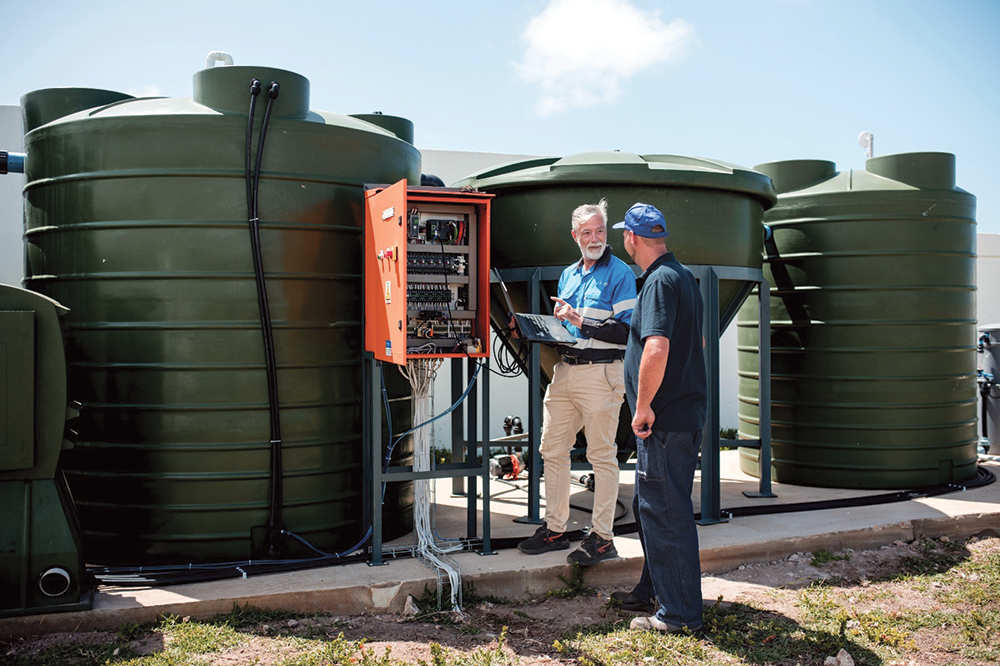
The Calcamite wastewater treatment project delivered by 4Sight OT Automation demonstrates how digital transformation can drive sustainability outcomes. Calcamite designs modular wastewater treatment plants for remote communities and sites where conventional sewage infrastructure is not viable. The challenge was to create a scalable, cost-effective model for managing distributed treatment assets with limited onsite resources.
The remote monitoring solution combined Edge-to-cloud connectivity with real-time monitoring. Schneider Electric PLCs collects plant data, while AVEVA Connect provides cloud-based visualisation and oversight. 4Sight OT Automation delivered the integration architecture, communications and commissioning, enabling visibility of performance, alarms and critical operating parameters across multiple sites.
The pilot was deployed at Gourikwa Nature Reserve, approximately 1380 km from Calcamite’s Gauteng factory. Treating 15 m3 of wastewater per day, the site operates without specialist onsite personnel. Real-time monitoring and alerts enable a shift from reactive maintenance to proactive intervention, reducing both cost and operational risk.
A roll-out is planned to get more plants connected, with the intent of reducing maintenance costs related to minimising travel costs. The platform also provides a foundation for evidence-based compliance reporting and performance verification, helping Calcamite scale its operations while improving environmental stewardship
This is why the project was recognised with the AVEVA Sustainability Impact Award at AVEVA World Milan 2026. The award recognised the project’s contribution to decarbonisation, circularity and resilience, and highlighted how decentralised wastewater treatment, when supported by real-time visibility, can become more practical and scalable for underserved communities.
The sustainability value of projects such as Calcamite extends beyond environmental outcomes. Having completed the 2026 United Nations Global Compact Sustainable Supplier Training Programme, the 4Sight team has further strengthened its understanding of how sustainability principles should be embedded across business operations. The programme reinforced the fact that sustainability encompasses not only environmental responsibility, but also human rights, labour practices, ethical governance, and anti-corruption. When combined with trusted operational data and informed decision making, these principles provide a practical framework for delivering measurable and lasting business value.
For industrial organisations, these principles translate directly into operational behaviour. Reliable data supports transparency. Remote monitoring reduces unnecessary travel and resource waste. Better compliance reporting strengthens governance. Proactive maintenance protects infrastructure, communities and the environment. Environmentally responsible technology becomes most valuable when it improves the daily decisions that determine whether assets run safely, efficiently and sustainably.
This is the deeper link between digital transformation and sustainability. Technology alone does not create sustainable outcomes. People do, when they have the information, systems and accountability needed to make better decisions.
As AI, cloud platforms and industrial data architectures continue to mature, the opportunity is no longer only to monitor what has happened. It is to anticipate what is likely to happen next, recommend action and continuously improve performance across distributed operations.
Sustainability is ultimately built through thousands of practical decisions such as when to intervene, where to optimise, how to maintain assets, how to prove compliance and how to use fewer resources while delivering better outcomes. By turning trusted data into actionable intelligence, organisations can improve efficiency, strengthen resilience and create measurable value for business, communities and the environment.

For more information contact 4Sight OT Optimisation,






© Technews Publishing (Pty) Ltd | All Rights Reserved
 printer friendly version